One is to work with our friends and allies around the country to shine a transformative spotlight on the Federal Energy Regulatory Commission (FERC), an arm of the oil and gas industries that masquerades as government bureaucracy. Each rubber-stamped permit issued by FERC for fracked gas infrastructure is really an act of violence perpetrated against communities, towns, and the climate by the fossil fuel industry. We believe that exposing FERC is an important part of the larger movement to stop the unnecessary use of poisonous, climate-change inducing fossil fuel infrastructure.
Another objective of Beyond Extreme Energy is to fight for a world free of exploitation, including for an exploitation-free energy system. Building this better future means working side-by-side with frontline communities resisting harmful projects where they live. It also means playing an active role in larger movements against white supremacy, patriarchy, colonialism, and corporate capitalism.
Although Beyond Extreme Energy is a mostly volunteer organization of remarkably committed folks, as a collective, we also rely on two paid organizers to help carry our objectives forward. That’s why we’re turning to you, the Beyond Extreme Energy community, to financially sustain our collective work.
Inspired by a similar model used by the Backbone Campaign, we are launching a “community supported organizer” (CSO) program. Would you consider signing up to make a sustaining donation for our two paid organizers?
Beyond Extreme Energy would like to make Jimmy Betts and Lee Stewart our community-supported organizers. This means their ongoing work and $2,500 per month salary would be 100% community supported.
If you sign-up to make a sustaining donation to Jimmy and/or Lee, you will receive monthly updates from them on the work they’re doing.
To read more about Jimmy and Lee, their backgrounds, and the work they do for Beyond Extreme Energy, and to sign up to make sustaining donations, please click on the links below. Thank you for your much needed support. Without your financial contribution, we wouldn’t be able to do the work as well as we’re able to now. It is very much appreciated!
WALK TO PROTECT OUR PEOPLE AND THE PLACES WE LIVE: STOP THE PIPELINE
The $5 billion Atlantic Coast Pipeline has been proposed by Duke Energy and Dominion Resources to bring fracked gas from West Virginia, through Virginia. and through North Carolina almost to the South Carolina border. It will endanger and otherwise do enormous damage to homes, farms, wetlands, rivers, mountains, and communities along its entire 500 mile route. In addition it will contribute enormously to climate change, and to extreme weather events like Hurricane Mathew which devastated some of the counties which the ACP is proposed to pass through. Along the entire route, individuals, communities, and organizations are coming together to prevent its construction.
.
On Saturday, November 19 there will be three walks in three counties.
.
NOVEMBER 19 ROBESON COUNTY PRAYER WALK Sponsored by Eco-Robeson
1:30 PM; Meet at the Pembroke Town Park, 413 West Third Street in Pembroke across from UNC Pembroke. 2 mile walk. Rally and prayer circle at corner of Prospect Rd and Hwy 72 near the Methane Transfer Station. Snacks & water will be available. For more information contact Rev. Mac Legerton, 910-736-5573, mac_cca@bellsouth.net or Alisha Locklear 910-827-2528. lockleara@hotmail.com
NOVEMBER 19 CUMBERLAND COUNTY WALK Sponsored by Cumberland County Caring Voices
9:30 AM: Meet in front of Cape Fear Regional Theater in Fayetteville. 1209 Hay St, Fayetteville, NC 28305. March 1 mile down Hay Street to Rally at Market House for rally and speak out. Ending about noon. Snacks & water will be available. For more information contact Denise Bruce, 910-726 5745 greenaction@sustainablesandhills.org Mary Walker, 910-584-4343 walkerm0185@yahoo.com
NOVEMBER 19 NASH COUNTY WALK Sponsored by Nash Stop the Pipeline
10:00 AM: Meet at Ennis Recreation Park in Red Oak, on Hwy 43. (Take exit 141 east from I-95; go 3 miles turn right into Park at 1st stop light.). Walk is 9 miles and will end at Nash County Court House about 3 pm in Nashville, NC with rally and speak out. Shuttles available to return participants to Red Oak. Snacks & water will be available. For information contact Marvin Winstead, 252-478-5442 marwinstead@gmail.com
For more information about housing and the organizing contact: Connie Leeper of NC WARN connie@ncwarn.org 704-731-6762 Steven Norris earthsun2@gmail.com 828-777-7816
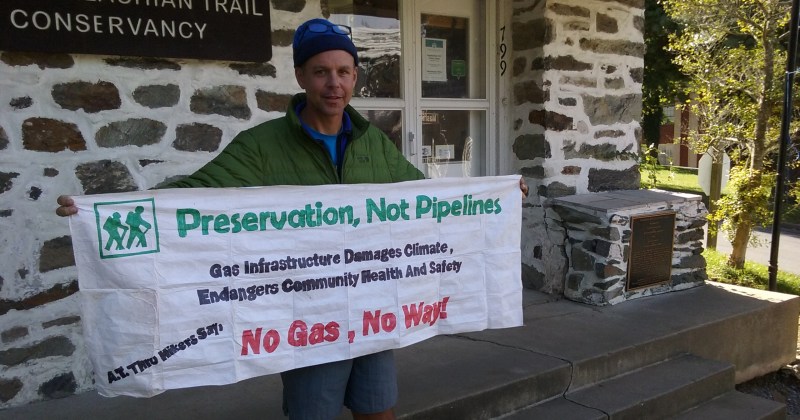
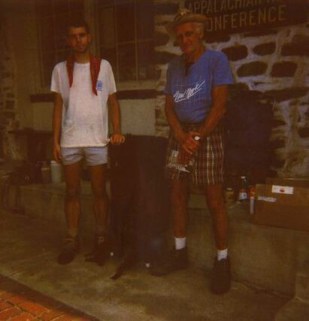
Greg Yost, with his banner, in Harpers Ferry. Follow his progress here.
By Elisabeth Hoffman
Not many people accidentally walk 30 miles in a day.
But that’s what Greg Yost has done on occasion as he heads south along the Appalachian Trail. More than halfway now, he should reach Springer Mountain in Georgia before year’s end. He walks with a sense of urgency, not only to get back to his family near Asheville, NC, but to talk to people about the climate crisis.
Most thru-hikers, those who walk the full 2,190 miles in one continuous journey, take on this arduous yet stunningly scenic trip as a personal challenge. Greg did that sort of walk in 1989. The inspiration for that hike occurred in the summer of 1987 when he was working at Habitat for Humanity in Americus, GA. That February, National Geographic had published a fascinating article on the Appalachian Trail.
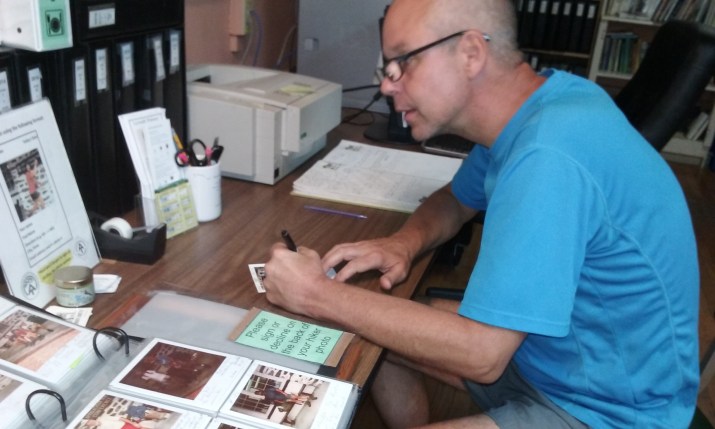
Thru-hikers have their picture taken and record their start date, trail name and contact information for notebooks kept at the Appalachian Trail Conservancy in Harpers Ferry. Greg fills in his information next to the 1989 notebook with his image.
“It was soooo hot,” he remembered during his recent stop in Harpers Ferry, WV. “I was sweating and dying down there in that south Georgia heat in July, but at night I would read that National Geographic article over and over and over. That article was so well-written and so well-photographed, it in and of itself led to this huge spike in thru-hiker numbers, and I was part of that in ‘89.”
Greg, at left, in 1989.
This time, however, Greg talks with anyone who will listen about fracked gas, climate change, methane leakage, and the dangerous buildout of fracked-gas infrastructure.
As he puts it, he wants to “educate and to incite rebellion.”
The Greg this trip is a different person, he says.
“We just don’t have the time or the money to build out all this new infrastructure that’s going to be in place for 30 years and expect to slow or even put a dent in our global warming problem,” he tells other hikers. “This is a real emergency and requires real tough decisions to be made. Incremental steps are not going to be enough here. We need to absolutely say no to building out this fossil fuel infrastructure.”
Greg’s daughter, Anna Farlessyost, proposed the walk. The last-minute – less than three weeks to prepare – father-daughter adventure was to be part of Anna’s gap year. After numerous injuries in Maine and many “0-mile” days, Anna reluctantly decided to take a bus home Aug. 10, less than a month into the trip. She’ll resume her walk in the spring. Greg carried on alone.
Trail names are usually bestowed on hikers. Cinderella, for example, got her trail name when one of her camp shoes fell off of her backpack. Three Prince Charmings came to her rescue and hike-shuttled it back to her. Anna earned hers after forgetting to pack her glasses, retainer and sleeping pad. “That’s a lot of forgetting,” Greg wrote in his Facebook blog, Preservation, Not Pipelines. That’s how Anna earned the trail name Dory, the blue tang that suffers from memory loss in the Disney film “Finding Nemo.”
Greg, however, chose for his trail name BXE, the abbreviation for Beyond Extreme Energy, a nonviolent climate group that uses direct action to try to stop dirty energy projects – for oil, coal and fracked gas – and to promote clean energy from the sun and wind. BXE focuses on the Federal Energy Regulatory Commission (FERC), which approves nearly every fracked-gas project that comes before it. The group also supports front-line struggles, such as in Lusby, Md., where a fracked-gas export facility is being built at Cove Point; in North Dakota, where Native Americans and their allies are trying to block the Dakota Access Pipeline; and a host of communities battling pipelines and compressors, particularly in the Northeast. He’s also seeking sponsors (21 so far), who will pledge to donate a cent a mile ($21.89, or more is welcome) to Beyond Extreme Energy at the conclusion of his walk.
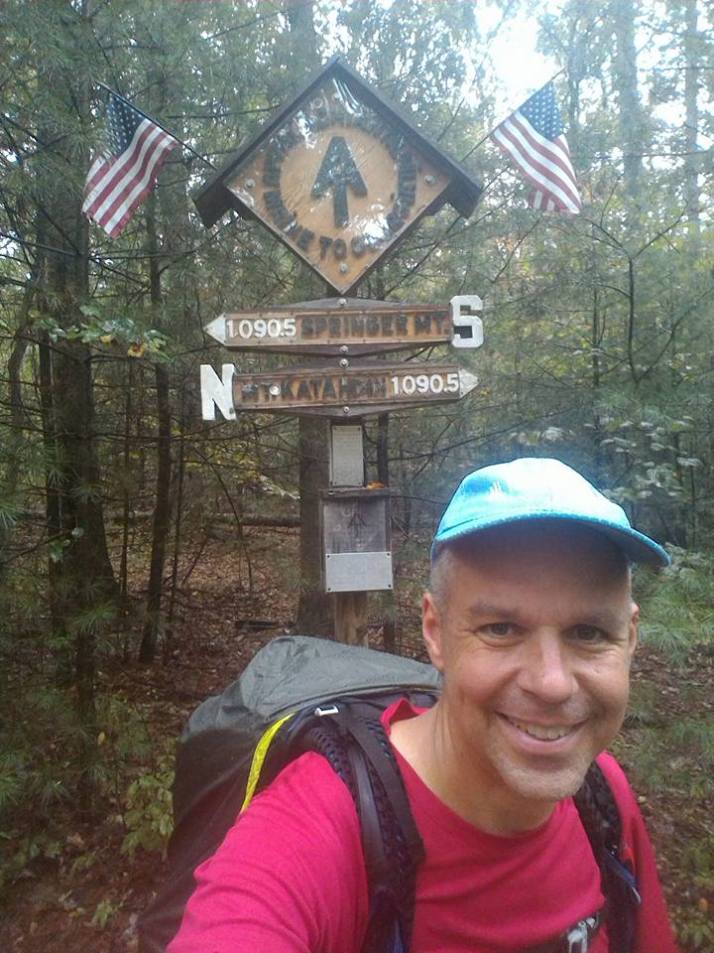
Greg posted this photo on Facebook at mile 1000.1 on Oct. 3.
When he introduces himself, the question invariably arises: What does BXE mean? And that’s how Greg starts these conversations. By Day 53, he posted on Facebook, he had already had at least a couple hundred face-to-face conversations.
Not many hikers are thinking about these issues, he says. “What I think’s valuable,” he says, “is that they meet somebody who has this passion. And beyond the particulars, a nice guy considers this important enough to talk about. The next time they have an opportunity to learn something, they will take it in.”
Greg posted this image of a “sweet little AT blaze” on Sept. 12
He approaches the Facebook blog posts the same way. He knows that many, perhaps most, of his followers – nearly 300 – want to hear about his hiking adventures. They also know him as a high school math teacher, a position that garners him some respect. “So what I want to do is not just to give the facts and figures about the climate stuff,” he said “I want to normalize the idea that paying attention to this is not being weird or nerdy or abnormal. It’s normal to pay attention when your home and your lives are threatened. In fact, it’s normal to resist.”
Many view protesters as “whiners,” he said, so they are not inclined to be sympathetic to the direct action he thinks is critical: “I want them to understand [that] when a system is broken, when all the civil institutions that you would normally trust to take care of you and make good decisions, when they are all broken, what do you have left? What you’ve got is citizen action. I want people to consider this as an option. Not even an option. A necessity.”
“I’ve done a lot over the last seven years including risking arrest many times and putting my own body in the way of fossil fuel polluters. As much as I swim in these waters now, I know that for some of you I am something entirely different. You may not know anyone else personally who speaks openly and knowledgeably about carbon pollution and the climate. Through this blog – its tone, its humor, and hopefully its humanity – I hope to catalyze a resistance reaction within you so that you decide, as I have, to protect what you love. It’s your trust I hope to earn.” – Day 53, Friday, September 2
Last week, he wrote about an encounter with about 15 students, ages 11 to 14, and their adult counselors. When the question came about BXE, he was ready. After describing FERC and noting that its office near Union Station was blocks from the youths’ school, he laid out the planetary dilemma:
“FERC won’t stop saying yes to dirty energy projects that hurt people and make the planet get hotter. So they have to be pushed to do what’s right. And that’s what we do. We get up in their face so that they have to listen to us people and not just the dirty energy companies. They don’t like it, but we don’t ever stop. We interrupt them, we sometimes block their doors, we talk to their employees, and we generally make a scene. Sometimes we even get arrested for what we do. But we definitely won’t stop until they change and do better.”
And then it happened. A 12 year old girl made my day. Maybe even made this whole trip worthwhile for me. Eyes alight, she threw her fist in the air in an act of spontaneous, irrepressible emotion. Eye contact was total. She got what we are doing. They all did, really, in that moment. What they saw: We have power. And it’s right when we use it.
This girl’s enthusiasm, though, however personally encouraging it was for me, nonetheless prompts some uncomfortable questions for her elders. To wit, what is wrong with us? Why aren’t we stopping people who want to dig the hole of global warming and environmental degradation ever deeper? Why can 12 year olds understand this stuff, but we seemingly cannot? Year after year after year, why have we allowed the folly of new billion dollar investments in fossil fuels to continue? Where is our courage, our intelligence, our conviction? Don’t children deserve action, not apathy, from us? – Day 99, Tuesday, October 18
On Sept. 11, Greg turned 50 on the trail. “I am appreciative of the best birthday present ever, the chance to hike long distance again,” he wrote on his Facebook blog. “I want to add that this is more than just a masochistic dream vacation for me. It’s also preparation. I’m reminding myself of places, feelings, plants, animals, communities, clean water, clean air, health, and sanity that I’ll fight like hell for. I’m banking this time away now, building up some spiritual resources that I’ll need to draw upon soon. For I mean to spend myself completely in my second half century.”
Greg reached what was formerly the halfway spot Oct. 8; the trail is frequently rerouted, so his halfway point was still ahead.
Sometimes he meets “courageous folks fighting pipelines, compressor stations.” Tom Denny, for example, is fighting a 650-megawatt gas plant being built near his home and is mere miles from the controversial Minisink, NY, compressor station that was completed a few years ago. Denny’s “point of entry,” Greg wrote, was not a public meeting. It was severe headaches that his doctor couldn’t explain.
Those of us who haven’t suffered the misfortune of having fossil fuel companies invade our homes and our lives will not easily understand the sense of desperation that comes from having no choices available other than fighting against long odds or just plain rolling over. Thanks, Tom, for not rolling over. You deserve real, tangible support from all of the rest of us. Your fight is our fight whether or not we yet understand that like we should. – Day 72, Wednesday, September 21
Greg has decided that hiking south is by far the better way to go. It’s harder at first: “You encounter the toughest parts right away, when you are not in shape. The trail is instantly hard,” he says. It took him about six weeks to acclimate, including “the matter of losing 30 pounds – any extra weight makes you more miserable than you need to be.” The benefits of going south, starting in late July, are that he avoided the northbound “mob” – there are about 15 or 20 northbounders for every southbounder – and, for the most part, the black flies that greet northbound hikers in New England over summer.
“Walking this trail is like getting to open lots of presents on Christmas morning. Each new hiker I meet is a gift and seeing old friends … is just that much better.” – Day 99, Tuesday, October 18
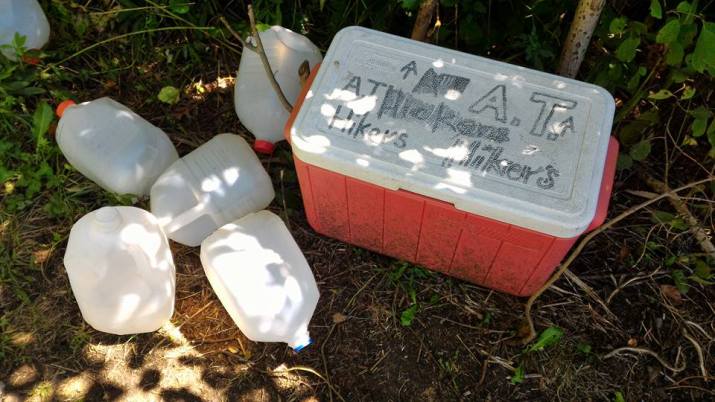
“Trail angels” leave water for hikers
His hardest days came in early September in Connecticut, during days of drought and high humidity. Places he expected to be able to find water were sometimes dry. One day, he had to hike 6 or 7 miles without water. “My clothes were drenched from my own sweat, yet I had nothing to drink. This went on for hours, my strength gradually leaving me, literally dripping away,” he wrote on Facebook. Fortunately, at the summit, a water spigot was working. Other days, he relied on “trail angels” who leave water jugs at road crossings for hikers.
Most days, he wakes at 5 a.m., sometimes even 4 a.m., and walks until late afternoon, has dinner, and then resumes hiking. As the days shorten, he’s had to turn on his headlamp as darkness falls. When he’s had enough, he looks for a flat spot, rolls out the sleeping bag, writes his blog entry and sleeps in the open. He’ll pull out the tent only if it rains and he can’t reach a shelter. It was also useful for keeping out bugs in August. Nights are getting cold, but the mummy sleeping bag has kept him warm. He doesn’t sleep that well, mainly because his feet are so painful. Not from blisters but from metatarsalgia. His knees also hurt: “That’s not just me, that’s every hiker,” he says.
The mathematician in him loves creating spreadsheets on his smartphone. Every night, he logs his miles. He’s written crude formulas that anticipate what date he will arrive at certain places. His average is picking up – especially given that he logged many days of zero miles while Anna was trying to heal on the trail. So now he knows he’ll arrive in Georgia in 2016.
The journey offers Greg much time for reflection, particularly about how best to seize the crisis of our time, to create a new community and to move forward. He wrote this on his birthday:
“There’s a chant I’ve heard at many protests and demonstrations: ‘We are unstoppable. Another world is possible.’ It’s a chant that gives voice to hope that wells up in people, especially young people, when they lose their sense of isolation for a moment in the joy of taking the street with others who share their deep hope and longing.
I think of these words often in the mornings on my hike. I recommend them to you, too, to use like a mantra. But I feel it’s important to distance ourselves emotionally, at first anyway, from any image of a crowd chanting exultantly and triumphantly. Rather, say the chant slow and low. Growl it. Get to know the truth of it for yourself. Another world is possible. Do you believe that? I feel myself being changed and prepared by that insistent meditation. And then, ‘We are unstoppable.’ Who are ‘we’, these people who will fight instead of watch or look away? I’ll tell you what, I’ve noticed that when I look for them, I find them. In fact, it’s sadly comical how easy it has been for me to find them.
So on today’s day of rest, given more to reflection than mileage, those are just a few thoughts about what my walk means to me. As always, I appreciate having you along. – Day 62, Sunday, September 11
While our political leaders are pretending that being better than Trump is an adequate response to the climate crisis, the climate movement is boldly stepping up to the unprecedented challenge of climate change with courage and commitment. Just in the past few days since the presidential debate ignored climate change, there have been several bold acts of civil disobedience around the country. The sustained resistance to the Dakota Access pipeline at the Standing Rock reservation in North Dakota had 29 people arrested on Monday for refusing to back down in the face of increasing repression and state violence. Four activists in New York spent all day Monday occupying the Spectra fracked gas pipeline that will run right next to the Indian Point Nuclear Power plant.
On Indigenous People’s Day, four water protectors crawled inside Spectra’s fracked-gas AIM pipe that is being built under the Hudson River. They stayed in the pipe for nearly 17 hours. // photo by Erik R. McGregor
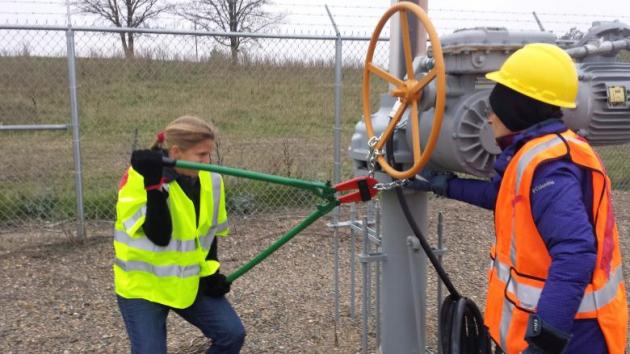
Then Tuesday, activists in four states shut down all five tar sands pipelines entering the U.S. from Canada. Ten people involved in that action remain in jail right now with bails that range from $5,000 to $75,000.
Activists cut chains at a valve station for pipelines carrying tar sands oil near Clearbrook, Minnesota. //Photo from Climate Direct Action and ShutItDown
There is a stark divide between the politicians who seem incapable of thinking about the climate crisis outside of the boundaries of old assumptions about political feasibility and the activists who are making real sacrifices to treat climate change like the unprecedented crisis it is. Al Gore is campaigning for Hilary Clinton without questioning her extreme support for fracking and fossil fuel infrastructure expansion, while Al Gore’s own daughter, Karenna, is currently facing a potential two-and-half-year jail sentence for protesting fracked-gas pipeline construction in West Roxbury, Massachusetts.
Too many failed centrist attempts to address climate change without standing up to the fossil fuel industry have taught honest pragmatists that we simply can’t deal with climate change in a non-confrontational way. Those failures have brought us to this point of record-breaking climate impacts. As the climate crisis quickly intensifies, the climate movement is committing to intensifying our efforts to defend a livable future, as yesterday’s huge pipeline shutdown demonstrated. We hope that our political leaders will join us.
Guilty verdict for disorderly conduct for four protesters to be appealed
READING, NEW YORK — In a decision likely to have broad implications for hundreds of We Are Seneca Lake defenders, Judge David Brockway dismissed trespassing charges against six local business owners due to insufficient evidence. The 12-hour trial took place in the Town of Reading Court on September 30.
In addition, four of the business owners were found guilty of disorderly conduct for preventing a vehicle from passing through the gates of Crestwood’s gas storage complex on Route 14 in Reading, NY. Attorney Gibson will appeal that decision.
“We saw in the testimony that the officers arrested these people without any direct knowledge that they actually were on private property,” said Sujata Gibson, defense attorney. “We are considering a federal lawsuit to ensure that this type of apparently politically motivated mass arrest and prosecution cannot continue to take place. The kind of behavior we saw here between law enforcement, the company, now recused members of the local justice courts and the prosecution has no place in a free democracy.”
The group of business owners included Anna Redmond and Asa Redmond of Regional Access, Julia Abernathy-Uticone of Swamp Road Baskets and Bluebird Botanicals, Jessica Thorpe of Glen Mountain Bakery, and Peggy Aker of Macro Mamas, who had formed a human blockade on November 19, 2014, at Crestwood’s gates. Asa Redmond and Peggy Aker were charged with trespassing, while the other four were charged with both trespassing and disorderly conduct.
They were protesting Crestwood’s plans to store highly pressurized, explosive gas in abandoned salt caverns on the western shore of Seneca Lake. The Federal Energy Regulatory Commission (FERC) green-lighted the plan in 2014, but to date, construction has not begun. Opponents say the storage plan threatens drinking water for 100,000 people, and the regional economy based on farming, wineries and ecotourism. Thirty-two municipalities around Seneca Lake have passed resolutions denouncing Crestwood’s plans because of overwhelming public opposition citing grave geological and public health concerns. To date, there have been 657 arrests at peaceful protests. On Sept. 1, Senators Gillibrand and Schumer requested that FERC withdraw the permit.
Defendant Julia Abernathy-Uticone of Cayutaville pointed out that “people don’t plan vacations to look at a gas flare or swim in a polluted lake. We have been given this beautiful gift of where we live, the Finger Lakes. It is our job to protect it.”
Peggy Aker of Trumansburg added, “We should be focusing on clean, sustainable energy practices that will be supportive of the life-stream of this planet and all the recipients of its natural resources. Without an economy based on clean energy, the economic vitality of this area will greatly diminish.”
Asa Redmond of Trumansburg stated, “My sister Anna and I are owners of Regional Access, a local, organic and natural food distributor/ food hub. I know from first-hand experience how important the local food and wine economies are to this area. That is why I am standing up against the proposed expansion of gas storage.”
“What will happen when they have ruined our water?” asked Anna Redmond of Trumansburg. “What will the farmers do when there is no water to irrigate their crops? How will the wineries continue to attract tourism to our area when it becomes the next scene of a natural disaster?”
Earlier today, BXE members visited the Federal Energy Regulatory Commission (FERC) for a special hearing on Aliso Canyon – the fracked gas storage facility in California that sprang a massive leak last year. The leak eventually lead to evacuations, major health problems for people and animals in the area, massive media coverage, and an emergency declaration from Gov. Jerry Brown.
Five BXE members entered the meeting and spoke out to disrupt the hearing and demand that the concerns of the public be included. Ellen (in the video below) and other speakers were backed up by more than 300 people who joined a “thunderclap” action – tweeting and posting at the same time to show solidarity with BXE and our allies around the country fighting fracked-gas infrastructure projects that FERC reviews and oversees.
A short while later, we set up camp outside the building and held our own “people’s hearing” featuring front-line activists and experts from around the country. Our lineup included:
Dr. Robert Howarth on the climate threat of fracked gas.
Ellen and other BXE activists on the hearing and why FERC doesn’t work.
Nancy LaPlaca on cumulative v individual threats and federal policy on fracked gas infrastructure.
John Dennis A researcher from near Seneca Lake New York on the current and future risks of fracked gas storage in his area.
Michael Bagdes-Canning on the local harms from fracking in Western Pennsylvania, where he lives.
Karen Feridun from PA Against Fracking on the climate effects of methane leakage.
And finally Richard Mathews, a Save Porter Ranch board member who has been organizing during and after the evacuation to expose Sempra Energy’s terrible conduct. Richard’s interview was cut off when we lost power for a few minutes. We’ll post our interview with him as a separate video soon.
Here’s the recording:
After our people’s hearing (and a short break), BXE members marched to the national headquarters of the Army Corps of Engineers a few blocks away. Several volunteers including Ellen Barfield and Steve Norris, who are themselves veterans, asked to meet with someone from the Army Corps about the Dakota Access pipeline.
When no one would come out to meet us, BXE marched around the building blowing whistles and ringing bells to “blow the whistle” on the Army Corps for not denying the DAPL permit outright. To date, the Army Corps, in coordination with the Department of Interior and other parts of President Barack Obama’s administration have ‘paused’ the pipeline pending a review now expected to last just weeks.
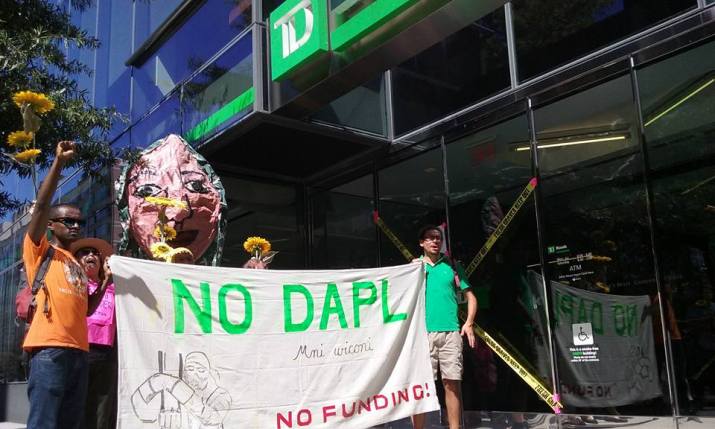
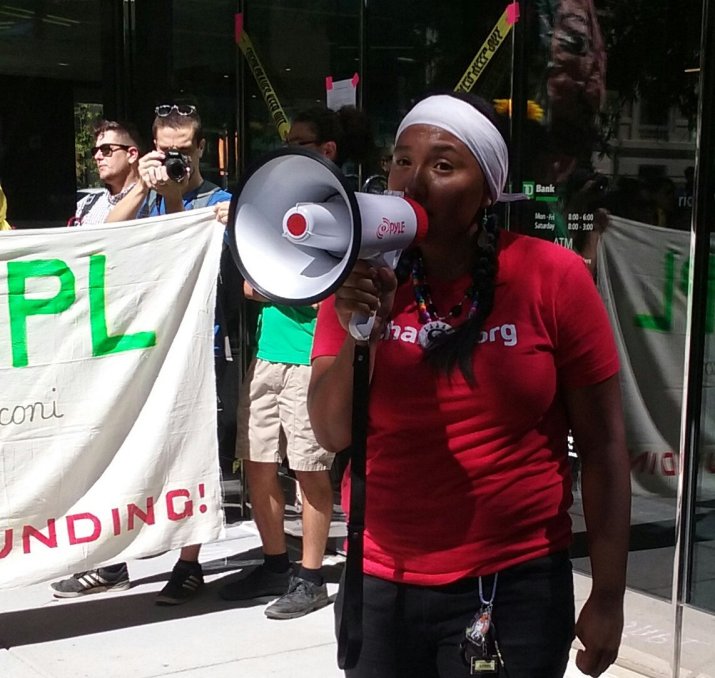
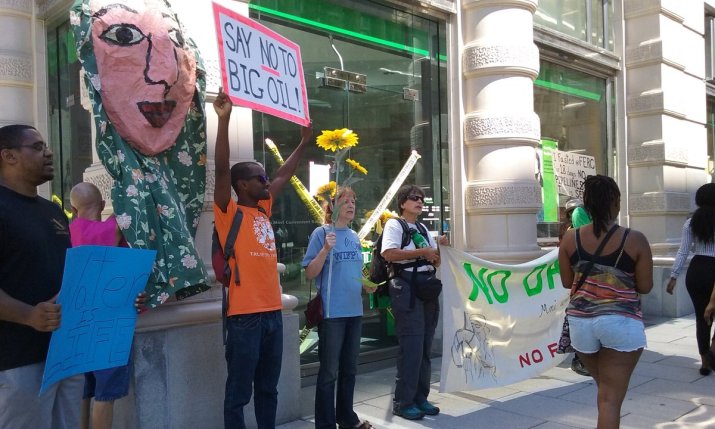
Activists called out TD Bank today for its financing of a gigantic, $3.8 billion fracked-oil pipeline that would cross Lakota Treaty territory in North Dakota.
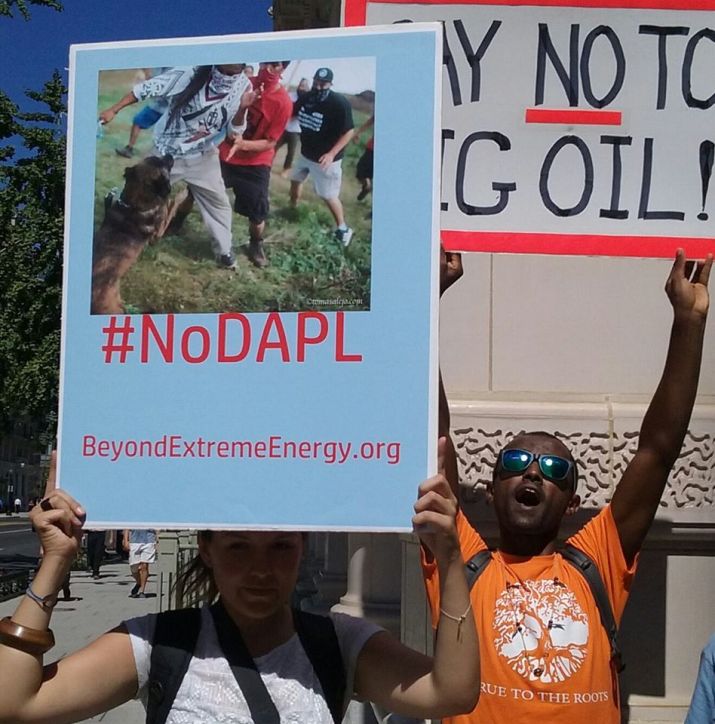
While drumming, chanting and carrying posters and banners, the protesters first walked from Lafayette Park in front of the White House to the TD Bank branch on 17th Street NW. They drew the attention and cameras of many tourists with their call-and-response, “One: We are the people. Two: You can’t ignore us. Three: We will not let you build this pipeline.”
Several of the activists walked into the branch to deliver a letter calling on TD Bank to stop lending its investors’ money to Energy Transfer Partners to build the 1,134-mile Dakota Access Pipeline that would run from North Dakota to Illinois, crossing beneath the Missouri River near Standing Rock Reservation and threatening the tribe’s water supply and sacred and cultural lands. TD Securities, the bank’s parent, is contributing $365 million to the project.
As the letter-deliverers rejoined the group outside, bank officials locked the doors as the protest continued on the sidewalk.
“I believe that we will win. I believe that we will win,” the group chanted. And “Stop funding this pipeline. Stop funding genocide.” And “White, black, yellow, red; without water, we’re all dead.”
Protesters strung yellow crime-scene tape that said “FRESH GRAVES KEEP OUT” across the bank’s doors.
“This is not just an assault on Mother Earth. This is an assault on Native Americans,” said Caro Gonzales of the International Indigenous Youth Council. The pipeline originally was to cross under the Missouri River farther north, near Bismarck, North Dakota’s capital. “The white people there said, ‘We are afraid for our children,’ ” she said. So, they moved the pipeline route to “right above Native American territory – that has children. That is racism,” she said.
“This is not just an assault on Mother Earth. This is an assault on Native Americans,” said Caro Gonzalez, in town after a 23-hour drive from North Dakota.
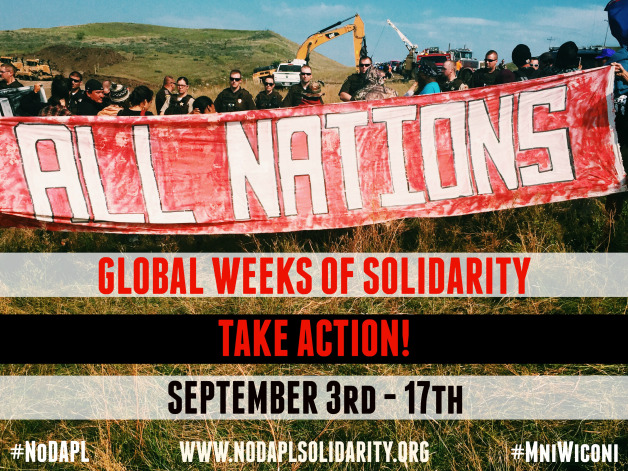
The spirited local action, organized by Beyond Extreme Energy, was one of many across the nation this month during Global Weeks of Solidarity, which was called by the Camp of the Sacred Stones and the Red Warrior Camp in North Dakota. A day earlier, for example, hundreds rallied in front of the White House to call on President Obama to stop the pipeline. In response to the expanding protests, the Justice and Interior departments and the U.S. Army have called for a halt in construction until the pipeline can be reviewed.
After a 23-hour drive from the North Dakota resistance camps, Gonzalez and Lauren Howland had arrived in Washington late the night before. Their first stop: the White House.
Lauren Howland says she has felt like “a tourist in my own land.”
“It’s funny how I felt like a tourist in my own land,” Howland said. “My ancestors died here. … Everywhere there’s a building built, my ancestors are underneath. … Everywhere in America is built on my ancestors’ [burial ground]. That is desecration.”
She said about 5,000 people are at the Sacred Stone and Red Warrior camps near the Standing Rock Sioux Reservation in North Dakota. “Money doesn’t exist at Standing Rock, and we are making it work very well,” she said. “To TD businessmen and women: You have caused violence. … You cannot drink oil.”
Gonzalez and Howland plan to take their urgent message to President Obama and Congress. “They need to know that Native Americans are no longer expendable,” Howland said. She added that she is relearning her culture and Native ways: “I am decolonizing my people.”
“We are living proof that we are not giving up,” she said. “A hundred million Native Americans died to make the United States what it is today. … It was stolen; it was genocide.”
After writing #NoDAPL messages in chalk on the sidewalk, the group headed for a second TD branch on 14th St. NW, where the doors had already been locked.
Activists are sending a message to TD bank officials, customers and employees that they don’t approve of their investments, said Gabe Shapiro of BXE and Chesapeake Climate Action Network. “It is 2016. It is time for us to take a moral stand on these issues, whether or not it’s your job, whether or not it’s how you put food on the table for your kids,” he said. “This bank right now is funding the destruction of Indigenous sovereign land, land that was granted to be Native land. It was the concession to them – after we stole it from them and invaded this country violently.”
“Every person working for this bank is complicit,” he said. “This bank is profiting off of genocide of the Indigenous people in this country. Is it not enough, everything that has been done? Is it not enough? When do we draw the line?” He called on the president to stop the pipeline or be prepared for more actions and arrests. “This pipeline is already history,” Shapiro said.
“The federal government has paused the pipeline, and its future is uncertain,” said BXE member Drew Hudson. “It would be prudent for TD’s customers, and for the planet, if they pulled the funding now and invested in clean energy instead.”
Since April, Native Americans and their allies have flocked to the Sacred Stone and Red Warrior camps. The tribes are seeking supplies and preparing to stay until the pipeline is stopped permanently.
About 125 people came to New Haven, CT, on Sept. 7 for an action in solidarity with the Standing Rock Sioux tribe, which is fighting to stop the Dakota Access oil pipeline from invading its historic territory. The pipeline would cross the Missouri River just outside the reservation in North Dakota, threatening the tribe’s water supply. (More from at BXE’s blog post here.) “Water is Life,” many of our signs said.
Our target was TD Bank, conveniently located across from the New Haven Green and Yale University. Dozens of students joined community members in picketing outside the bank, since it is a financial backer of the pipeline to the tune of $365 million. After awhile, most of us entered the bank to deliver a letter asking the branch manager to pass on our demand to TD Securities that it cut off its line of credit to the pipeline company. We made a lot of noise and eventually left.
We crossed back and forth on Chapel Street – a main thoroughfare in town – between the bank and the Green, where several speakers gave their perspectives on the need to support the indigenous leadership of the Sacred Stones camp and the Red Warrior camp at Standing Rock.
Many people asked me, “What’s the next action?” One said she’s ready to go to North Dakota and would like to organize others to go with her. We collected 85 names and emails. Once the federal judge issues his ruling on the tribe’s request for a restraining order to stop construction until a more thorough assessment can be done of the pipeline route, I will send an update with information from many local groups that participated in the action, including 350CT, Black Lives Matter, SURJ (Showing Up for Racial Justice) and BXE.
(An article from the New Haven Register is here. )
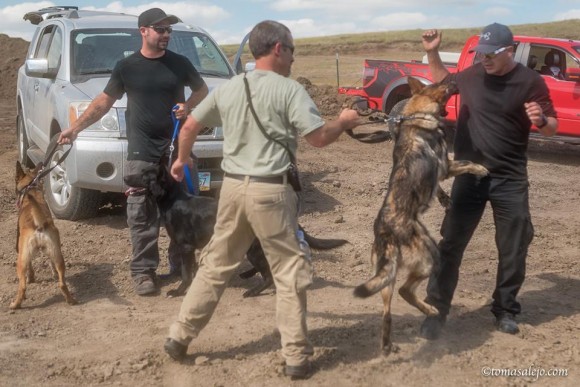
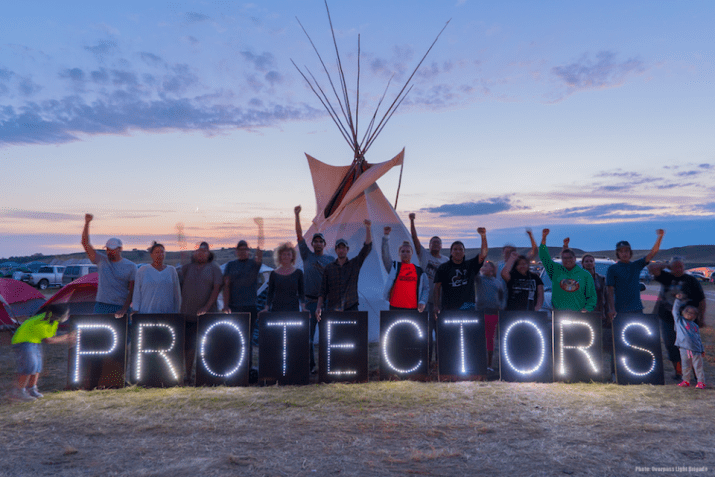
Our Native American brothers, sisters, relations & settler supporters have assembled at the Sacred Stone Camp and are converging with hundreds of Indigenous Tribal Nations and thousands of Water Protectors at Standing Rock Sioux Reservation in North Dakota. They are holding the line against construction of a pipeline that would carry highly flammable, fracked oil from the Bakken oil fields in that state to Illinois. The pipeline would go under the Missouri River, and protesters — referring to themselves as “protectors” and holding signs such as “Water is Life” — are carrying out radical non-violent resistance. Their numbers swell daily at the Camp of the Sacred Stones and the Red Warriors Camp. They have maintained their determined, nonviolent stand even when confronted with force, such as on Sept. 3, when security workers brought dogs and mace to the work site to terrorize the men, women and children who had rushed to an area where bulldozers had begun digging the pipeline trench. Shouting, “We’re not afraid of you!” and “Make your money some other way!” they pushed the security workers, dogs and bulldozers off their land.
Private corporate security guards used dogs to attack protectors. //Photo by Tomas Alejo
The $3.8 billion, 1,134-mile Dakota Access pipeline crosses the Missouri River a half-mile outside the Standing Rock Reservation, but Cody Hall, a member of the Cheyenne River Sioux and spokesperson for the protectors, says it’s still on Indian land.
“This proposed pipeline, it’s going to go right over the 1851 treaty land. That’s what we’re talking about being native domain land. And then of course the powers that be shortened the 1851 treaty down to the 1868 treaty and then said, ‘Here’s what the native people have on what is presently Standing Rock.’ But we’re going by the 1851 treaty land.”
The white-supremacy, genocide, land theft, and greedy-conquest culture that dominated Indigenous encounters in the mid-1800s was on display again in the planning for the pipeline. As reported in Inside Climate News, the Army Corps of Engineers approved the Dakota Access pipeline, owned by Energy Transfer Partners, while ignoring not only tribal concerns but those of three federal agencies: the Environmental Protection Agency, the Department of the Interior and the Advisory Council on Historic Preservation. “Citing risks to water supplies, inadequate emergency preparedness, potential impacts to the Standing Rock reservation and insufficient environmental justice analysis, the agencies urged the Army Corps to issue a revised draft of their environmental assessment,” Phil McKenna reported. But the Army Corps ignored these concerns and a few months later issued its final environmental assessment, which stated, “The anticipated environmental, economic, cultural, and social effects” of the project are “not injurious to the public interest.” That assessment gave the project the green light.
The assessment also said the route specifically avoided tribal land as a way of addressing environmental justice concerns, and included the statement: “The Project does not anticipate any impact to water supplies along its route, and to the extent a response action is required [emphasis added], federal regulation will be complied with.”
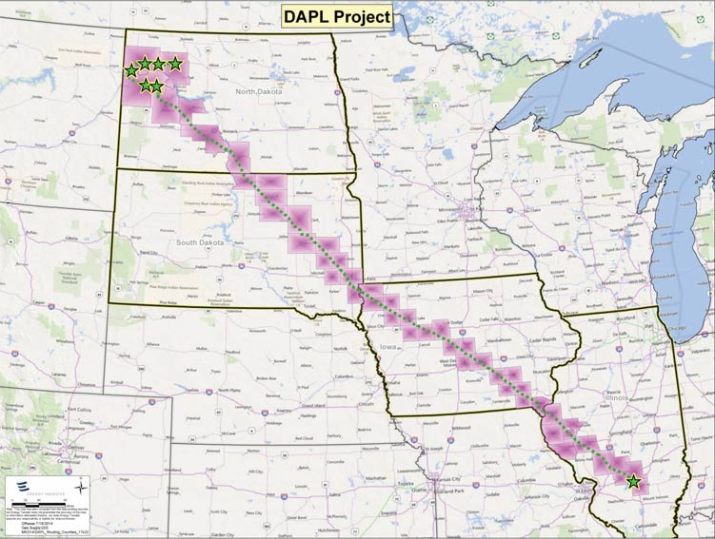
The Dakota Access Pipeline route crosses four states. Map from Energy Transfer.
The pipeline would carry about 500,000 barrels of crude oil a day through four states, from North Dakota to Illinois, along a route parallel to and east of the rejected Keystone XL pipeline. That battle was won with a national mobilization, led by local people known as the Cowboy and Indian Alliance.
The judge hearing the case has indicated he will issue a ruling by mid-September on the tribe’s request for a temporary injunction that would halt construction on sections of the pipeline where it hasn’t already started (which could explain the appearance of the bulldozers working on new ground last week). The injunction would allow a lawsuit requiring the Army Corps to redo its permitting process to be heard.
Over Labor Day weekend, sacred burial sites were bulldozed, prompting the tribe to file for another temporary restraining order to halt construction of the Pipeline. (DC Media Group reports that U.S. District Court Judge James Boasberg has ordered the parties involved in a standoff over the Dakota Access Pipeline to appear in court on Sept. 6 to hear a motion for an emergency injunction.)
Cody Hall says every minute of every day is critical for the company to lay its footprint. “They want to have a good majority of this construction done so by the time the judge hears the case, the judge will say, ‘How far have you progressed? Where are you at?’ And if they can say, ‘We are 95 percent near completion for North Dakota,’ the judge will say, ‘Well, there’s not much I can do about it, if you’re that close. I’ll let you complete it, just pay your fines, and move forward.’ We’re trying to prevent all that from happening, because it’s not right. You know, we’re not going to wait for the judge to make a call. If we can stop that momentum, then we have to. We need to take that action. And hopefully the judge will rule in our favor.”
Hall says that several protectors have already been arrested. He urges everyone to heed the call of The Red Warrior Camp, which is leading the non-violent resistance, to hold solidarity actions from Sept. 3 – 17 that target the pipeline owners’ offices, the consortium of financial institutions bankrolling the project, or the construction company doing the work. Information about solidarity actions is here.
“This is a movement, this is a people’s movement,” he says. “This isn’t one tribe or many tribal people saying it’s their movement. It’s everybody’s movement. It’s a humanitarian issue right now. Because this water will be poisoned, and it will affect the Standing Rock people first, and then it goes down the river and it will affect my people at Cheyenne River next, and it just keeps going down the line. It’ll affect all of South Dakota; it’ll affect all of Nebraska. So we just have to raise awareness on this. There are other alternative means for fossil fuels. There’s no alternative for water. There’s no Plan B if the water’s gone.”
He adds, “If you can make it, physically [to the camp], come support and we welcome you with open arms and open heart. But if you cannot make it in a physical presence here in North Dakota, please keep us in your prayers, and just hear our fight. Even if it’s a word of encouragement to give the camp, that means a lot to the people that are on the front lines.”
We are excited to announce the launch of our Frontline Community Support Fund – through which we’re able to make small grants (up to $1,000) that support frontline community action to stop fossil fuel infrastructure. Because of the nature of our fund, it may be best to ask for specific items or equipment that you’ll need for an action rather than cash.
In general, we hope to fund actions that strengthen you or your group’s engagement with the entities you are opposing. The BXE Frontline Fund is primarily focused on fighting against fossil fuel infrastructure, environmental racism, and the social impacts of the energy industry such as man camps.
That means we’re more likely to support a rally, protest, civil disobedience, non-violent direct action, or training for an action. We’re less likely to fund a conference, a legal review, or general operating expenses like staff and rent. We do not reject any application out of hand – tell us what you need and how we can help.
Initial applications are screened for relevance by our staff person (Shane). The application then passes to a council of Frontline Advisors — we’re honored to have Cherri Foytlin, Donna Chavis, and Michael Bagdes Canning as our current FLCF Advisors. Their choice and advice are passed along to the BXE General Meeting, which discusses the application and tries to come up with any further questions. We welcome applicants to attend the beginning portion of the General Meeting to talk more about their plans. The BXE General Meeting – which is open to all – to make sure we honor our commitment to horizontal leadership and the motto “To leave no one behind, we must all lead.”
The coordination and final call on how to fund a project is made by the BXE Fundraising and Budget Committee.
For more details on how to apply, and tips on what to expect, download the 1-page support guide above, or just click on the application to get started. We look forward to working with you!





 Guilty verdict for disorderly conduct for four protesters to be appealed
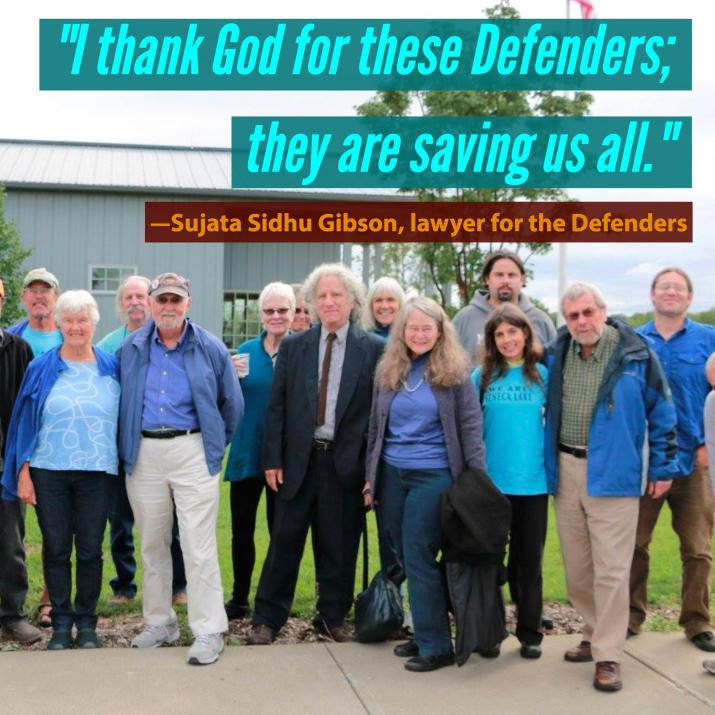 They were protesting Crestwood’s plans to store highly pressurized, explosive gas in abandoned salt caverns on the western shore of Seneca Lake. The Federal Energy Regulatory Commission (FERC) green-lighted the plan in 2014, but to date, construction has not begun. Opponents say the storage plan threatens drinking water for 100,000 people, and the regional economy based on farming, wineries and ecotourism. Thirty-two municipalities around Seneca Lake have passed resolutions denouncing Crestwood’s plans because of overwhelming public opposition citing grave geological and public health concerns. To date, there have been 657 arrests at peaceful protests. On Sept. 1, Senators Gillibrand and Schumer requested that FERC withdraw the permit.
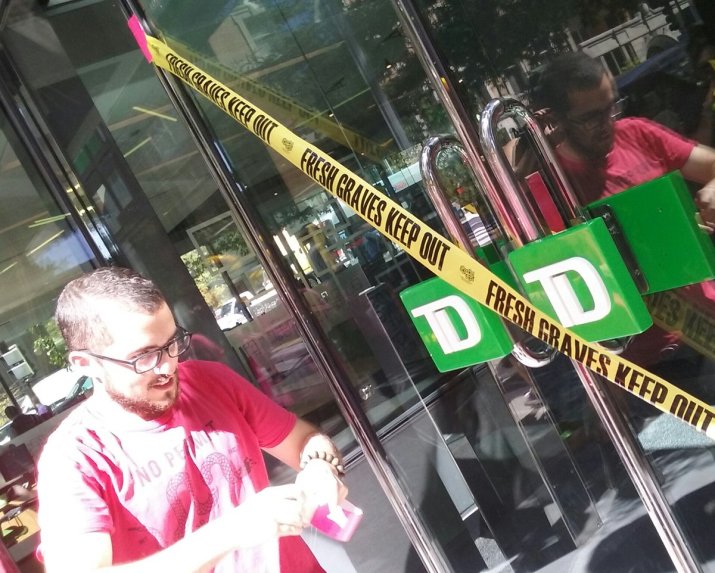 Protesters strung yellow crime-scene tape that said “FRESH GRAVES KEEP OUT” across the bank’s doors.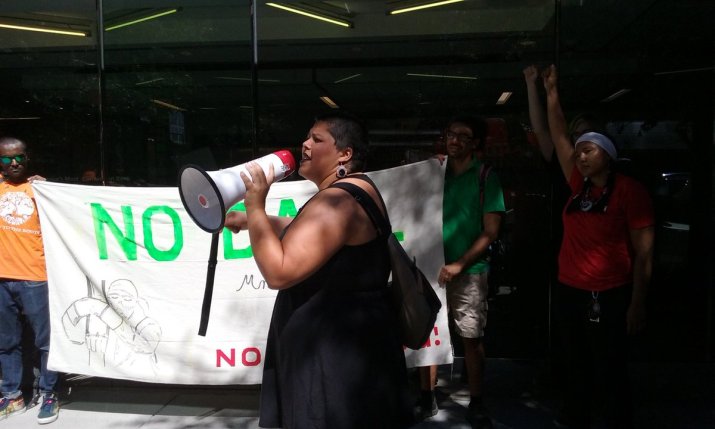


 Beyond Extreme Energy