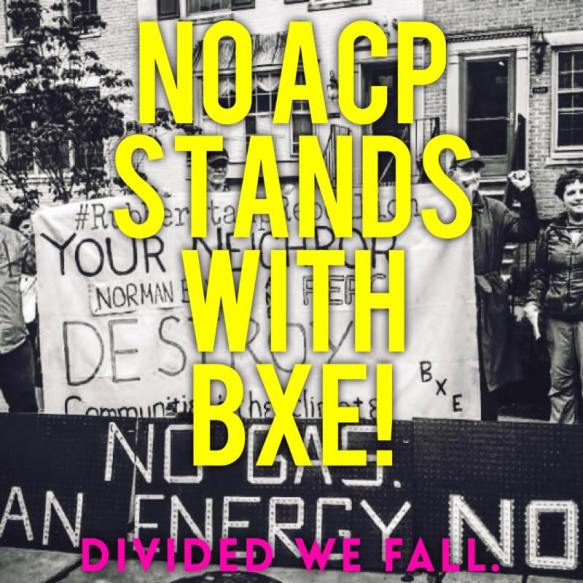
No, we will not denounce BXE’s tactics or their actions. They are justified. They are escalating because FERC continues to ignore the voices of those saying no to fossil fuel projects. BXE is our extended family and we support… their choices. No more divide and conquer.
There are surely nonprofit orgs out there who claim to be fighting for our futures, but who will continue to distance themselves from groups like BXE and No ACP because these non-profits often have competing interests, as well as financial or philanthropic ties to the same corporations that are killing us. They do so even without request, for fear of ruffling one financial feather or another. We hope that will change very soon.
We hope the nonprofit world, a.k.a Big Green, will see that they are on the wrong side, and that these corporations and the institutions that uphold them are toxic. We hope the staff and directors of these groups realize the dedication of those who do this work without compensation, those who engage out of love and out of necessity. We hope they realize the political climate is really shifted by grassroots organizations, who take risk and direct action, that force them to react. Power to the people. BXE you have our love.”
Activists from Beyond Extreme Energy interrupted the Virginia Energy Policy Forum in Hampton today to dramatize forcefully our conviction that current policies of the U.S. government, the Department of Energy, the Federal Energy Regulatory Commission, Dominion Resources and others represented at the event are wrong-headed and dangerous.
As U.S. Energy Secretary Ernest Moniz was addressing the forum, BXEers Steve Norris and Lee Stewart walked in front of the stage carrying a banner that said: “NO LNG EXPORTS.” and “Guys, we ain’t asking … Clean Energy Now.”
“We are here to say ‘NO to LNG exports,’ ” Norris called out. “No to fracked gas. No to the climate change that they will produce. We are here to save Cove Point, which has one of the largest LNG facilities in the East Coast [and] is being built by Dominion Resources. We are sorry to interrupt you, Secretary Moniz, but this is a message that does not seem to be being heard well here.”
As they were led out, others shouted “No fracked gas, Save Cove Point. Renewable Energy now.”
In a fliers distributed outside the forum, BXE also said:
These government agencies and private corporations are uprooting, damaging and endangering numerous communities in Virginia where fracked-gas pipelines, compressor stations and an LNG export terminal are being built. At the same time, they are threatening the planet and all human civilization and animal life through the release of greenhouse gases that could cause runaway climate change.
We are here to demand now that, as caretakers for Virginia’s climate and environment, DOE, FERC and Dominion immediately: ban liquefied fracked-gas exports from Cove Point and elsewhere; stop the permitting and build-out of fracked-gas infrastructure; and adopt policies consistent with the immediate installation of clean, renewable energy infrastructure, including wind, solar and energy efficiency. Only through policies such as these can the United States and Virginia meet their obligations under the 2015 Climate Conference in Paris.
DOE, FERC and Dominion have embraced the misguided notion that fracked gas is a bridge fuel to renewables because it burns cleaner than coal and emits less carbon dioxide. Yet during extraction, transport, and liquefaction, fracked gas leaks by design or by accident huge amounts of methane, a greenhouse gas far more potent than carbon dioxide. Even though the United States has recently seen a drop in carbon dioxide emissions, a more potent greenhouse gas, methane, has been increasing dramatically, as fracked gas has become much more readily available.
Fracked gas is not a bridge fuel. It is a gangplank to catastrophe.
Clean, renewable energy must be adopted now, in Virginia, the United States and around the world.
Words from the field: 350 Plattsburgh in New York!
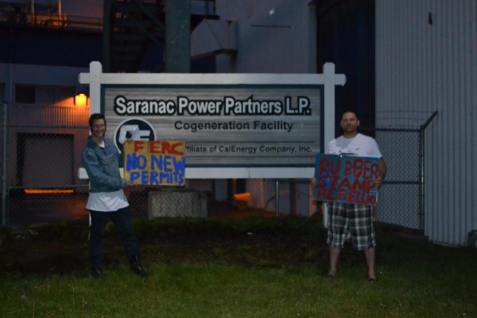
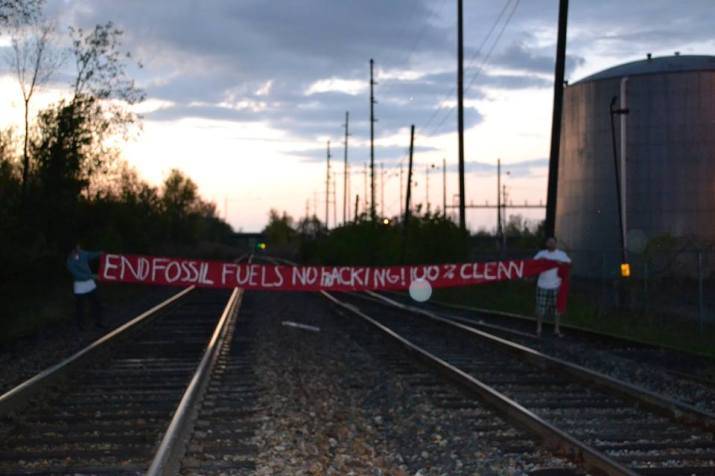
“Part of Beyond Extreme Energy’s #RUBBERSTAMPREBELLION – a local action targeting FERC and the Saranac Power Partners Liquid Petroleum Cogeneration Power Plant in Plattsburgh New York. To the Federal Energy Regulatory Commission (FERC) We demand: No NEW Fossil Fuel Permits and 100% Prioritization of Renewable Energy i.e. wind, solar and other renewables and demand to end the fossil fuel regime. This is the #RubberStampRebellion!
Two separate actions on two separate days in Plattsburgh, New York. Banner drop at City Hall in downtown Plattsburgh and a photo opportunity and bike mass at the Saranac Power Partners power plant outside the city limits of Plattsburgh. This power plant is not only a presence within the community of Plattsburgh, but it also is a symbol of the expansion of natural gas infrastructure and markets into the Adirondacks of New York.
Therefore it is a symbol of infrastructure and markets citizens must end from growing. 350 Plattsburgh demands to #KEEPITINTHEGROUND and asks FERC to approve #NONEWPERMITS. This is part of the week of actions that are occurring across the United States.
The symbol also tells a story of the combination of dangerous fossil fuel infrastructure that reside across the continent from California to Maine. This power plant resides directly next to a rail line that carries Bakken Crude Oil to the Port of Albany in Albany, New York. Two hours from this location was an explosion from a Bakken Crude Oil train in Lac Megantic, Quebec that echoes a foreboding warning that if we do not stop burning fossil fuels and approving pipelines/fossil fuel infrastructure, our communities are in danger in the context of not only one fossil fuel, but from entertaining risk of a multiple triggered event. The rails skid close to a fracked gas power plant whose explosive power could multiply a catastrophe, a triggered explosive event of fossil fuel proportions, where two separate fuel sources could set off a crisis with their combined explosive force.
If a derailment of Bakken Crude Oil were to derail into this power plant, nestled in a poor but quiet neighborhood, directly next to power lines, the New York State Thruway (interstate), directly beside a wetland this could create a social, environmental and political crisis the Adirondack region never could have seen.
We do not want fossil fuels, the costs outweigh any benefit in our eyes. We want safe renewable sustainable energy that does not threaten our livelihoods, pollute our air and poison our children, families and planet. We joined together over these two days to say #FERC#NONEWFOSSILFUELPERMITS#YESRENEWABLES#ENDTHEFOSSILFUELREGIME.
In the last 30 days, the Federal Energy Regulatory Commission (FERC) has rubber-stamped three major projects in the Gulf South: the Magnolia LNG export facility in Louisiana, the TransPecos natural gas pipeline through Big Bend National Park, and the Lake Charles LNG export expansion project. The future impacts of these facilities is immeasurable; the Gulf South is already damaged from years of exploitation by the fossil fuel industry, and it is now set to feel some of the worst impacts of climate change, including rising seas and more violent storms.
Our home, the Rio Grande Valley of Texas, is the site of three proposed LNG export terminals pending FERC approval. These LNG companies have set their sights on greenfield areas that are part of the largest swath of unindustrialized coastline in the state. The lands are home to 17 endangered species, and their pristine state contributes to a flourishing local economy dependent on beach and ecotourism. People travel here from all over the country to relax on the beach and to explore our coastal wildlands.
The Rio Grande Valley region has over 1.3 million people of whom 90% are Latino. It also has the two poorest metropolitan areas in the country. About 34% of the population is below the poverty line and 2 out of 5 children dependent on welfare programs that the State of Texas is aggressively trying to cut. These LNG companies are touting the few hundred highly specialized jobs their dangerous business can provide as a means of curing the economic disparity. In reality, LNG will bring many threats to the RGV: lights, flarestacks, and industrial pollution that could depress the tourism economy, massive quantities of hazardous materials handled within 2 miles of populated areas, supersized natural gas pipelines for which a rupture would mean a catastrophe, and exposure to cancer-causing and lung damaging air pollutants. In short, the LNG industrial complex will transform our region into a sacrifice zone.
No one deserves to live in a sacrifice zone. From my backyard to your backyard, we don’t want extreme energy extraction anywhere, and we want FERC, the regulatory agency that is aiding and abetting its spread, to be reformed and made accountable to the people of the United States rather than to the corporations it pretends to regulate. We demand a local economy, respect for cultural identity, and clean renewable energy power and jobs. By approving these many toxic industrial projects, FERC is standing in the way of progress. The community members of the Save the Rio Grande Valley from Liquefied Natural Gas group stand with the #RubberStampRebellion.
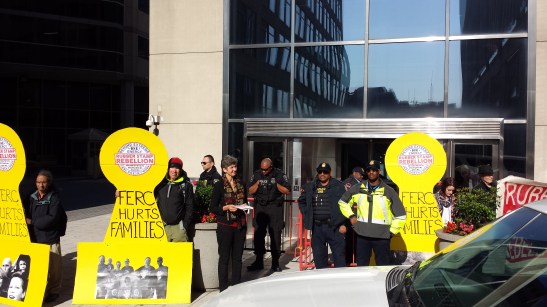
On Day 4, the #RubberStampRebellion held an open, very public meeting on the sidewalk in front of the Federal Energy Regulatory Commission on First Street, NE.
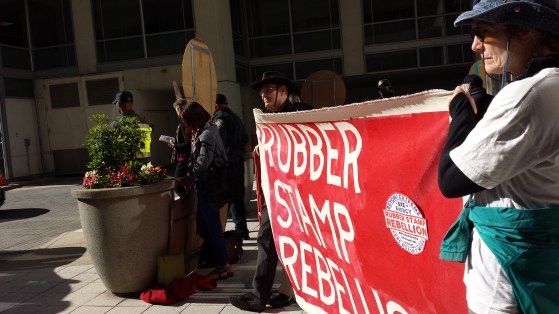
Barred from FERC’s monthly meeting, activists held banners and large cardboard rubber stamps, chanted and beat drums, and listened to speakers and singer Luci Murphy. Several stood on a small wooden platform to say the few words they would have said to commissioners – if they had been allowed into the meeting.
Linda Reik of Upper Delaware, NY, decrying the Ds of FERC: disingenuous, distortion, deception and defective reasoning.
We envisioned industry reps languishing in the so-called overflow room (where activists known to FERC are typically sent), watching the live webcam along with the public. But when Toma from Philadelphia approached the building in hopes of watching from the overflow room, Homeland Security officers explained that the building was closed to all but government employees and “invited guests.” AKA industry representatives.
Sure enough, among the “invited guests” visible on the webcam was Bret Lane, chief operating officer of SoCalGas, part of a panel speaking about “preparations for Los Angeles basin gas-electric reliability and market impacts.” Included was discussion of the Aliso Canyon gas leak disaster and aging infrastructure.
So, FERC excluded only the public from the meeting. Security officials told Toma, who didn’t want to disclose her full name, that she could have pre-registered – but then she would have had to know in advance that FERC commissioners were closing the meeting to all but the pre-registered and invited.
“This is our government,” she said, in tears, afterward. “It’s so frightening – what all this means.” Her family lives near Greensburg, PA, the site of a recent fracked-gas pipeline explosion and hellish fire.
“The decision to conduct this open meeting by webcast only was not made lightly,” FERC Chairman Norman Bay said at the meeting. “It was made after consultation with law enforcement and our security staff. And the primary concern was preserving the safety of the public and commission staff.”
The only threat to safety, however, has been from security officers sometimes brusquely removing outspoken Beyond Extreme Energy activists and other citizens from the room.
Jane Kleeb of Bold Nebraska says the “seeds of resistance are growing everywhere.”
Also stopped from speaking was Jane Kleeb, founder of Bold Nebraska, which played a critical role in defeating the Keystone XL pipeline and is now working with people in other states to fight fossil fuel projects. Kleeb said she had planned to talk about the need to end the use of eminent domain at the federal and state levels. “FERC should stop using eminent domain for private gain and [for] giving that power to pipeline companies,” she said. “If pipeline companies didn’t have eminent domain powers, none of these projects would be built.” She also wanted to call for a “climate test” on pipelines, a reason President Obama cited in stopping the KXL. “If our land [in Nebraska] was important enough to use a climate test, then everybody else’s land is important as well.”
Of FERC’s decision to close the meeting, she said: “On the one hand, it’s a victory for citizens. It shows they are nervous about citizen action and they are feeling some public pressure. But on the other hand, our government is supposed to be for the people, by the people, and they just shut the people out.”
On the sidewalk, the people’s meeting was at times festive but mostly serious.
— Environmental Action (@EnviroAction) May 19, 2016
“We’re here for a new world and FERC is trying to stop the new world. FERC is stuck in the fossil fuel economy of the 19th and 20th centuries,” said Ted Glick of BXE.
“The folks inside are losing,” said the Rev. Lennox Yearwood after highlighting several defeated fossil fuel projects and the fracking ban in New York. “We are winning and winning and won’t stop winning. We’ve got to win for the next generation,” he said. He criticized the climate movement for too easily giving the role of climate leader to politicians. “Jerry Brown can’t discuss renewables on Monday and discuss fracking on Wednesday and still be called a climate leader. Justin Trudeau can’t discuss renewables on Tuesday and be an oil baron on Monday and still be a climate hero. President Obama can’t talk about stopping drilling in the Atlantic and still talk about drilling in the Arctic and Gulf [of Mexico] and still be a leader,” he said. “They are not climate leaders until they realize we must transition to 100 percent renewable energy.”
Mary Wildfire from West Virginia said coal, oil and gas pollute in different ways but have global climate change in common. For some officials, she said, “there will be documentation about how they permitted all this stuff well into the 20-teens, when it was blindingly obvious what was being done was destroying the planet, destroying the food and hundreds of years of evolution — because we don’t want to change our habits, because there was some money in it, because the corporations ruled the world.”
“The more I find out about this criminal agency that masquerades as an arm of our government, [the more] I have to step up and put my body on the line,” said Nancy Vann from Westchester, NY, who is fighting the AIM pipeline that will run under the Hudson River and 105 feet from the aging Indian Point nuclear power plant.
Mike Tidwell, executive director of the Chesapeake Climate Action Network, blasted Gov. Terry McAuliffe’s support for the Mountain Valley and Atlantic Coast pipelines. After CCAN gave the governor an F for his climate efforts, McAuliffe planted a tree on Earth Day. “A million trees will be wiped out by those pipelines,” he said. “The time for green-washing and planting trees is over.”
In mid-afternoon, the #RubberStampRebellion headed for the neighborhood of FERC Commissioner Colette Honorable. While Commissioner Tony Clark called these visits acts of “uncivility,” at least one pipeline fighter offered via twitter: “I’ll trade you #RubberStampRebellion protesters for massive Spectra pipeline. Deal?”
With faux pipeline and eminent domain papers at the ready, rubber-stamp rebels set up banners and handed out fliers at a nearby intersection because the neighborhood was posted as private property. Plans were underway to serve up the eminent domain papers via a pizza delivery.
The #RubberStampRebellion concludes its week of actions today. In at least 20 communities, allies organized local #rebellious actions. FERC, we’ll be back. #ResistanceIsEverywhere.
On Day 3 of the #RubberStampRebellion, during a free-to-the-community dinner party in front of FERC Commissioner Cheryl LaFleur’s apartment building, we received startling news: FERC has decided that its monthly open meeting planned for tomorrow will instead be open-with-air-quotes. “Open.” In other words, closed. Turned into a tv show. We can watch the livestream.
“Upon the affirmative votes of Chairman Norman C. Bay and Commissioners Cheryl A. LaFleur, Tony Clark, and Colette D. Honorable, the status of the Commission’s May 19, 2016 public meeting is open to the public via webcast only.”
“It’s an outrage,” said Steve Norris, a Beyond Extreme Energy activist from Asheville, NC. “We live in a democracy. We have an open meeting. And then they cancel it. Of course, it has never really been open, but now we can’t even be in the room with them.” People traveled from as far as Nebraska to attend the meeting, he said. “And they pulled the rug out from under them. What kind of democracy is that? It shows what we are up against.”
“We are considering other options consistent with our commitment to non-violence and our commitment to getting FERC to prioritize a rapid shift from fossil fuels to renewable energy to protect the lives and health of current and future generations,” said Melinda Tuhus of BXE media.
For 18 months, BXE has attended each of FERC’s monthly meetings, calling attention to FERC’s rubber-stamping ways on behalf of the oil and fracked-gas industry. Each month, a few people have spoken out, been ushered quickly from the room – and barred from meetings. Forever. FERC has called these interruptions “a situation.” Many of those trying to speak to commissioners have traveled from communities fighting fracked-gas projects under FERC’s purview and feeling decidedly unheard.
During the #RubberStampRebellion, BXE has continued to call on FERC to stop granting permits that expand fracked-gas infrastructure and, instead, to prioritize wind, solar and other clean and renewable energy sources. The health of communities and the planet depends on making energy generation and distribution locally sourced, democratically controlled, and greenhouse gas-free.
Earlier the day, the #RubberStampRebellion participated in a #FlushTheTPP protest decrying the U.S. International Trade Commission’s (US ITC) report about that corporate power-grabbing agreement. The ITC’s Economic Impact Report applauds the Trans-Pacific Partnership (TPP) and actively fails to mention the significant economic impacts of the climate crisis, which the TPP will worsen. TPP Resisters have issued People’s Economic Statement.
On the morning of Day 3, the #RubberStampRebellion delivered an order of eminent domain for a pipeline at the home of FERC Chairman Norman Bay. Just like the many similar orders resulting from Federal Energy Regulatory Commission permits for fracked-gas pipelines, compressors, export plants or storage facilities.
To ensure the profits of Spectra or Williams or Dominion or Duke or Kinder Morgan and the rest of the industry, FERC always decides that the pipeline must come through, a community must move aside, fossil fuels must flow and burn, the trees must fall, the children must fall sick, the climate must fall apart, the air must fill with pollution, the land must be disturbed, the water must be spoiled, the woodland critters must scatter, the fracking must continue. In fact, FERC routinely says that the effects from fracking are outside its scope or unforeseeable.
While FERC insulates itself from dissent and expands the fracking industry’s reach with each permit, outrage and resistance grows. Beyond Extreme Energy is one of countless groups and communities pushing back against FERC’s rubber-stamp machine. The #RubberStampRebellion goes on.
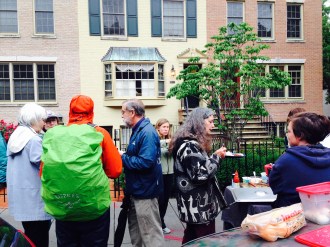
On the evening of Day 2, the #RubberStampRebellion dined al fresco — on the sidewalk in front of FERC Chairman Norman Bay’s house near Dupont Circle. Attire advice for the 25 or so in attendance: Rain gear. On the menu from Seeds of Peace: spicy tacos with beans, rice and cabbage and an apple dessert cake.
Activists enjoy dinner in front of Norman Bay’s home.
Visiting the commissioner at his home is a step not lightly taken. The chairman has expressed disdain and impatience regarding Beyond Extreme Energy (BXE) activists’ repeated interruptions at monthly meetings of the Federal Energy Regulatory Commission. These speakers are promptly ushered out. He and other commissioners don’t attend hearings in communities in the way of fracked-gas pipelines, storage facilities, liquefaction and export facilities, and compressor stations, instead sending staff. His agency advises industry about a “successful” strategy that “greatly increases the chances that a project will proceed in a timely, efficient and credible manner.” And FERC disregards the countless carefully submitted objections to the fracked-gas industry’s plans for communities.
The commissioners are not listening. They are instead determined to expand fracked-gas infrastructure (while denying any role in fracking), tethering the economy to yet another climate-disrupting fossil fuel for decades to come.
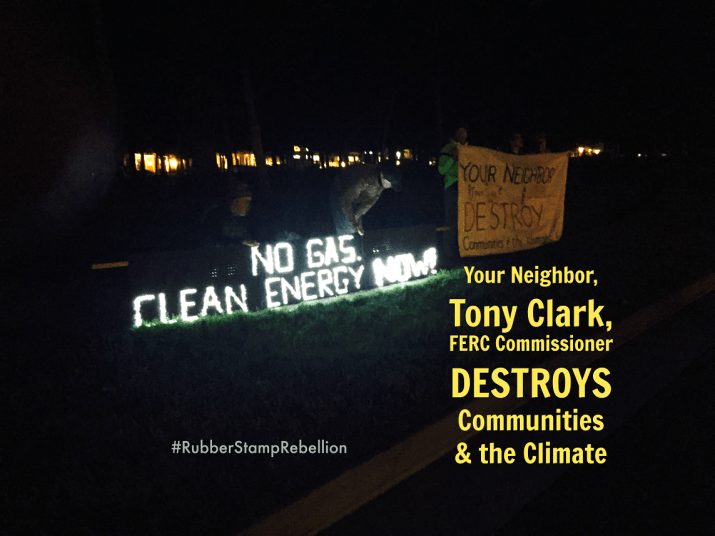
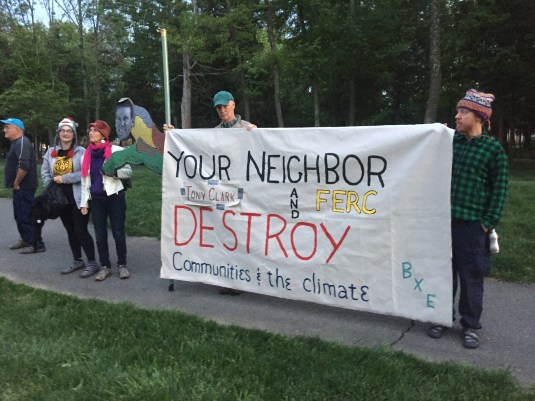
So, as part of BXE’s #RubberStampRebellion actions this week, activists are spending one night on the sidewalk in front of the house of each of the four commissioners. On the first night, activists posted a notice of eminent domain on the front door of Commissioner Tony Clark’s house. They also taped wanted-style posters in the park across the street, letting neighbors know about his job as serial community- and climate-wrecker.
Tonight, Norman Bay’s neighbors were learning the same about him. Posters wheat-pasted on street lights include a photo with the message:
Chairman Norman Bay, Commissioner of the Federal Energy Regulatory Commission, Rubber stamps fracked gas projects for the oil and gas industries, Complicit in the deaths of 100 million people which the World Health Organization says may die by 2030 due to climate change.
They also brought giant yellow cardboard rubber-stamps with images of families harmed by FERC’s decisions, and a banner announcing: #RubberStampRebellion Your neighbor Norman Bay and FERC Destroy communities and the climate
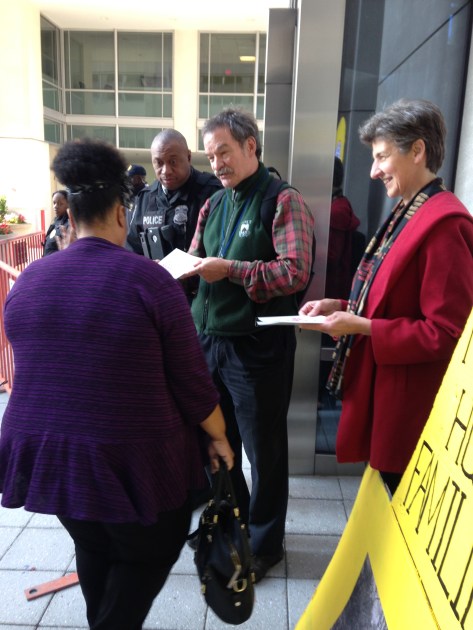
Kendall Hale from Asheville, NC, said many passersby accepted the #RubberStampRebellion pamphlets. She said one friendly neighbor revealed that Bay had told neighbors he was leaving town and warned that people were coming to harass them and knock on their doors. “We aren’t disrupting anyone. We are very polite. It’s FERC that’s disrupting communities,” Hale said.
Another neighbor took a pamphlet and said “great cause. Keep doing what you’re doing,” said BXE activist Melinda Tuhus from New Haven, CT.
“Chairman Norman Bay rubber stamps fracked gas infrastructure projects despite knowing that each permit issued is another nail in the coffin,” said BXE activist Lee Stewart of Greenbelt, MD. “The World Health Organization says 100 million people could die by 2030 as a result of climate change. The commissioners at FERC know the horrific consequences of burning fossil fuels, yet they continue to work on behalf of the industry by approving permit after permit. They are willfully complicit in these deaths. The story of their unwillingness to break the mold and do what needs to be done is the story of our unwillingness to break the mold and do what needs to be done. It’s time to break free.”
As night fell, a lighted sign declared: NO GAS. CLEAN ENERGY NOW!
During the day, #RubberStampRebellion activists went to Capitol Hill on behalf of local communities who are fighting FERC projects. They visited offices of Florida Sen. Ben Nelson, asking him to oppose several projects moving through the FERC approval process, including Spectra’s Sabal Trail pipeline; New York Sens. Chuck Schumer and Kirsten Gillibrand, asking them to speak out against the Spectra AIM pipeline; and Rhode Island Sen. Sheldon Whitehouse, calling on him to oppose a fracked-gas liquefaction facility proposed at Fields Point in South Providence.
Peter Nightingale, a member of Fossil Free Rhode Island and a professor of physics at the University of Rhode Island, described a “respectful conversation” with Senator Whitehouse’s staff. He invited the senator to FERC’s monthly meeting on Thursday, asked him to use his influence to stop the LNG facility in Providence from being built, and continued an ongoing discussion about the dangers of methane for the climate. “He ignores that methane is worse for the climate than coal and oil,” Nightingale said. “We offered him a free lesson about the physics of that.”
The #RubberStampRebellion continues through the week – and beyond.
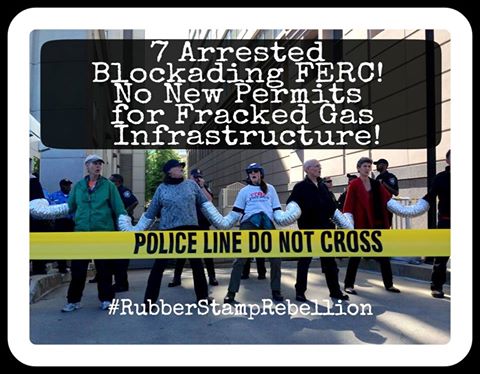
On the first day of the #RubberStampRebellion, seven climate activists were arrested while forming a human blockade at the exit of the underground parking garage at the Federal Energy Regulatory Commission in Washington, DC.
“My grandchildren and all future grandchildren thank you,” Steve Norris, an organizer with Beyond Extreme Energy (BXE), called out as Homeland Security agents handcuffed the seven and led them away. “Thank you for standing up to this corrupt rubberstamp machine that is destroying communities and whose policies are destroying the planet.”
Those arrested were Ellen Taylor of Washington, DC; Peter Nightingale of Kingston, RI; Claude Guillemard of Baltimore; Don Weightman of Philadelphia; Clarke Herbert of Virginia; Linda Reik of Upper Delaware River, NY; and Melinda Tuhus of New Haven, CT. They were released shortly after 10 p.m.
While blocking the entrance, the activists as well as others from the #RubberStampRebellion called out chants and sang songs, such as “Fighting for our health, we shall not be moved” and “Fighting for our children, we shall not be moved.”
All week, BXE is carrying out creative, non-violent actions throughout the Washington, D.C., area, targeting FERC and the fossil fuel industry whose projects that rogue agency approves.
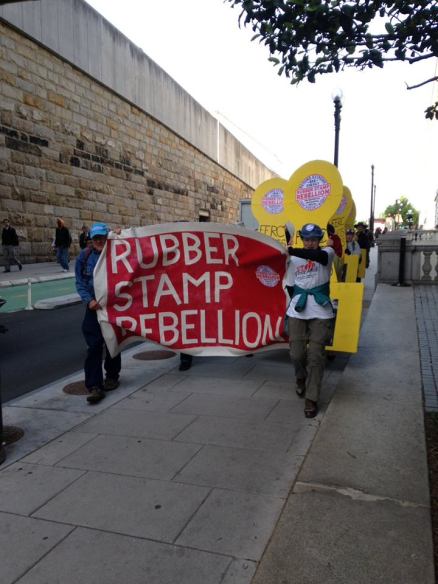
Activists display giant rubber stamps with images of families harmed by FERC permits for fracked-gas infrastructure.
During the blockade and at an action in the morning, #RubberStampRebellion activists distributed a small pamphlet to passersby that explained the rationale for the rebellion actions planned for this week:
For too long, this invisible federal agency has caused community destruction and climate devastation with every permit it issues.
For too long, FERC has rubber-stamped fracked-gas pipelines, compressor stations and export facilities.
For too long, FERC has guided the fracked-gas industry through the permit process and offered advice on handling community opposition.
For too long, FERC has insisted that it can’t take into consideration climate change caused by fracking and other fracked-gas infrastructure.
For too long, FERC has insulated itself from community dissent, sending aides to local hearings while forbidding comment at its monthly public meetings in Washington, DC. Those who speak out are hauled from the room and barred fromeverreturning.
BXE is calling for an end to theFracked-gas Expansion Rubber-stamp Commission, an end to the FERC that promotes fracking and fossil fuel infrastructurethat makes wealthy corporations more powerful while sacrificing communities, our health and our Earth. BXE calls for a swift, just transition to a renewable-energy economy.
The Rubber Stamp Rebellion camps outside FERC Commissioner Tony Clark’s house in Virginia.
On the first night of the RubberStampRebellion, six climate activists visited the Ashburn, VA., home of FERC commissioner Tony Clark.
Although the activists didn’t bring toxic and climate-wrecking air and water pollutants that FERC permits, they taped wanted-style posters in a park across from the Clark townhouse that included a photo and notified neighbors:
Tony Clark, Commissioner of the Federal Energy Regulatory Commission, Rubber stamps fracked gas projects for the oil and gas industries; Complicit in the deaths of 100 million people which the World Health Organization says may die by 2030 due to climate change.
The #RubberStampRebellion visits FERC Commissioner Tony Clark’s neighborhood.
They also posted on his front door a notice of eminent domain, similar to the orders used to seize land for pipelines for transporting fracked gas. In March, BXE had a #PancakesNotPipelines action at FERC to protest maple trees razed under an eminent domain seizure for the proposed Constitution pipeline in Pennsylvania and New York, even though all state permits had not been granted. With Josh Fox and Tim DeChristopher acting as pancake chefs, landowner Megan Holleran served up the last drops of syrup from her trees at the event. A week after the Holleran family’s maple trees we cut down, New York said it would not issue permits needed for the pipeline. Read about that action here.
Among those visiting the Clark residence for the #RubberStampRebellion was Wes Eastridge from Marshall, Va., who said: “We’re fighting against the continued development and reliance on methane–because it’s totally unnecessary. FERC allows companies to destroy people’s property with eminent domain and that methane is obtained by an extremely destructive process known as fracking.”
— Environmental Action (@EnviroAction) May 16, 2016
The #RubberStampRebellion heads for FERC.Clarke Herbert’s drumming announces the giant rubber stamps are headed to FERC.Ted Glick and Claude Guillemard hand out #RubberStampRebellion pamphlets to passersby.
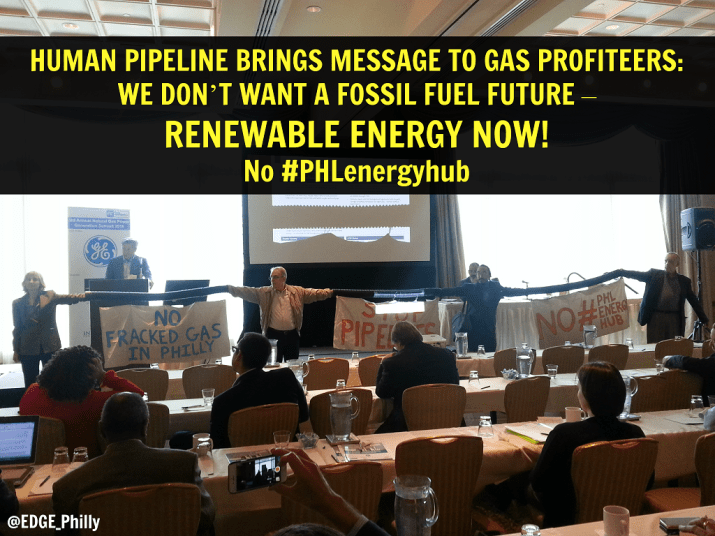
WE DON’T WANT A FOSSIL FUEL FUTURE – RENEWABLE ENERGY NOW!
Philadelphia – A group of Pennsylvania residents claimed eminent domain today for a right-of-way through the lobby of a Penn’s Landing hotel during two energy industry conferences. Using their own bodies and lengths of industrial tubing, they built their own pipeline to carry their message to industry and government officials who want to double down on investment in fossil fuels and fracking instead of shifting to renewable energy sources.
“Converting coal-fired plants to gas often really means building a new gas-fired plant. It’s another investment that justifies more fracking, more pipelines to Philadelphia and more pollution,” said Meenal Raval, a Mt. Airy business owner. “Using fracked gas for power causes a path of destruction from wells, pipelines, and compressor stations through thousands of communities.”
The chairman of the NPGP Summit is Michael Krancer, who served as Secretary of the Pennsylvania Department of Environmental Protection and then returned to his partnership at Blank Rome, where he heads the law firm’s Energy, Petrochemical & Natural Resources Practice. Krancer is also a member of the Greater Philadelphia Energy Action Team, a trade group that recently announced plans to seek public funding for a massive natural gas pipeline to Philadelphia.
“This is the revolving door in action,” said Angela Vogel of EDGE (Ending Dirty Gas Exploitation). “The same people go back and forth between government and industry, working together to keep profiting by poisoning us.”
On Monday an NGPG session called How to Overcome Environmentalist & Community Opposition and Accelerate the Approval Process included the topic “How to influence regulators and dominate the regulatory review and permitting process.” Tuesday morning featured pipeline proponent Philip Rinaldi, CEO of the Philadelphia Energy Solutions, whose refinery has suffered multiple fires in the past two years and produces two-thirds of the toxic air emissions from industrial sources in Philadelphia.
Built along two tidal rivers, Philadelphia is the city second-most at risk to power outages from climate-change-fueled storms. Members of the public who brought their message to the conferences say that reliance on fossil fuels undermines global efforts to slow climate change and locks the city and the state into decades of fossil fuel use while the rest of the world shifts to energy efficiency and renewables.
“Monday’s presenter on community opposition said, ‘Listen, listen, listen’ to what communities tell you. We are telling these industries that Philadelphia wants clean energy, not the fossil fuels that are making Philadelphia the asthma capital of the Northeast, poisoning our drinking water, scarring our state with pipelines, and destroying our planet,” said Elizabeth Arnold of EDGE (Encouraging Development of a Green Economy).
Since April 2014, 10 fracking infrastructure projects have been canceled or delayed. Here’s the list:
April 2014: The Bluegrass Pipeline in Kentucky was stopped by a court decision upholding landowners’ rights against the use of eminent domain to take their land for private profit.
November 2015: The Port Ambrose liquified natural gas (LNG) project was vetoed by New York Gov. Andrew Cuomo. The project was proposed by Liberty Natural Gas off the shores of New York and New Jersey.
March 2016: The Jordan Cove LNG export terminal and 223-mile Pacific Connector pipeline in Oregon were rejected by the Federal Energy Regulatory Commission (FERC), signifying FERC’s first gas-infrastructure rejection in 30 years.
March 2016: The Republican-dominated Georgia legislature voted overwhelming for a one-year moratorium on any new gas pipelines, setting back efforts to build the Palmetto Pipeline.
March 2016: FERC announced a seven-month delay on making a decision about the Penn East pipeline in Pennsylvania and New Jersey and a 10-month delay for the Atlantic Sunrise pipeline in Pennsylvania and Maryland.
April 2016: The Oregon LNG company announced that it’s ending its years-long effort to build an export terminal and pipeline.
April 2016: Kinder Morgan announced it is suspending its efforts to build the Northeast Energy Direct pipeline, which would have run from Pennsylvania through New York into Massachusetts and New Hampshire.
April 2016: Dominion Resources announces that the start time for beginning construction on the Atlantic Coast pipeline, going from West Virginia through Virginia into North Carolina, is being moved back from this fall to summer 2017.
April 2016: New York Gov. Andrew Cuomo announced that the New York Department of Environmental Conservation rejected the application of the Constitution Pipeline company for a water quality permit, a permit it must have in order to begin construction.
“We are actually experiencing the clean energy revolution, it’s really happening right now,” I said to my wife when I heard the news about the Constitution Pipeline.
It’s very significant that the movement against fracking and fracking infrastructure projects is winning these victories, but it does not mean we can take a break. As of March 24, FERC lists 58 interstate gas pipelines on its website.
We need to gain strength from these victories and, with the wind shifting from a headwind to being more at our back, step up our pressure on FERC, and the gas and pipeline industry. Join Beyond Extreme Energy from May 15 to May 22 in Washington, DC, for the Rubber Stamp Rebellion.
Ted Glick is a cofounder of Beyond Extreme Energy and a climate activist since 2003. Past writings and other information can be found here, and you can follow him on Twitter @jtglick.






 Beyond Extreme Energy