Theories, rumors abound on FERC vacancies

Hannah Northey and Rod Kuckro, E&E News reporters

Published: Friday, April 21, 2017

Companies and lawmakers have been wondering what’s taking the White House so long to fill three vacancies at the Federal Energy Regulatory Commission.

A few theories making their way through energy circles include lengthy background checks, debates about which nominee should be chairman and the bipartisan pairing of candidates.

“Everyone is scratching their heads as why it is taking so long to move formal nominations for FERC,” said Tyson Slocum, director of Public Citizen’s energy program.

More than two months ago, Democratic Sen. Joe Manchin of West Virginia said President Trump vowed in a meeting with lawmakers to fill the empty slots. Then came surefire signals that decisions were underway with the surfacing of key names.

Today, agency watchers and commission members are still waiting.

One former transition source said the debate over who should serve as FERC chairman is at the heart of the administration’s delay.

Possibly up for the job are Kevin McIntyre, a co-head of Jones Day’s global energy practice; Neil Chatterjee, a longtime energy aide to Senate Majority Leader Mitch McConnell (R-Ky.); and Robert Powelson, a Pennsylvania regulator who is serving this year as president of the National Association of Regulatory Utility Commissioners.

Currently leading the agency is acting Chairwoman Cheryl LaFleur, accompanied on the panel by Commissioner Colette Honorable. The duo, both Democrats, have been unable to make high-profile decisions since former FERC Chairman Norman Bay, also a Democrat, abruptly left in February, depriving the panel of a quorum.

Some sources say the Trump administration’s hangup stems from a long queue of nominee background checks that can take months to wrap up.

Others suggested it may have more to do with the practice of pairing up nominees by party. Democrats getting a pick may make them more likely to agree with a GOP choice.

Slocum threw out another theory, pointing to Energy Secretary Rick Perry’s recent memo calling for a study of the effect of clean energy subsidies on the U.S. electric grid and baseload power.

“I have to think that the holdup there might be a vetting process to see particularly if the incoming FERC chair is going to align with the kinds of objectives and tone that we see in this memo here,” Slocum said.

Green groups have seized on the lack of quorum to challenge FERC actions. The Sierra Club, for example, asked a federal court in March to block the agency’s approval of the $3 billion Atlantic Sunrise pipeline.

The group argued FERC rushed the decision on Bay’s last day and failed to make critical environmental information available, thereby violating the National Environmental Policy Act (Energywire, March 14).

Twitter: @HMNorthey Email: hnorthey@eenews.net

Sweet Potatoes, Not Pipelines!

Join us at FERC on Friday, April 28, between 8-10 am.

untitled(meme credit: Jimmy Betts)

On the day before the March for Climate, Jobs and Justice, Beyond Extreme Energy is taking close to half a ton of sweet potatoes to the headquarters of FERC, the Federal Energy Regulatory Commission, 888 1st St NW in DC. We will be speaking out about our passionate opposition to the Atlantic Coast Pipeline (ACP) and all new proposed fossil fuel infrastructure. FERC is a rubber-stamp agency for the gas industry!

We will be distributing these sweet potatoes in small bags free to FERC employees and passers-by, with a leaflet explaining why we are taking action at FERC.

Sweet potatoes are grown in eastern North Carolina, site of Duke Energy and Dominion Resources’ proposed ACP, which would run 550 miles through West Virginia, Virginia and North Carolina. Land would be taken by eminent domain, including land where sweet potatoes are being grown, degrading soil fertility, threatening growers’ livelihoods, water and way of life and the chance for a stable climate for all of us.

This area has the highest concentration of people of color in the state: African American, indigenous, and Latino, and lower-than-average income for N.C., so it’s no surprise that the pipeline was diverted from two earlier routes that were whiter and wealthier.

This area is also home to a growing number of solar and wind energy projects. This renewable future is better for farmers and all energy consumers – that is, all of us. It’s time to leave the gas and all fossil fuels in the ground!

NO ATLANTIC COAST PIPELINE! NO NEW PERMITS FOR FOSSIL FUEL INFRASTRUCTURE!

(All BXE actions, gatherings, and activities adhere to our Principles of Nonviolence, which can be found here.)

Michigan AG Says Lack of FERC Quorum Means No Nexus Pipeline Until 2018; Backers Disagree

Michigan Attorney General (AG) Bill Schuette and companies backing the proposed Nexus natural gas pipeline are in disagreement over when the pipeline will enter service, with Schuette saying the lack of a quorum at FERC will delay it until 2018 but the companies predicting it will be 4Q2017.

The 255-mile Nexus pipeline, which is being jointly developed by DTE Energy Co. and Spectra Energy Corp., would move 1.5 Bcf/d of Marcellus and Utica shale gas from eastern Ohio into Michigan, connecting Appalachian gas to markets in the Midwest and Canada. Enbridge Inc. acquired Spectra earlier this year.

The disagreement surfaced after Schuette filed a brief last week with the Michigan Public Service Commission (MPSC), in a case [No. U-18143] to discuss plans by DTE Electric Co., a DTE subsidiary, to implement a power supply cost recovery plan (PSCR) in its rate schedules for 2017.

The Federal Energy Regulatory Commission has been without a quorum since the departure of Norman Bay, who had served as the Commission’s chairman before announcing his resignation in January. President Trump then named Commissioner Cheryl LaFleur to serve as acting chairman. A flurry of activity took place before Bay’s last day on Feb. 3, but several major natural gas pipeline projects, including Nexus, did not win last-minute approval.

“DTE Electric Co. cannot demonstrate that the inclusion of the Nexus pipeline related expenses in its 2017 PSCR factor is warranted,” Schuette said, later adding that the pipeline’s backers “expected approval of the certificate of necessity (CON) by FERC in February in order to put the Nexus pipeline into service by Nov. 1. However, as of today there was still no final approval and the quorum issues at FERC…remain an obstacle to moving the project forward.

“Given the roughly nine-month lag time between approval and putting the pipeline in service…even if FERC were in the position today to approve the CON, it would still be 2018 before the pipeline could reasonably be put into service. There is no evidentiary support in the record to sustain [DTE Electric’s] request to include Nexus gas transportation expenses in this PSCR plan this year.”

A footnote in the filing clarifies that Schuette was not making a concession that Nexus expenses should not be recoverable in future PSCR years. Schuette filed the brief in support of the Michigan Environmental Council and the Sierra Club.

Adam Parker, a spokesman for Nexus Gas Transmission LLC, disagreed with the AG’s assessment.

“While Nexus’ certificate application remains pending before FERC, the record supporting the FEIS [final environmental impact statement] and application are complete and ready for prompt FERC approval once a quorum is restored,” Parker told NGI’s Shale Dailyon Monday. “We are exploring all opportunities to improve our schedule and are actively working with our contractors and other relevant parties to ensure a safe and responsible construction plan is in place to achieve a targeted Q4 2017 in-service.”

DTE spokesman Peter Ternes concurred. “We are still projecting to have the Nexus project completed this year,” he said Monday.

Nexus received afavorable draft environmental impact statement from FERC last July.

Last January, the MPSC agreed with an administrative law judge’s finding that DTE Electric’s plans to contract with Nexus to buy natural gas for power generation appear “reasonable and prudent,” but it denied the utility permission to recover power supply costs for the $2 billion project from its customers without an evidentiary hearing.

Earlier this month, the Sierra Club urged FERC to wait until the MPSC ruled on capacity commitments to Nexus before issuing a Natural Gas Act certificate for the pipeline.

DTE has encountered pushback in Michigan over its proposed commitments to Nexus, including a 75,000 Dth/d commitment from DTE Gas Co. and a 30,000 Dth/d commitment from DTE Electric. Regulators and opponents, including ANR Pipeline Co., have questioned the affiliated nature of the transactions and whether DTE Gas or DTE Electric properly considered alternatives, including the competing Rover Pipeline project.

Meanwhile, lawmakers from both parties have urged Trump to make nominations to FERC, but so far none have been forthcoming. New FERC commissioners must be confirmed by the Senate.

BXE April Convergence

Beyond Extreme Energy Convergence
April 26-28

Beyond Extreme Energy (BXE) is getting together with friends and accomplices ahead of the People’s Climate March in Washington, DC to be together, build community, organize, and take action to stop Trump’s appointments to the Federal Energy Regulatory Commission. Below, you will find everything we know about our plans, including a tentative schedule of events. If you have questions or concerns, please contact Lee Stewart at Actions@BeyondExtremeEnergy.org, or if it’s an emergency, 703-999-2634.

Everyone is welcome to join BXE for our any of our activities. Everyone is also welcome to join BXE as an affinity group as we participate in other actions together during this time period.

If you would like to join us, please fill out this registration form.

Housing, Food, and Logistics

If you plan on being with Beyond Extreme Energy during your time in DC, we’re providing housing and food.

Housing will start on the night of Wednesday, April 26th at First Trinity Lutheran Church (309 E St NW) and go through the night of Saturday, April 29th. The church has 50 mattresses on the floor for people to sleep on. Because another group is sharing the space on Friday, depending on our numbers, some people will have to stay in overflow space at St. Stephen’s Church in Mt. Pleasant/Columbia Heights that night.

Please bring everything you need to sleep and be comfortable, including toiletries and a towel. Please do not bring alcohol, drugs, or weapons. First Trinity will have a locked room for storing gear and personal items during the day.

Food will be provided by Seeds of Peace starting at dinner on the evening of Wednesday, April 26th.

Please be sure to fill out the above linked registration form if you plan to stay and/or eat with us.

Transportation to and from DC and within the city is up to everyone as individuals. There is no parking at the church. Parking in DC is notoriously difficult. If you are bringing your car, you will have to find a parking garage and pay to park there. If possible, leave your car home and come to the city via public transportation.

Tentative Schedule of Events

(An official People’s Climate Movement can be found here.)

Wednesday, April 26th
*
**

Beyond Extreme Energy Gathering
11am-Evening, First Trinity Lutheran Church (4th and E Street NW)
Discussion. Action planning for Thursday. Time to be together.

Thursday, April 27th
***

Senate Actions
Morning, Senate Office Buildings
Leafleting Senate staff. Noise demonstration. Traditional lobbying on FERC vacancies.

Youth Climate Lawsuit Speak-Out
9am-10:30am, Supreme Court (1 First Street NE)
Stand with the 21 youth plaintiffs suing the federal government for perpetrating climate chaos. Click here to learn more.

Afternoon Actions
TBD
We will target the oil and gas industry with creative, non-arrestable action

Dinner by Seeds of Peace
6pm, First Trinity Lutheran Church (4th and E Street NW)

Action Planning/Training
7pm, First Trinity Lutheran Church (4th and E Street NW)
Legal Training with BXE’s lawyer. Planning for Friday.

Pre-PCM Native Round Dance At Trump Hotel
8:30pm-10pm, 1100 Pennsylvania Av. NW
Click here to learn more about this event.

Friday, April 28th
***

Morning Actions
TBA

It Takes Roots Action: Mother Earth’s RED LINE
2pm to 4pm
Join It Takes Roots to take direct action against corporations and politicians driving the extractive economy. Click here for more details.

Environmental Justice In Action: How HBCU’s Are Leading the Climate Fight
6pm-9pm, Howard University
Click here to learn more about this convergence.

Labor Network for Sustainability Gathering
7pm-10pm, 2333 18th Street NW
Click here to learn more.

Saturday, April 29th
***

People’s Climate March
9am-3pm
Click here for more information.
BXE will be marching as part of the Fossil Fuel Resistance bloc, itself a part of the Reshapers of Power group which is gathering on the Mall between 3rd and 4th Sts., on the south side of the mall.

Climate Showdown: Flood Trump
5pm-8pm
Click here to sign-up to flood Trump with action.

Sunday, April 30th
***

People’s Climate Candidate Training
7:30am-3:30pm, Thurgood Marshall Center (1816 12th St NW)
Click here to learn more about this training to run for political office.

Monday, May 1st
***

FERC Technical Conference
Morning, FERC
Click here for more details and to register. We’re trying to get people to go.

March on May Day
12pm-1:30pm, Malcolm X Park
Learn more about this worker’s march against racism, sexism and capitalism.

(All BXE actions, gatherings, and activities adhere to our Principles of Nonviolence, which can be found here.)

Judge Slams FERC’s Climate Review

Ellen M. Gilmer, E&E News reporter
Published: Tuesday, April 18, 2017
(https://www.eenews.net/greenwire/2017/04/18/stories/1060053227)

untitled
Photo by Bilfinger SE, courtesy of Flickr.

A panel of judges grilled the Federal Energy Regulatory Commission today on its approach to studying climate impacts from natural gas pipelines.

The case before the U.S. Court of Appeals for the District of Columbia Circuit centered on a project in the Southeast, but Judge Judith Rogers spent much of today’s oral arguments airing broader concerns about FERC’s typical treatment of downstream greenhouse gas emissions.

“FERC just doesn’t have to do its duty because it thinks someone else will,” she said, responding to the agency’s argument that many downstream impacts fall under the jurisdiction of other agencies.

The Sierra Club and other environmental groups filed the lawsuit last year, challenging FERC’s decision to issue certificates for the Southeast Market Pipelines Project, which includes the Florida Southeast, Hillabee Expansion and Sabal Trail projects.

The groups say FERC violated the National Environmental Policy Act by failing to adequately consider downstream climate impacts and the effects on environmental justice for communities along the project’s route.

Sierra Club attorney Elly Benson argued today that FERC had tools available to conduct the downstream greenhouse gas analysis — and was prodded by U.S. EPA to use them — but ultimately opted for a less-detailed approach.

“There’s no reason to not engage in reasonable forecasting,” she told the panel, which included Rogers, a Clinton appointee, and Judges Janice Rogers Brown and Thomas Griffith, both George W. Bush appointees.

FERC attorney Ross Fulton pushed back, noting that the agency conducted a more general downstream analysis that concluded the project would not significantly contribute to cumulative greenhouse gas impacts because power plants receiving natural gas from the pipelines were switching from coal, which emits more carbon dioxide.

“And the commission found that it could rely upon the plants being subject to federal and state air permitting processes for pertinent emissions and mitigation requirements and that these permitting bodies are best positioned to receive relevant air quality information,” FERC told the court in a brief earlier this year.

Moreover, he said, the agency determined that the linkage between the pipelines and the power plants was not direct enough to merit closer FERC review, as the commission has no control over how the natural gas is used.

Brown seemed receptive to that argument, but Rogers jumped on it, noting that contracts with end-users have already been signed. “When would FERC ever have enough information and enough certainty” to look more closely at downstream greenhouse gas emissions, she asked.

She also rejected the notion that the case was analogous to other D.C. Circuit decisions that held FERC had no obligation to conduct in-depth downstream analyses because other agencies held the keys to final approval. In last year’s EarthReports Inc. v. FERC, for example, the D.C. Circuit ruled that FERC was not required to consider indirect effects of increased liquefied natural gas exports from a FERC-licensed facility because the Department of Energy alone has authority to increase exports. In today’s case, Rogers said, FERC has final authority over the Southeast projects.

Griffith also appeared skeptical of FERC’s position, asking Fulton and counsel for industry intervenors why they were so resistant to the idea of attempting to quantify downstream emissions.

“It wouldn’t have been hard to do, right, with all that information available?” he asked Fulton.

Fulton responded that “it would not have been hard to do, but it would have been hard to do in a meaningfully informative way,” because it is difficult to estimate how much of the project’s natural gas would be used to replace coal in power plants.

The environmental groups are asking the court to vacate the certificates and remand to FERC.

Interested in a simple living/ecovillage experience in rural West Virginia?

Five days in rural West Virginia between May 19 and June 11, 2017

  • Simple living, activist, ecovillage, experience in rural West Virginia.
  • Time to write, research, create.  Learn or swap ideas about Appalachian history, nature, gardening, tree crops, and carbon neutral ways of life
  • Room and board in exchange for three hours shared work per day – garden / orchard work, building, organizing for people and planet over profit.
  • Housing:  small separate bedroom and use of outhouse, Food: mostly local and mostly vegetarian
  • Please send a short (max 200 words) pitch for why you’re a good fit for this idea – Robin Wilson robin@wvcag.org – I’ll email you back if it looks like it will work for one of the five day slots between the dates given.

for bxe blog(Local school kids making homemade cider for the first time.)
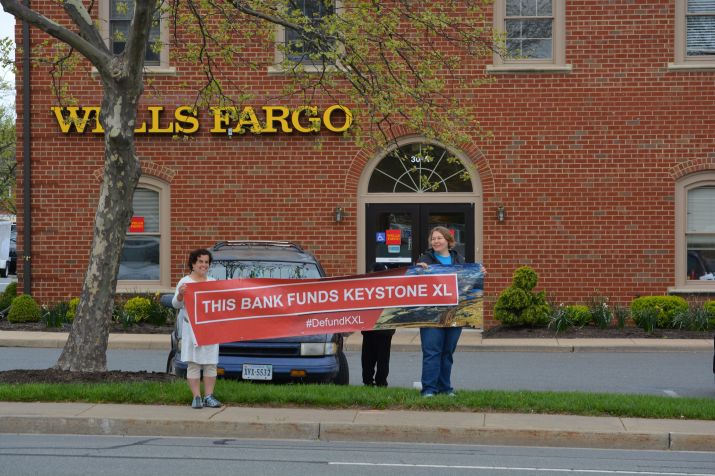
Loudouners Protest Wells Fargo Over Its Funding of the Keystone XL Pipeline

Saturday, April 15, 2017
(Photo Credits: Chris Tandy)

Leesburg, VA–Residents of Loudoun and members of local climate justice group 350 Loudoun gathered outside Wells Fargo on Catoctin Circle in Leesburg on Saturday morning to protest the bank’s funding of the Keystone XL pipeline. The protest aimed to pressure the bank to divest from the pipeline by calling on customers who care about the issue to close their accounts.

DSC_0022

“I’m protesting at Wells Fargo today because they are funding the Keystone XL–which would be an environmental disaster for the planet,” said Amanda Tandy, co-chair of 350 Loudoun. “They claim that it would create jobs, but they would be short-term. This is not a good investment and Wells Fargo customers should vote with their dollars to protect our planet.”

“I believe creating new pipelines will only slow our move to renewable energy” said Samuel Hamblin, a Loudoun high school student who entered the bank and read a letter to  management.

The protest was part of a national week of action coordinated by the Rainforest Action Network. Called the “#DefundKXL Week of Action,” these nationwide actions are meant to pressure big banks such as Wells Fargo to take their money away from the Keystone XL pipeline project.

map(Action map for the #DefundKXL Week of Action)
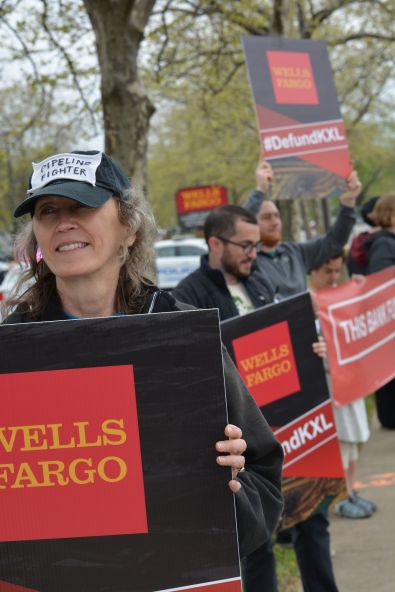
“I am against Wells Fargo and any bank that supports or invests in corporations that poison and rape our planet,” said Connie Cota. “Everyone needs to work together for a livable future for generations to come.”

DSC_0379

Other banks targeted by the campaign include JP Morgan Chase, Citibank, and TD Bank.

If built, the 1,179-mile long pipeline would bring 830,000 barrels of dirty tar sands oil a day from Alberta, Canada to Nebraska, where it would link to an existing pipeline on-route to the Gulf Coast for export. The project stands to endanger precious ecosystems, vital aquifers, and Indigenous and sacred lands. It would also exacerbate climate change at a time when a just transition off fossil fuels is critical for the health and well-being of life on Earth.

20170410_160502

“Sunlight really is the best disinfectant,” said Courtney Soria. “My daughter deserves to drink water that is safe, play barefoot in the dirt without getting poisoned. If I don’t stand up for her, who will? Most people probably have no idea their bank actually sponsors the degradation of the environment–we must be their sunlight and show them.”

“Here in Virginia, we’re fighting the Atlantic Coast and Mountain Valley fracked gas pipelines, said Lee Stewart. “We stand in solidarity with people all around the country who are fighting an onslaught of other pipeline projects at a time when a just transition off fossil fuels is not only possible, but absolutely necessary.”

Wells Fargo isn’t a stranger to national ire. In addition to the Keystone XL pipeline, the bank is also under fire for funding the Dakota Access Pipeline, another high profile pipeline that gained national attention when indigenous Water Protectors in North Dakota created a spiritual encampment to block its construction. Additionally, the bank has been called out for holding shares in GEO Group, which operates private prisons and immigration detention centers around the country.

On top of funding harmful projects and institutions, a sales scandal has embroiled Wells Fargo. Last year, the bank fired 5000 employees for opening over 2 million fake accounts for customers without their permission. The bank was fined $185 million dollars for this scandal, and this year, revoked $180 million for its former CEO John Stumpf and executive Carrie Tolstedt.

The bank recently reported that consumers opened 35% fewer checking accounts in March than they did in the same time last year, and that credit card applications fell 42% during the first quarter. All of this represents the bank’s seventh straight month of declines.

Mass. lawmaker asks FERC to halt 2 projects

Sam Mintz, E&E News reporter

Published: Monday, April 10, 2017
https://www.eenews.net/eenewspm/2017/04/10/stories/1060052887

Massachusetts Democratic Rep. Stephen Lynch has again asked the Federal Energy Regulatory Commission to suspend pipeline projects in his district, expressing concerns about the company that operates them.

untitled
Rep. Stephen Lynch (D-Mass.). Photo by Congress, courtesy of Wikipedia.

In a letter to acting FERC Chairwoman Cheryl LaFleur last week, Lynch referred to multiple leaks at facilities managed by Spectra Energy Corp.. In two recent cases, he said, one in Providence, R.I., and one in his district in Weymouth, Mass., the leaks were first noticed when nearby residents smelled gas.

Spectra has two projects — an active pipeline and a proposed compressor station — in Lynch’s district. He asked FERC to put them on hold, citing the “safety of local families.”

“I am deeply concerned that Spectra Energy does not have the infrastructure in place to appropriately monitor gas leaks or potential safety hazards,” he wrote.

Spectra is now part of Enbridge Inc. after it was bought out by the pipeline giant earlier this year. Marylee Hanley, a company spokeswoman, said in a statement that the Algonquin Gas Transmission pipeline, a segment of which runs through Lynch’s district, has been operating safely for more than 60 years.

“Our projects are designed, constructed, operated and maintained to meet or exceed federal safety standards and regulations,” she said.

Lynch has a history of concern about the pipelines in his district. He made a similar request to FERC in November after a pipeline exploded in Alabama, killing one person and seriously injuring four others (Greenwire, Nov. 7, 2016.)

But the Democrat also supported the controversial Keystone XL pipeline in the Midwest, earning the wrath of California climate activist Tom Steyer, who then poured money against Lynch into the primary election for a 2013 Senate race. Lynch lost the primary to then-Rep. Ed Markey, who went on to win the Senate seat.

Call In Days to Protect Communities from Pipelines & FERC!

(Thanks to Delaware Riverkeeper for putting out this information)

Mark Your Calendars

  • April 5 & 6

Call In Days to Protect Communities from Fracked Gas Pipelines, Compressors and LNG Exports

Right Now, FERC Can’t Approve Any Fracked Gas Pipelines or LNG Export Facilities Because they Don’t have the Legal Quorum Necessary to Cast Binding Votes. Let’s Keep it That Way

Join the call-in days on April 5 and 6 when we’re asking you to make 6 calls to tell your Senators and the members of the Energy and Natural Resources committee to hold hearings to get to the bottom of FERC’s abuses of power and address them before approving one more appointee to the Commission!

78

The Federal Energy Regulatory Commission (FERC) is a proven rubber stamp for fracked gas pipelines.  In 30 years, the FERC Commissioners have only rejected one (1) pipeline project.

Right now, FERC is operating without a Quorum – it only has 2 Commissioners, not the needed 3.*  Until a new FERC Commissioner is approved by the Senate, the agency cannot issue the Certificates needed to approve fracked gas pipelines, compressors or LNG exports subject to its jurisdiction.

This means communities are in a rare moment of protection.  Please help us fight to keep it that way.

We need Congress to keep FERC in this power vacuum until it has held hearings that expose the abuses of power and law inflicted by FERC on our communities and environment.  And to then craft legislative reforms that will prevent these abuses from continuing in the future – even if that means dismantling FERC altogether and replacing it with a better option.

Any time now, President Trump will nominate new commissioners for Senate consideration and confirmation.

Help us call on Congress to push for what we really need—congressional hearings that lead to needed reforms and an agency dedicated to facilitating a just transition to an exploitation-free energy system based on locally controlled and distributed renewable sources.

(* Information Note: FERC only has 2 confirmed Commissioners on its 5 seat Board.  Until FERC gets a quorum of Commissioners – three – it does not have the power to approve pipelines, compressors or LNG export facilities.)

It’s Time to Call Our Senators and Secure their Commitment to:

  • Oppose Any New FERC Commissioners
  • To Demand Congressional Hearings into FERC Abuses and Bias
  • To identify reforms that will result in an agency dedicated to a just transition to energy that serves the people rather than abuses them.

Demand an investigation and reform of FERC before supporting any Trump nominations.

What will we be saying to senators?

  1. FERC is a demonstrably biased agency – it has only denied one pipeline project brought before its commissioners in 30 years
  2. Trump’s nominees for FERC Commissioner need to be opposed until Congress has held hearings into FERC’s abuses of power and has identified and put in place needed reforms.
  3. Ask Trump’s nominees the tough questions that will expose the bias and abuses that exemplify FERC.

Find more information and all of the resources you need to make your calls, including phone numbers, a sample script, and an optional form to tell us how your calls went here: http://bit.ly/CallReFERCApril

Details can also be found at our Facebook event page: http://bit.ly/2o2xGkr

Tips on Meeting US Senators or Staff About FERC Vacancies

Senate Goes On Recess from April 10 to April 21.

Plan a meeting with your Senators in their district offices to say:

  • FERC approved pipelines are damaging communities and devastating the climate.
  • FERC is so biased that its approval of pipelines is a foregone conclusion.
  • FERC is abusing communities — stripping them of their legal rights and undermining the authority of state protections.
  • Be a champion to demand that Congress take steps to dissolve FERC and replace it with an agency that is dedicated to a just transition off fossil fuels.
  • Vote NO on Trump’s nominations to FERC until steps are taken to replace FERC.

Tips on Meeting With Your US Senators or Their Staff

The first thing to do is to contact the Senator’s office and request a meeting. Do not take “no” for an answer. Their job is to represent the people of their state. You have an important and very timely issue to discuss with them.

You can find your two Senators’ contact information at the link below. Go to the Senator’s website page and find the local office closest to you and your group and call that number. Here’s the link:  https://www.senate.gov/senators/contact/senators_cfm.cfm?State=MA

Explain to the person who answers the phone that you want to meet with the Senator or a member of his staff while the Senator is back home from DC. Tell the staff person that you are representing an organization, or organizations, and tell him/her the name(s). Explain that you want to discuss the issue of the nominations by President Trump to the leadership of FERC, the Federal Energy Regulatory Commission. If there is any hesitation by the staffer, explain that your group knows about FERC, that it has a history of abusing communities and misusing the law when it comes to reviewing and approving new natural gas infrastructure like pipelines, compressor stations and LNG facilities, and the Senator needs to be aware of these issues before he votes to confirm anyone.

The staffperson may ask you to send an email with the specific request. You should send it right after the phone call, and follow up with another call the next day if you don’t hear back by then.

If there is continued hesitation or resistance after the call and the email, and especially if you are told no one will meet with you, you might want to firmly but calmly tell the staffer that if neither the Senator nor his staff are willing to meet, they can expect to see you outside his/her office with signs and that you will be alerting the local press.

If that doesn’t get them to agree to meet, then you should organize a demonstration at the local office on a date and time that you determine is best for your group, or the coalition of groups you’re part of.

If you do get a meeting date and time, be sure to reach out within your organization or coalition to recruit a decent-sized and effective delegation. A good goal as far as numbers is 10-20 people, not too big to fit into an office but big enough to give a sense of your organization representing many people.

Designate the person from your group who will begin the discussion. That person should plan an opening presentation of 2-3 minutes summarizing why we want the Senator to vote “no” on all of Trump’s nominations until there are Congressional hearings on FERC and action taken to make reforms.

During the meeting people should be respectful but direct. If the Senator or staff person says something that you know to be wrong, respond and correct them. Listen carefully to see if there is something said that indicates an openness to what you are saying, so that you can follow up afterwards with additional information.

Use this handy Education and Ask Sheet to help plan your meeting and guide your discussion: http://bit.ly/FERCDoesntWorkMessageSheet

Here is some helpful information from the ACLU about meetings with elected officials:

Additional tips from the ACLU

https://www.aclu.org/meeting-your-elected-representatives

Be prompt and patient. Elected officials run on very tight schedules. Be sure to show up on time for your appointment, and be patient — it is not uncommon for legislators to be late or to have your meeting interrupted by other business.

Keep it short and focused! You will have 20 minutes or less with a staff person, and as little as 10 minutes if you meet with your elected official. Make the most of that brief time by sticking to your topic.

Bring up any personal, professional or political connections to the elected official that you may have. Start the meeting by introducing yourselves and thanking the legislator for any votes he or she has made in support of your issues, and for taking the time to meet with you.

Stick to your talking points! Stay on topic, and back them up with no more than five pages of materials that you can leave with your elected official.

Provide personal and local examples of the impact of the legislation. This is the most important thing you can do in a lobby visit.

Saying “I don’t know” can be a smart political move. You need not be an expert on the topic you are discussing. If you don’t know the answer to a question, it is fine to tell your legislator that you will get that information for him or her. This gives you the chance to put your strongest arguments into their files, and allows you to contact them again about the issue. Never make up an answer to a question — giving wrong or inaccurate information can seriously damage your credibility!

Set deadlines for a response. Often, if an elected official hasn’t taken a position on legislation, they will not commit to one in the middle of a meeting. If he or she has to think about it, or if you are meeting with a staff member, ask when you should check back in to find out what your legislator intends to do about your request. If you need to get information to your legislator, set a clear timeline for when this will happen. That way, you aren’t left hanging indefinitely.

For the full ACLU text, go to https://www.aclu.org/meeting-your-elected-representatives

Finally, AND IMPORTANTLY, be sure to fill out this google form to let us know how things went and so we can report publicly how much our groups are doing to oppose these nominations: http://bit.ly/2nDXRgs