It’s Time to Stop FERC’s Rubber Stamping of Fracking Infrastructure Projects

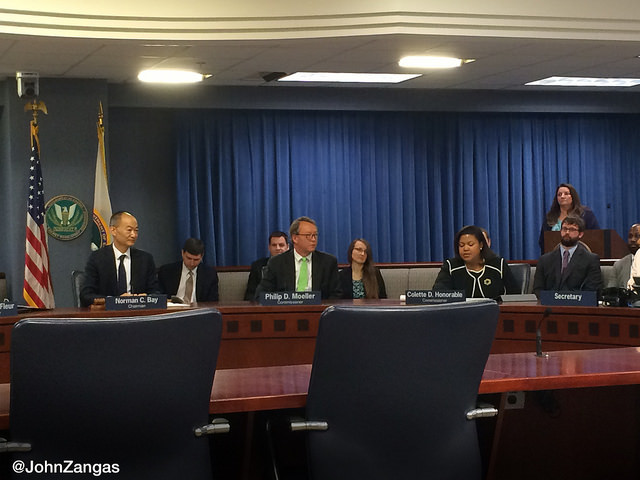
“If someone is upset with fracking, they should probably talk to the states.” —Norman Bay, Chairman of the Federal Energy Regulatory Commission (FERC), May 14, 2015

Why protest? Why demonstrate? Why nonviolent direct action? Part of the reason is to put pressure on those in power to smoke them out, to get them to say things publicly they might otherwise not say, to expose the truth about how and why things are working the way they are.

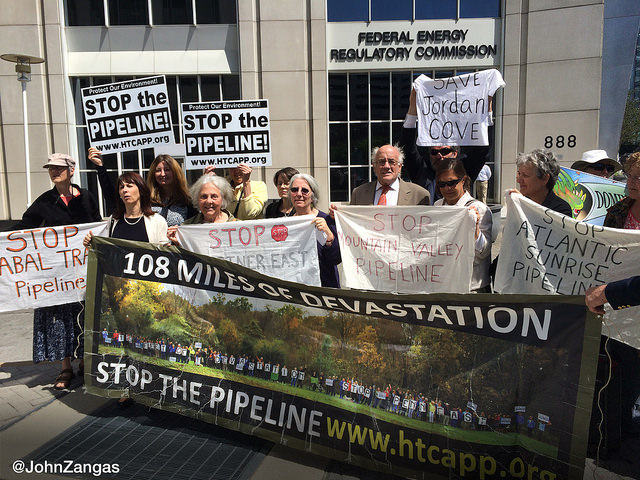
Protesting outside of the Federal on May 14. Photo credit: Beyond Extreme Energy
Concerned citizens protest outside of the Federal Energy Regulatory Commission building in Washington, DC on May 14. Photo credit: Beyond Extreme Energy

a

FERC has more to do with fracking than any other federal agency, and much more than any one state. They approve interstate pipelines to carry fracked gas, compressor stations to push the gas along, storage terminals to store it and, for the last two years, export terminals to ship it around the world. Without this infrastructure, fracking wouldn’t be happening.

Norman Bay is not stupid. He knows this. And yet, because FERC has been a target of nonviolent direct action for more than 10 months, organized by Beyond Extreme Energy (BXE), and because BXE is planning a return to FERC from May 21-29, he has been thrown off, saying and doing things that have not been helpful to resolve “the situation” they are now in.

Bay made this ridiculous statement on the day that FERC had its monthly public meeting. But it was not held on the regular third Thursday of the month that it has been held for years and years. Bay and his fellow FERC Commissioners canceled it because of a disingenuous concern, they said, for “the safety of FERC staff and the public” in the face of BXE’s publicly-announced plans to take nonviolent action at FERC on that day.

To add insult to injury, on May 14, the day that this meeting was rescheduled, dozens of members of the public were kept from the room where the “public” meeting was held, six were detained by Federal Protective Services police and three were arrested.

I was contacted by a reporter after this action, wanting to know why BXE was engaged in this campaign, where it came from. I proceeded to explain to him that it had emerged out of years of experience by lots of grassroots people trying to get a fair hearing from FERC concerning pipelines, compressors and storage and export terminals being proposed for their communities. These are people who played by FERC’s rules, going to the one public meeting attended by FERC staff to learn about the proposed project, becoming an official “intervenor,” presenting well-researched arguments against proposed infrastructure projects, filing large numbers of comments with FERC, appealing a FERC decision within the FERC administrative process and the results were always the same: FERC approval of what the gas industry wanted.

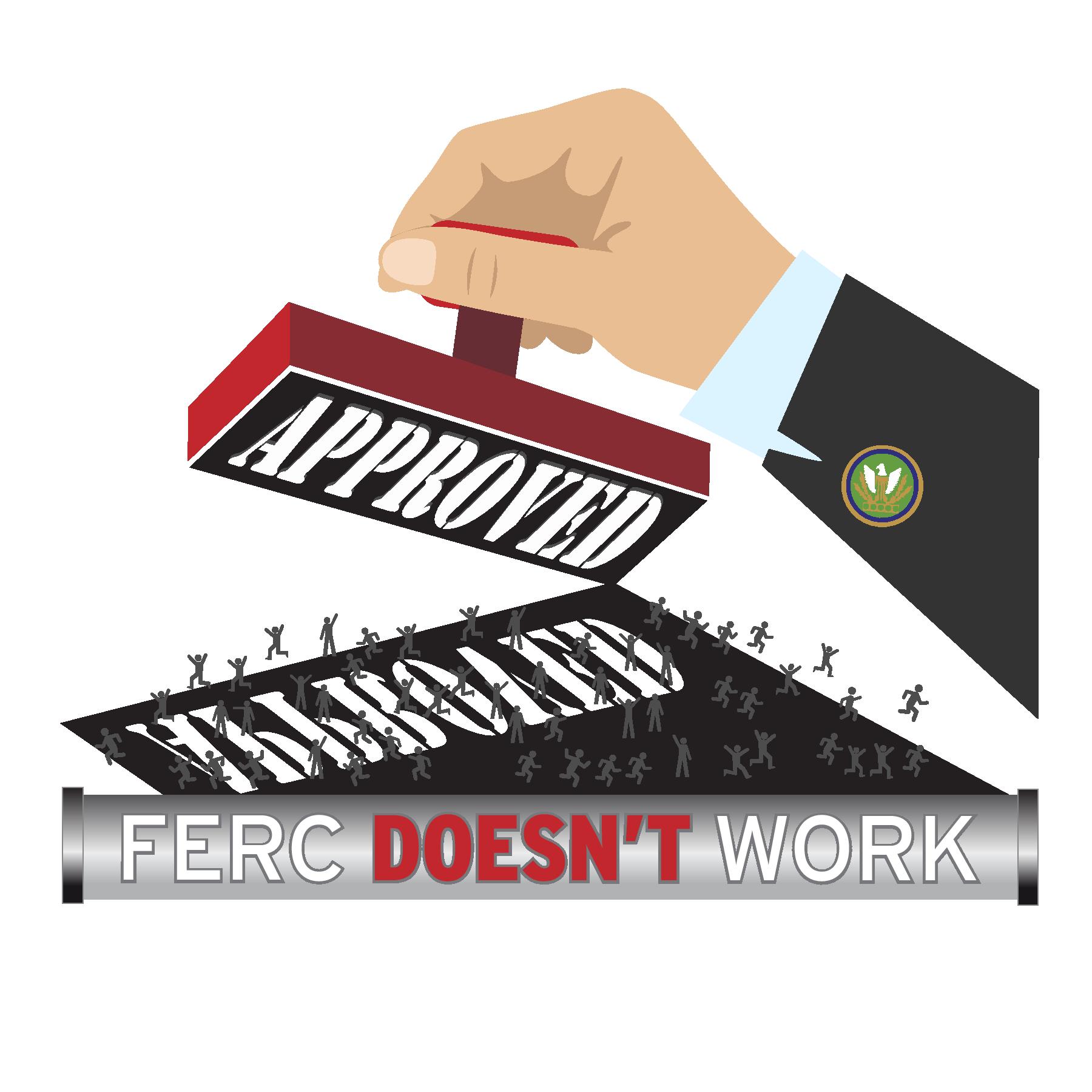
Many of us who had never heard of FERC, now understand that it is a rubber stamp for the fossil fuel industry.

A month ago a story, Employees negotiate for industry jobs under agency’s eye, published by E&E’s Greenwire and written by Hannah Northey and Kevin Bogardus, reported on the corrupt, internal FERC culture which explains FERC’s rubber-stamping ways:

“Employees at the Federal Energy Regulatory Commission have deep ties to the industry they regulate, according to agency documents detailing their job negotiations and stock holdings.

“Ethics records throughout 2014 show agency staff seeking employment with grid operators, law firms and utilities that the agency has jurisdiction over and often meets with as it sets new orders and rules. In addition, FERC employees have held stock in or remain part of pension plans from companies that can be affected by the agency’s work. Greenwire obtained the 88 ethics documents under the Freedom of Information Act.

“The disclosures reflect how FERC, which oversees the interstate transmission of electricity and permitting of gas infrastructure, is regulating an industry that many of its staffers are well-suited for and often courted to work in.”

This corruption, this washing of hands of any responsibility for the massive harms of fracking and its threat to the climate, is why hundreds of people are planning to participate over the course of BXE’s May 21-29 Stop the #FERCus actions. FERC is rattled. It’s time to ratchet up the pressure.

(It’s Time to Stop FERC’s Rubber Stamping of Fracking Infrastructure Projects published 5-18-15 at http://ecowatch.com/2015/05/18/ferc-fracking-infrastructure/)
Dozens Denied Access to FERC Public Meeting

(written by Anne Meador and John Zangas, re-posted from dcmediagroup.us)

Agency refuses to acknowledge widespread outrage at role in burgeoning gas infrastructure

On May 14, the Federal Energy Regulatory Commission in its monthly open Commission meeting took up the issue of the electrical grid’s vulnerability to geomagnetic disturbances. But the government agency’s own vulnerability to public disturbance was front and center.

Federal Protective Services took extraordinary measures to prevent disruption of the Commission meeting by planned protests, barring access to about 30 members of the public. FPS also banned the use of recording devices, brushing aside FERC’s own rule expressly permitting it. Two people were escorted out of the meeting room, three arrested and two more detained.

FERC’s actions occurred after the last several Commission meetings were disrupted by protesters who object to FERC’s no holds barred approval of gas infrastructure projects, such as interstate gas pipelines. May’s meeting was originally scheduled for Thursday, May 21, but it was moved up a week to thwart a protest planned by coalition group Beyond Extreme Energy, which has stepped up the pressure on the formerly obscure agency.

Denied entry to the auditorium, demonstrators took it to the lobby. Their loud chants of “Shut FERC down! Shut FERC down!” were heard in the background.

Banned from Entry

Protesters remain at FERC after being barred from Commission meeting./Photo by BXE

“I feel like FERC is destroying democracy in this process,” said Steve Norris of coalition group We Are Cove Point, who wasn’t allowed to enter. “FERC has denied people’s rights, democratic process in community meetings. They really don’t care what is happening in communities. So we came here because we have no forum other than being disruptive and forcing them to listen,” he said.

Security for the “open” meeting was tight. FPS officers recorded each person’s name and phone number and searched bags thoroughly. Dozens of peoples were not allowed into the meeting room are were instead directed to overflow rooms, even though empty seats remained in the auditorium. Security personnel had singled them out by affixing blue dots to their name tags.

People from several states, including Virginia, North Carolina, Rhode Island, Massachusetts, Connecticut and Pennsylvania, had come to FERC headquarters to voice their concerns. Norris said that about half of those barred had never been there before. He speculated that electronic surveillance of BXE communication may have put those people on a list to be culled from the crowd. “Someone is looking over their shoulders,” he said.

Breaking Its Own Rules

As soon as the meeting was called to order, Patty Cronheim of Hopewell Township, NJ stood up and shouted, then left the room at security’s request. Soon after, Angela Switzer of Delaware Township, NJ was told to leave as well. Both are affected by the Penn East Pipeline.

A statement was read by the Secretary which was clearly intended to address any protesters in the room. It reiterated the gag rule FERC instituted in March,  which forbids “disruptive behavior” and “communications made… by unscheduled presenters.”

Yet one portion of the new rule–which expressly allows members of the public to use audio and visual equipment–was ignored. Apparently with the Commission’s blessing, FPS told audience members to stop recording.

Hear No Evil

FERC Commissioner /Photo by John Zangas

FERC has escalated efforts to maintain order at its meetings. Last month, an abundance of officers from Federal Protective Services (a division of Homeland Security) prowled the room and warned that disruption would result in a permanent ban. Six protesters were ejected.

The agency has insinuated that protesters are dangerous, saying that it needed to reschedule the Commissioners meeting “to better ensure the safety of its staff and the public during the protests planned for May 21 at FERC headquarters.”

All demonstrations up to now, however, have been peaceful, and participants in major protests planned for May 21 – 29 at FERC headquarters have pledged to be nonviolent.

Commissioner Tony Clark took the opportunity to praise natural gas as a crucial energy source. He asked people to “consider an alternate reality” without natural gas. It would be “a very, very scary place,” he said. “Thank goodness” for those states who cultivate their natural resources, he said. “Because of it, we’re in a much better place.”

The Rubberstamp Agency

FERC’s actions have become controversial as a tidal wave of infrastructure to transport gas produced by hydraulic fracking intrudes on property owners and communities. FERC never fails to approve pipelines, earning it the nickname “rubberstamp agency.”

Frustrated by FERC’s intransigent bureacracy, those affected by giant pipelines, compressor stations and LNG terminals, thousands around the country are now circumventing the process.

Since September, hundreds have been arrested blockading the gates of an underground gas storage facility next to Seneca Lake in New York in the belief that a collapse of the salt cavern would poison the drinking water of a 100,000 people.

On May 13, Josh Fox, director of acclaimed documentary Gasland, was arrested at the Crestwood facility. Fox said that FERC acts “like a subsidiary of the fossil fuel industry masquerading as a government agency.”

“FERC has to be overhauled. FERC is a disaster,” he said. “There is no public participation that has any meaning and it is very, very unclear how those decisions are being made.”

FERC recently declined to revisit the approval of Cove Point LNG, an export terminal on the shores of the Chesapeake Bay, which will be a crucial hub for fracked gas from Pennsylvania on its way to India and Japan. The liquefaction of natural gas is highly energy intensive and dangerous, and the site is located in a neighborhood populated by thousands of people. FERC took several months to make a ruling on rehearing the certificate, a delay which critics say was intentional and has helped Dominion Resources get a jump on construction before the faults in the project’s application can be contested in court.

Last November, FERC headquarters was blockaded for an entire work week by demonstrators intent on proving that gas infrastructure projects are negatively impacting their communities. More protests are planned later this month. Beyond Extreme Energy predicts that more than 500 people will participate in the protests.

Josh Fox Arrested At Seneca Lake Protest

1431540325207.cached
photo by Bob Nilsson, http://tinyurl.com/n2452aw

Award-winning documentarian Josh Fox was arrested today in New York in support of We Are Seneca Lake and their fight to stop a dangerous underground fracked gas storage facility.

In a statement, Fox connected the dots between Seneca Lake’s immediate problem—Crestwood Midstream and their harebrained scheme to store liquefied gas in depleted salt caverns adjacent to the lake—and the federal agency which gave Crestwood Midstream a green light to do it.

I’m also here to say the regulatory agency, which is FERC — the Federal Energy Regulatory Commission — which is just 5 people who are appointed by the president — is really acting like a subsidiary of the fossil fuel industry masquerading as a government agency. FERC has to be overhauled. FERC is a disaster. There is no public participation that has any meaning and it is very, very unclear how those decisions are being made.

Amen, Josh!

Taking a stand in support of groups like We Are Seneca Lake is implicitly a condemnation of FERC’s role in authorizing outrageous gas company behavior. Conversely, we are going to confront a root cause of Seneca Lake’s problems by taking action together in DC at FERC May 21-29 during Stop The #FERCus.

FERC is a rogue federal agency acting against the best interests of our country. Help stop them now!

(For more coverage of We Are Seneca Lake and Josh Fox’ arrest today, including the mini-documentary Fox made, check out http://www.thedailybeast.com/articles/2015/05/13/exclusive-anti-fracking-filmmaker-josh-fox-arrested-in-finger-lakes-protest.html?source=TDB&via=FB_Page)

Citizens Express Outrage at FERC by Raising Voices in Song

by Susan Rubin

(Yorktown, NY) May 11, 2015  Residents of Westchester, Rockland and Putnam interrupted a Federal Energy Regulatory DRN_FERCIMAGE2_V2-page-001Commission (FERC) public “scoping session” with a singalong at 6:45 p.m. tonight at the Yorktown Community and Cultural Center at 1974 Commerce Street in Yorktown Heights, NY. Sung to the tune of the Beatles’ Yellow Submarine, the protestors sang about FERC being “a rubber stamp machine.” A spokesperson explained that FERC deliberations are often deficient and incomplete, that public comments are ignored, and that virtually every fossil fuel project presented to the Commission has been approved.

FERC’s mission is to “regulate the interstate transmission of natural gas, oil and electricity,” but their funding comes from the fees they receive from the fossil fuel industry. An April 7 article in Greenwire stated, “employees at the Federal Energy Regulatory CommissionEmployees have deep ties to the industry they regulate, according to agency documents detailing their job negotiations and stock holdings.”http://www.eenews.net/stories/1060016380

The scoping session tonight in Yorktown was for the Atlantic Bridge project, the second of three proposals by Spectra Energy to transport massive quantities of fracked gas through New York, into New England and then on to Canada and beyond.

FERC approved the first of the three Spectra projects, the Algonquin Incremental Market (AIM) Project on March 3, 2015 and participants of the singalong object to FERC’s dismissal of many relevant issues that were raised throughout the public comment period. The most alarming situation is the siting of a new 42 inch diameter pipeline less than 150 feet from vital structures at the Indian Point nuclear power plant.  A pipeline safety expert and a nuclear expert believe that the premise for the approval of the project is based on unverified assumptions that are in direct conflict with sound engineering principals and common sense.  The Nuclear Regulatory Commission (NRC) accepted the plant operator’s estimated three-minute timeframe for the gas valves to be closed, but that timeframe is not substantiated anywhere.

Peaceful protests across the country are increasing as citizens discover that FERC acts as a rubber stamp machine and is clearly more interested in the needs and profits of industry than in the needs of the American people. When all the legal routes are rejected, nonviolent direct action becomes the last option for people to defend their rights. With each passing month of these unjust undemocratic processes, more people are using their voices to express their deep concern for their communities and for their health, safety and their children’s future. FERC’s session tonight was an affront to citizens of the region who feel that the federal government is allowing corporate profit to prevail over public risk.

An Invitation To Student Divestment Groups and Leaders from Beyond Extreme Energy

Dear Student Allies,

These past few months have been outstanding for the divestment movement. Its been very humbling to see the growing success of fossil fuel divestment campaigns all across the country. This unity of students is a force so powerful that it is changing the way major institutions regard their portfolios and demanding that they use their prerogative to take a moral stand against anthropogenic climate change. I commend all of you for your tireless work to divest your schools from fossil fuels.

Just as many universities are being held accountable for their investments in dirty energy, there is another major institution that is being called out for an alarming hypocrisy. The Federal Energy Regulatory Commission (FERC) is an independent agency whose mission is to “regulate the interstate transmission of natural gas, oil and electricity.” However all of their funding comes from the fees they receive from the fossil fuel industry. Thus their bottom-line is to approve every proposed project for fossil fuel infrastructure p despite how severe the resulting health, safety and climate impacts are.

Watch this video to learn more and fill out this form to participate in a week of action to stop business-as-usual at FERC.

Our Mission:

BXE_Silent_EcoWatch Photo by Erik Mc Gregor erikrivas@hotmail.com

Beyond Extreme Energy is a non-profit organization that formed in 2014, which organized a mass blockade of the Federal Energy Regulatory Commission last November 3rd – 7th. They are committed to transforming FERC from a rubber-stamp agency for fossil fuel infrastructure into a leader in an urgently needed transition to renewable energy to eliminate greenhouse gas pollution.

FERC-impacted areas like Minisink, Myersville, Seneca Lake and Cove Point have been defended by frontline communities that have dutifully abided by FERC’s rules to stop construction of harmful natural gas infrastructure projects. Despite posing strong evidence of health, safety and environmental impacts, FERC has been unresponsive to community voices. When all the legal routes are rejected, nonviolent direct action becomes the last option for people to defend their rights. Acts of civil disobedience are springing up all over the country to shut down FERC-approved projects, which is a tactic we are replicating on FERC’s doorstep.

Our Invitation:

Fossil-Free-FERCusv4

We will return to FERC this May 21st – 29th to “Stop the FERCus” because we know that the commissioners of this agency are acting as rubber-stamping clowns for the fossil fuel industry. We will once again engage in nonviolent civil disobedience to shut down the building.

As inheritors of the future world, students have a critical voice in the fight against corporate power and climate change. Thus we are devoting a day of “Stop the FERCus” for student activists. We invite you to join us for Divestment Thursday on May 28th to show FERC that the next generation is demanding that they cease expansion of natural gas infrastructure.

To sign up, please fill out this form and we will be in touch with you soon.

Sincerely,
Kelsey Erickson
Videographer, Beyond Extreme Energy
kke7@cornell.edu
978-618-9816

 Can’t make it to DC but still want to help? Here’s what you can do…

Stay Informed: “LIKE” our facebook page and “FOLLOW” our twitter account

Spread the word: Share this video and tell your friends to join us!

Donate: To support the organizers and housing/transportation needs of participants

 Questions? Contact Jimmy Betts (info@beyondextremeenergy.org) or Lee Stewart (actions@beyondextremeenergy.org)

The Truth About Dominion Resources

Every year around Earth Day, a new crop of corporate greenwashing tends to spring up with the flowers. In the Mid-Atlantic region and Virginia, in particular, one of the biggest culprits is Richmond-based Dominion Power. Hopefully you already know about BXE and We Are Cove Point’s work exposing Dominion through the Beyond Dominion Sentinel. Now there’s a new web resource we hope you’ll check out.

bannerLarge

Dominion is the largest electric utility in Virginia, the state’s #1 emitter of the heat-trapping pollution wrecking our climate, and the #1 corporate donor to state politicians. It’s also a well-documented member of the climate-denying American Legislative Exchange Council. Yet, every year around Earth Day, Dominion funds slick ads, community projects like tree-plantings, outdoor festivals and more to paint itself as a “green” and “sustainable” company.

This year, our friends at the Chesapeake Climate Action Network have launched an interactive new website that sets the record straight: domtruth.org. Click here to start the “tour” and then pass it on!

As you scroll through domtruth.org, you’ll find that Dominion is a poster child of sorts for the type of business model that is both wrecking our planet and corrupting our politics. The company has a monopoly on over 60 percent of Virginia’s electric market — a monopoly ostensibly regulated by the same lawmakers raking in Dominion’s campaign cash. Instead of embracing the future of an electric grid powered by rooftop solar panels on customers’ homes and wind turbines spinning off Virginia’s coast, Dominion is currently investing in a massive build-out of pipelines and power plants to carry and burn fracked natural gas. Dominion uses its political power to set the agenda in Richmond and rig the system against the solutions we need to solve the climate crisis.

Here’s the good news: Domtruth.org comes at a time when the cracks in Dominion’s corporate image are already starting to spread. Just like BP in the Gulf and colleges like Harvard and the University of Mary Washington, this Earth Day Dominion is facing an increasing public backlash over its fossil fuel investments.

You know there’s a serious image problem when sixth graders and senior citizens alike are standing up at county meetings to decry Dominion’s 550-mile pipeline for fracked gas; when riverkeepers are joining with history buffs to challenge Dominion’s massive proposed transmission lines over Jamestown; and when editorial writers across the state are hammering the company’s anti-consumer “power politics.”

You can help pull back the curtain on Dominion’s greenwashing, and build the movement for solutions, by checking out domtruth.org and then passing it on — especially to your friends and family in Virginia!

Stop The FERCus

Stop the FERCus
Stop the FERCus

Videographer Kelsey Erickson has uploaded a video to YouTube you need to see. If you’re lucky enough that your own community isn’t afflicted with fracking’s toxic and dangerous infrastructure—well heads, pipelines, compressor stations, storage facilities, export terminals—then it may be difficult to understand the critical role the Federal Energy Regulatory Commission plays in its construction.

Erickson’s video documents the testimonies of numerous weary, exasperated individuals from multiple communities who wish that they’d never had to become such experts on this rogue federal agency. But watch what happens when they and their allies come together on FERC’s doorstep.

Football With Coach Kafka

Imagine a football game. You’re the home team and you’re playing defense. It’s a tough game and not exactly fair. Why? Because the other team is FREAKING HUGE.

giantfootballplayer-x-wide-communityBut wait, there’s more. Bloodied and bruised, now imagine looking over the line of scrimmage at the opposing team and seeing something that just can’t be right. What are the refs doing in the middle of their huddle?

In the great American game of FERCball, this surreal and grossly unfair situation occurs just as often as the Federal Energy Regulatory Commission (FERC) regularly convenes seminars around the country for the benefit of the industries it regulates. The purpose of the seminars is to help permit applicants successfully navigate the labyrinth of FERC procedures. It’s like the refs helping one side know which plays to call.

But FERC’s bend-over-backwards assistance to industry execs goes even further as Ann Nau of Myersville, MD discovered recently.

As if we don’t already know the disdain with which FERC looks onto impacted communities, they’ve been holding ‘pre-seminars’ in addition to the normal industry seminars.

(Myersville, by the way, has been fighting—and thus far, losing—a battle to keep a dangerous compressor station out of their town and away from their churches, stores, and elementary school.)

It’s easy to understand Ann’s frustration. Look how FERC describes these pre-seminars.

image[1]“Strategize for dealing with difficult behavior”? “Enhance your negotiation skills”? And these trainings are provided free of charge around the country, multiple times per year? It’s sadly obvious whose side these “referees” are on.

It’s also very predictable. Back in the locker room and out of sight of the public, these “referees” regularly exchange their striped jerseys for helmets and pads in order to take the field and actually play for the other team. Read—and be appalled by—an April 7, 2015 E&E report by Hannah Northey and Kevin Bogardus entitled Employees Negotiate For Industry Jobs Under Agency’s Eye.

Writing on the basis of research done under a Freedom Of Information Act request, Northey and Bogardus conclude in part,

Employees at the Federal Energy Regulatory Commission have deep ties to the industry they regulate, according to agency documents detailing their job negotiations and stock holdings…

Ethics records throughout 2014 show agency staff seeking employment with grid operators, law firms and utilities that the agency has jurisdiction over and often meets with as it sets new orders and rules.

The authors uncovered at least forty instances last year in which FERC employees entered job negotiations with the industries they regulate. What makes FERC’s employees so valuable? According to former FERC staffer Travis Fisher,

“It’s a certain level of expertise, the sweet spot is somewhere in that four-to-five-year mark,” he said. Fisher said he, like his former colleagues, gained a keen understanding of which draft orders would compel commissioners and what language would have to be scrapped or rewritten — valuable insight for utilities seeking to comply with the FERC regulation.

“Your job at FERC was to read those pleadings, from the utility side you’re writing those pleadings,” Fisher said. “Someone fresh out of FERC is extra valuable because of their knowledge of the politics of the organization.”

Of course, many FERC commissioners and upper level staff only put on referee jerseys after changing out of their industry uniforms and helmets in the first place. It probably goes without saying that no one thus far has written an extensively researched article about the revolving door between FERC and, say, the climate justice movement or the front line communities trying to protect their ground water, their children, and their lives.

So let’s sum up.

700-1

It’s not supposed to be this way. It’s time to change the game.

Communities Demand An Accountable Government

customLogo

The Fight Against FERC: 
Communities Demand An Accountable Government

by Angela Vogel

FERC (Federal Energy Regulatory Commission) regulates the interstate transmission of electricity, gas, and oil. FERC also reviews proposals to build liquefied natural gas (LNG) terminals and interstate natural gas pipelines as well as licensing hydropower projects. Since 1935 when it first became an independent regulatory agency it has done little to protect citizens from exploitation. Instead, the agency uses its vast powers to facilitate the expansion of dirty and deadly extraction for export to international markets. FERC ensures that toxic energy projects create greater profits for rich developers while leaving poisoned communities with the lie of so-called U.S. energy independence through fossil fuels.

Beyond Extreme Energy (BXE), a frontline and activist network that came together in 2014 to begin fighting FERC’s facilitation of dirty energy projects, has put constant “unprecedented” pressure on this industry-funded agency leading FERC Chair Cheryl LaFleur to say, “We have a situation here.” BXE believes that direct action plays a crucial role in supporting frontline communities to take their battles to FERC’s doorstep and face them in person and in bringing attention to the life and death situation these communities have been fighting for years.

“Here in rural Pennsylvania, there are many families who are facing a horrible fate. FERC would like to approve massive natural gas pipelines that will destroy countless generations-old family farms and homes.  For many of these families the option to move elsewhere does not exist due to financial burdens or long-time connections to the land and community,” says Deirdre Lally, a volunteer with Shalefield Organizing Committee.

“Our numbers are small but powerful,” says Maria Kretschmann of anti-fracking group E.D.G.E. (Ending Dirty Gas Exploitation) whose family-owned organic farm is threatened by expanding fracking infrastructure. “Communities must join together because we have enemies with fat pockets, dozens of lawyers on hand and no moral compass. We fight not just for ourselves and our friends but for those who cannot defend themselves or come to D.C.”

BXE is partnering with community-focused groups to echo the frontline fights in D.C. and to present a fully-rounded strategy against the industry-funded, rubber stamping behemoth FERC.  This battle must continue escalating to reflect the severe implications of what is at stake, and what is, quite literally, coming down the pipe.  The coalition has outlined a nine-point short-term plan for reforming FERC that is posted to their website (http://tinyurl.com/masznzn). However, long-term goals may look a little different. According to Faith Meckley of the frontline group We Are Seneca Lake, “The system is no longer made for the people but for the benefit of the companies. We need to make it really clear that we can no longer be ignored, and it’s time for a new system to be built.”

While it is of the utmost importance that frontline communities, separated by both geography and often culture, come together with support from the broader environmental movement, it’s equally important that the issue of global warming and impending climate chaos not get lost. Since Cornell first released findings in 2011 that high quantities of methane released from fracking makes it more dangerous than coal, the scientific community has found more and more evidence to back this up leaving many to wonder how the industry ever sold us the snake-oil promise of a ‘natural’ bridge-fuel and how we will reach the carbon emission goals necessary for ongoing life on the planet if fracked gas extraction continues to expand with the help of agencies like FERC.

“We are all downstream and downwind,” says Lally, “and we must continue to support each other in this struggle, because eventually we will win, but only if we do it together.”

Join BXE for a week of actions actions at FERC

May 21-29!

https://beyondextremeenergy.org/sign-up-for-mass-action-at-ferc-in-may/

Contact info@beyondextremeenergy.org

for details on housing, workshops, & more!


FERC Is A Rubber Stamp Machine

blue-meanie

Anyone remember the Blue Meanies from the Beatles’ Yellow Submarine movie?

Trust me–they were very mean. And although the film neglected to mention it, I wouldn’t be surprised to learn that in addition to hating music, they rubber stamped fracking infrastructure projects whenever they had the opportunity.

a

a

a

New lyrics by NYC’s Occupy The Pipeline. Inspired editing by Bill Huston. And let’s not forget a shout out to John, Paul, George, and Ringo!