More Than 80 Health Professionals Demand Federal Energy Regulatory Commission Stop Unethical Experiment

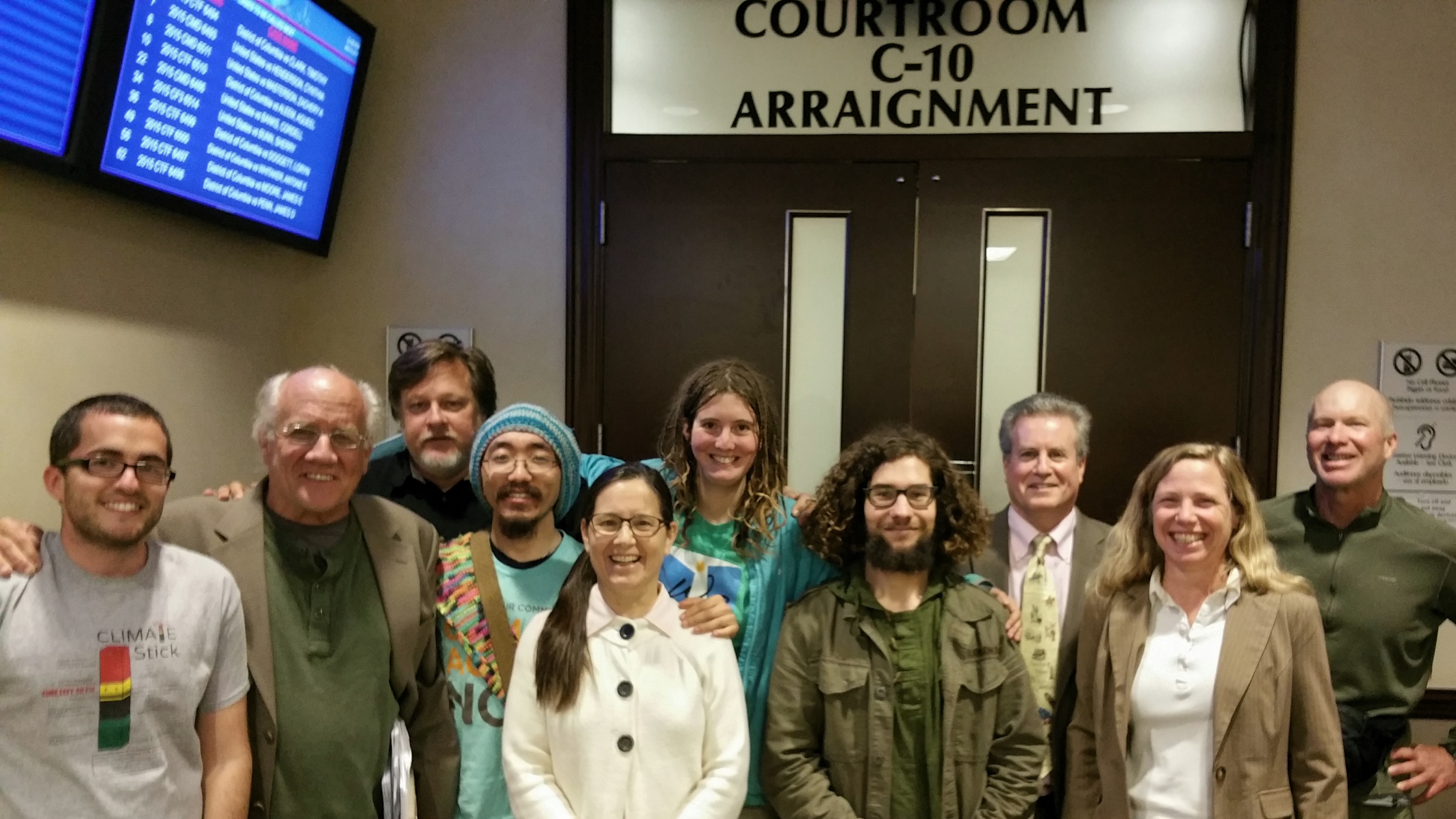
BLOCKADIA - THE BEYOND EXTREME ENERGY ACTION in Washngton DC

Washington, DC – In an open letter to the Federal Energy Regulatory Commission (FERC), more than eighty health professionals urge the FERC to stop permitting oil and gas infrastructure and to move to clean sustainable sources of energy to protect the health of people and the planet. The construction of oil and gas projects such as unconventional fracking, pipelines, compressor stations and export terminals which pollute with cancer and disease-causing chemicals is akin to an uncontrolled health experiment that is destroying communities and risking lives of residents. These projects also harm the workers who build and maintain them. For the health of all who are involved, health professionals demand that this unethical ‘experiment’ stop.

Most people are unaware of the existence of the FERC, which according to its website is “an independent agency that regulates the interstate transmission of electricity, natural gas, and oil. FERC also reviews proposals to build liquefied natural gas (LNG) terminals and interstate natural gas pipelines as well as licensing hydropower projects.” The FERC is independent of taxpayer dollars, but is dependant on the oil and gas industries for its funding, the very industries the FERC is supposed to regulate.

As a result of this fundamental conflict of interest, the FERC is a rubber stamp agency for new permits regardless of the danger they pose to the health and safety of communities and the future livability of the planet. A case in point is the new Liquefied Natural Gas (“natural” is an industry marketing term, the gas is more accurately called “fracked gas”) refinery and export plant being built in Southern Maryland by Dominion Resources. This huge plant will store 14.6 billion cubic feet of liquefied gas for export by tankers to Japan and India.

Dominion is building its plant in the community of Lusby, Maryland. When Dominion submitted its application to the FERC, it left out 90% of the surrounding population. There are more than 2,400 homes, 19 day care centers and 2 elementary schools within the 2.2 mile evacuation zone around the plant. This is the first time that a plant has been built in such a densely-populated area anywhere in the world. When the permit was appealed to inform FERC of the risks to the more than 8,000 people living close to the plant, some living directly across the street, the FERC refused to review the permit. Visit www.WeAreCovePoint.org to learn more.

A coalition of people and groups called Beyond Extreme Energy has been focused on the FERC for the past year to call attention to its reckless behavior but the FERC has only responded with disregard for the people’s concerns and by taking extra steps to exclude the people’s voices. For example, people from communities that are being destroyed by FERC-approved projects must sit in an overflow room during the FERC’s monthly public meeting to prevent them from speaking out at the meeting.

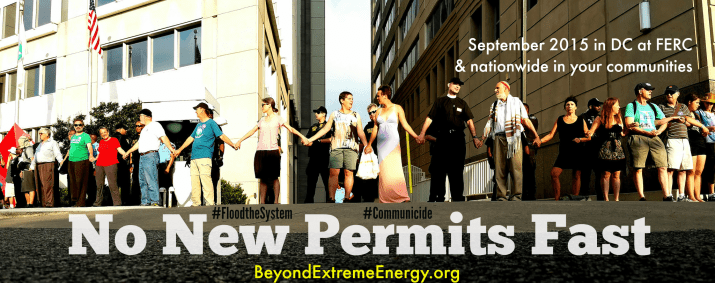
Members of Beyond Extreme Energy have tried to work within FERC’s tightly-controlled system without success. They used protest to call attention to the direct impact FERC-approved projects are having on their livelihoods and communities, but the FERC continues to close its eyes and ears to them. Now BXE members are taking a bigger step and will be fasting on FERC’s doorstep for three weeks beginning September 8 to demand no new permits.

Starting with this letter from health professionals, there will be a series of letters laying out the case for an end to oil and gas infrastructure and a rapid transition to clean sustainable sources. These will be posted on the Beyond Extreme Energy website. Join the action to stop the FERC from locking us into a dirty energy future and instead make the FERC responsible to the people and for the transition to the carbon-free and nuclear-free future that is so desperately needed.

OPEN LETTER: Health Professionals Call for Moratorium on Fossil Fuel Infrastructure to Protect Public Health

We, the undersigned health professionals, strongly urge the Federal Energy Regulatory Commission (FERC) to immediately stop issuing permits for any new fossil fuel infrastructure. Based on scientific evidence of the health and public safety risks associated with fossil fuel infrastructure such as oil and gas drilling, refineries, pipelines and compressor stations and of their contribution to the further escalation of climate change and its associated risks to public health and safety, there must be a moratorium on new permits and a hold on construction for projects that have not been completed until a plan is made to move completely to energy sources that do not cause harm. The evidence is clear that the US can transition to 100% wind, water and solar energy by 2050 [1] and, in fact, that the US can be carbon-free and nuclear-free by 2050 or sooner [2].

Although the FERC is not directly involved in permits for oil and gas drilling, the pipelines and associated infrastructure under FERC’s jurisdiction do create the conditions that make more drilling and extraction of fossil fuels possible. It is becoming overwhelmingly clear that the process of extraction, refining, transport and burning of fossil fuels for energy is harmful to people and the planet at all stages. FERC must understand its role in the bigger picture of a national energy policy which is hurting communities and worsening the climate crisis.

As fossil fuel reserves decline, more extreme measures are being taken to extract them. In recent decades there has been a boom in unconventional fracking for oil and gas. Fracking pads and associated infrastructure are being placed close to homes, daycare centers and schools without consideration of the health impacts, particularly on children who are more vulnerable to toxic effects and are more likely to live long enough to experience long term effects of some of the chemicals used such as those that are carcinogenic.

Public health studies reveal that of the hundreds of chemicals used in the fracking process, 25% can cause cancer or mutations, 37% are endocrine-disrupters, 40 to 50% can affect the nervous, immune, cardiovascular and renal systems and more than 75% irritate the skin and eyes and cause respiratory and gastrointestinal symptoms [3]. Additionally, the process of fracking brings heavy metals and radioactive elements buried deep in the ground to the surface where they contaminate air, soil and water.

Humans and animals are being adversely impacted by fracking and associated infrastructure from normal day-to-day operations as well as from industrial accidents and illegal activities. There are reports of fracking well failures that leak, explosions, failures of wastewater storage ponds and direct dumping of wastewater on roads and into waterways, pipeline leaks and compressor station malfunctions [4]. There are also frequent violations of regulations by oil and gas companies [5].

Researchers Michelle Bamberger and Robert Oswald write, “Without rigorous scientific studies, the gas drilling boom sweeping the world will remain an uncontrolled health experiment on an enormous scale.”

And in fact, as more health studies are published, it is becoming abundantly clear that there are significant adverse health impacts on humans and animals from extraction, processing and transportation of fossil fuels. It is time to stop this unethical experiment and end the fossil fuel era.

The climate crisis is another critical reason to stop permitting fossil fuel infrastructure. A recent study by Steven J. Davis and Robert H. Socolow looks at the carbon commitment of fossil fuel plants [6]. Based on their data, if we continue to build new fossil fuel power plants globally at the current rate, we will reach the limits of the carbon budget allotted by the International Panel on Climate Change (IPCC) to maintain warming below 2°C by 2018 [7].

Methane gas is being promoted as a ‘bridge fuel,’ but in reality the methane leakage from its production, transmission and use offsets any gains that methane has in emitting less carbon dioxide than coal when it is burned [8]. Methane is a more potent Greenhouse Gas than carbon dioxide over the short term by a factor of 80 to 100 [9].

The adverse health impacts of the climate crisis are already being felt. The World Health Organization estimates that 150,000 [10] people die prematurely each year because of factors directly related to the climate crisis, and this is expected to increase over time [11]. Extreme heat, weather-related disasters, infectious diseases, lack of access to clean water and crop failure due to the climate crisis cause increased suffering and death. A review of current science shows that fetuses and children, our future generations, are at greatest risk for adverse health impacts from fossil fuel and climate change [12]. In addition to mitigating the climate crisis, ending reliance on fossil fuels and replacing them with clean sources of energy would save additional lives by reducing pollution.

For these reasons, we urge FERC to immediately cease granting new permits for fossil fuel infrastructure and to halt construction of projects that are not completed. FERC needs to define the public interest not by what makes the energy market more profitable but by what creates a reliable energy supply without hurting communities and threatening a livable future. FERC can be a leader in transitioning to the necessary sustainable energy economy. We urge you to act now.

Signed,

Margaret Flowers, M.D., Baltimore, MD

Joseph A. Adams, M.D.,  Baltimore, MD

Kris Alman, Portland, OR

Gina Angiola, MD, Olney, MD

Nancy Ball, DVM, Lusby, MD

Michelle Bamberger, MS, DVM, Ithaca, NY

Barbara L Blake, RN, Los Angeles, CA

Kelly Branigan, RN, Cooperstown, NY

Michael Branigan, CRNA, MS, Cooperstown, NY

Mark Braun, MD, FACP, Cape Elizabeth, ME

Richard Bruno, MD, MPH, Baltimore, MD

Daniel C. Bryant, MD, Cape Elizabeth, ME

Sheila Bushkin-Bedient, MD, MPH, Waterford, NY

Claudia Chaufan, MD, PhD, San Francisco, CA

William D. Clark, MD, Woolwich, ME

Andrew D. Coates, MD, FACP, Albany, NY

Maureen Cruise RN, Pacific Palisades, CA

Mary L. De Luca, MD, Albuquerque, NM

Jane Diefenbach, M.S., Washington, DC

Martin Donohoe, MD, FACP, Portland, OR

Gwen DuBois MD, MPH Baltimore, MD

Robert Dubrow, MD, PhD, Hamden, CT

Larysa Dyrszka, MD, Bethel, NY

Tracey Eno, LMT, Lusby, MD

Frank A. Erickson, MD, Pendleton, OR

Steven Fenichel. MD, Ocean City, New Jersey

Richard Fireman, MD, Mars Hill, NC

James S. Goodman, MD, Albuquerque, NM

Jeoffrey Gordon, MD, MPH, San Diego, CA

Kendall Hale, MA, LMT, Fairview, NC

Lea Harper, Managing Director, Freshwater Accountability Project, Grand Rapids, Ohio

Paul Hochfeld, MD, Corvallis, OR

Bill Honigman, MD, Laguna Hills, CA

Julie Huntsman, DVM, Fly Creek, NY

Dana C. Iorio, ARNP, Seattle, WA

Norton Kalishman MD, Albuquerque, NM

Jeff Kaplan, MD, Baltimore, MD

Stephen B. Kemble, MD, Honolulu, HI

Phyllis S. Kimmelman, DVM, Cherry Hill, NJ

Naomi Kistin, MD, Albuquerque, NM

Robert Klotz, Jr., P.A., South Portland, ME

Miriam Komaromy, MD, FACP, Albuquerque, NM

Larry Learner MD, Nashua NH

Eric Lerner, Climate Director, Health Care Without Harm, Reston, VA

Bruce Levine, PhD, Cincinnati, Ohio

Eric London MD, Bethel, NY

Elizabeth T. Matthews, MD, Albuquerque, NM

David McLanahan, MD, Seattle, WA

Mary Menapace RN, Skaneateles NY

Art Milholland, MD, Silver Spring, MD

Eileen S Natuzzi, MD, MPH. Encinitas, CA

Eric Naumberg, MD, MPH, Columbia, MD

Curtis L Nordgaard, MD MSc, Boston MA

Cindy L. Parker MD, MPH, Baltimore, MD

George Pauk, MD, Phoenix, AZ

Jane Pauk, BSN, Phoenix, AZ

Julie Keller Pease, MD, Brunswick, ME

Sandra F. Penn, MD, FAAFP, Albuquerque, NM

Janis Bacon Petzel, MD, Islesboro, ME

Sally M. Pinkstaff, Baltimore, MD

Edward Pontius MD, DFAPA, Portland, ME

Bertram Rechtschaffer, DDS, Garrison, NY

King Reilly, MD, Los Angeles, CA

LeeAnn Rhodes, MD, Washington, DC

Max Romano, MD, MPH, Baltimore, MD

Henry Rose, MD, Dalton, MA

Katherine M Shea MD, MPH, Chapel Hill, NC

Michael A Siegel MD, Portland OR

Stacey Smith, MDiv, Hypnotherapist,Tully, NY

Gary Stoller, DDS, Great Barrington, MA

Paul Song, MD, Santa Monica, CA

Jim Squire, MD, Seattle, WA

Jill Stein, MD, Lexington, MA

Keldwyn Teves Asheville, NC

Bruce Trigg, MD, Albuquerque, NM

Walter Tsou, MD, MPH, Philadelphia, PA

Sandra Turner, MD, New York City, NY

Deborah Wagner, RN, Brookeville, MD

Kathleen L. Webster Readfield, ME

Neil Weinberg, L. Ac, Dipl. O. M., Ithaca, NY

Richard Weiskopf MD, Syracuse, NY

Gerri Wiley, PHN, Owego, NY

Charles I. Wohl, MD, FACP, Pittsfield, MA

Endnotes:

  1. http://news.stanford.edu/news/2014/february/fifty-states-renewables-022414.html
  2. http://ieer.org/resource/reports/carbon-free-and-nuclear-free/
  3. http://cce.cornell.edu/EnergyClimateChange/NaturalGasDev/Documents/PDFs/fracking%20chemicals%20from%20a%20public%20health%20perspective.pdf
  4. http://psehealthyenergy.org/data/Bamberger_Oswald_NS22_in_press.pdf
  5. http://www.indyweek.com/pdf/051111/pennsylvaniashalereport.pdf
  6. http://iopscience.iop.org/1748-9326/9/8/084018/
  7. http://motherboard.vice.com/en_ca/read/the-carbon-age-needs-to-end-in-2018
  8. http://www.usclimatenetwork.org/resource-database/report-coal-to-gas-the-influence-of-methane-leakage
  9. http://www.eeb.cornell.edu/howarth/publications/Howarth_2014_ESE_methane_emissions.pdf
  10. http://www.who.int/heli/risks/climate/climatechange/en/
  11. http://www.who.int/mediacentre/factsheets/fs266/en/
  12. http://ehp.niehs.nih.gov/11173/

Judge Faults FERC, Acquits Beyond Extreme Energy Activist

2015-05-15 16.10.50

A member of Beyond Extreme Energy (BXE) who was arrested inside the Federal Energy Regulatory Commission building in May and charged with illegal entry was declared not guilty last week (Aug. 20) in a bench trial before Judge John F. McCabe Jr. in D.C. Superior Court.

In acquitting Laura Gubisch, a resident of the District, Judge McCabe chastised the government for how it handled the situation of people wanting to access the main room where commissioners meet, which in the past has been the site of verbal disruptions by members of BXE opposed to FERC’s approval of virtually every gas infrastructure project that comes before it, including interstate pipelines, compressor stations and LNG facilities.

As people filed through security, security personnel put blue dots on the identity cards of those FERC believed would be disruptive – peremptorily excluding many individuals who had never been inside the building before.

The higher than normal turnout of visitors was due to the fact that FERC moved up by a week its standard monthly commissioners’ meeting with the express purpose of preventing BXE members from attending its meeting. BXE put out an emergency call to get people – who come from the District, Virginia, Maryland, and throughout the northeast corridor — to attend.
The judge said the government could have handled the situation better, and that people should be given an opportunity to observe without disruption. If they are disruptive security could ask them to leave. But there was no evidence that Gubisch had gone to a place where she was told she couldn’t go, or that she refused to leave.

After the judge’s ruling, her attorney, Mark Goldstone, said, “All citizens should be given an opportunity under the First Amendment to observe their government at a public hearing.  They should not be preemptively deemed to be disruptive and shunted off to an overflow room to watch a public hearing on a TV screen. Laura Gubisch and other climate change activists were able to illustrate the anti-democratic response by FERC, which supports their charge that that agency is a captive of the oil and gas industry and is tone deaf in considering the views of citizens deeply concerned by the hazards of hydraulic fracking on the air and water in communities across the United States.”

Gubisch released the following statement: “The urgency of the terrible devastation created by our human actions require every citizen to take corresponding actions of integrity; everyone must step outside their comfort zone to salvage Mother Earth. The problem is not just FERC but a raft of undemocratic and destructive practices like fracking, eminent domain, government overreach to quell dissent, illegal surveillance and abuse – all are unnecessary and can be ended now. The good news is that we have clean ways to operate in this world, abundant sources of energy are all around us and each person has the capacity and responsibility to turn in this direction.”

Gubisch said she plans to file a civil suit against FERC.

Students Construct Banner For Upcoming BXE Action

301_9396
from left: Madison Early College students Evan Cannon, Patrick Alvey, Travis Davis, Anna Hamlin, Tucker McKinney, and Will Thomas (not pictured)

The Fast For No New Permits begins September 8th in Washington DC and communities around the nation. The Federal Energy Regulatory Commission (FERC) is the target of the Fast. FERC is the federal agency charged with oversight and permitting of energy infrastructure such as pipelines for fracked gas, compressor stations, and liquefied gas export terminals. In conjunction with Pope Francis’ climate-focused visit to the United States and the United Nations, fasters will demand that FERC stop issuing permits for costly, dirty, and outdated fossil fuel infrastructure in favor of cleaner, climate-friendly options like wind and solar.

Six sophomores from Madison Early College High School in Mars Hill, NC devoted part of a recent Saturday to making a banner for those fasting in DC to use at the FERC building each day in talking to FERC employees. The students were surprised and impressed to learn that many of the fasters have committed themselves to eighteen days of water-only fasting in order to underscore their message that fossil fuels must now be left in the ground if the world’s nations are to meet crucial—and non-negotiable—climate goals.

The students aren’t rookies, however, when it comes to taking action on climate. Last spring they assisted the We Are Cove Point campaign by constructing two twenty feet banners to help marchers in the residential community of Cove Point, MD try to stop Dominion Cove Point’s construction of a LNG export terminal there.

And they’re not finished yet. The students say when the next opportunity presents itself, they’ll again be ready to put their artistic skill to use in the fight for climate justice and their futures.

For more information about how you can also join the Fast For No New Permits either in Washington DC or in your local community, click here or inquire at actions@beyondextremeenergy.org.

Support the movement to #StopSpectra!

1507615_205546302976696_1618522776_nTogether we can #StopSpectra and the expansion of fracked-gas infrastructure in the Northeast.

a

a

a

FANG (Fighting Against Natural Gas) is a collective of folks who are fighting the fracked-gas industry at multiple points of destruction while also supporting other movements for justice. You can read about and support the good work they’re doing to stop the Spectra pipeline on their Indiegogo page:  https://www.indiegogo.com/projects/support-the-movement-to-stopspectra#/story

Activists arrested in Burrillville, RI for protesting gas expansion project

LockdownInBuvill

From RI Future.org, August 13th and 14th, 2015. Articles, photo, and video by Bob Plain and Steve Ahlquist.

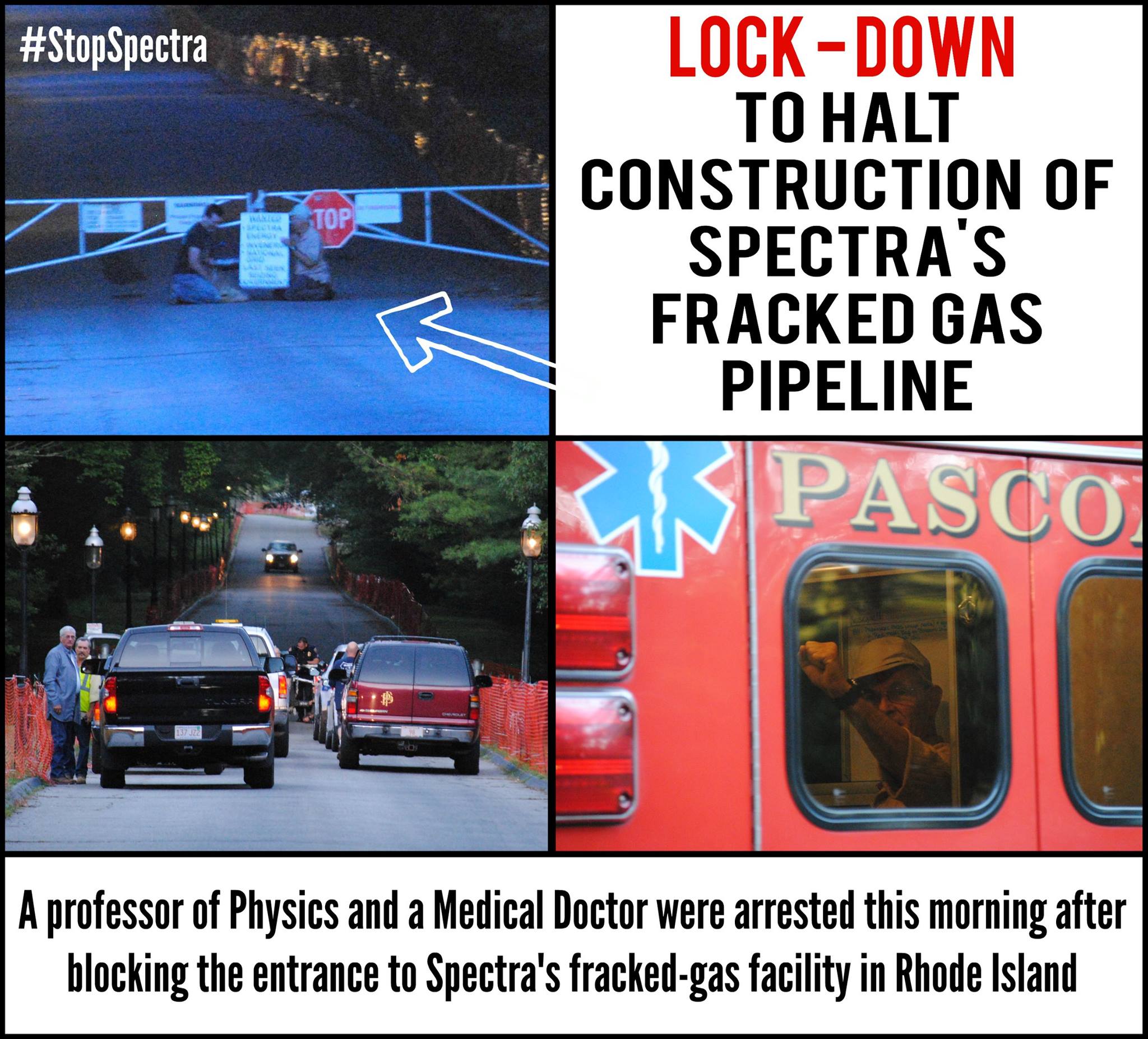
Police arrested two environmental activists arrested this morning who were protesting a methane gas pipeline project in Burrillville, Rhode Island, by chaining themselves to a gate at the project site.

“I’m taking action today because as a parent and being a pediatrician compels me to use any and all nonviolent means to stop this project,” said Nordgaard in a prepared statement.

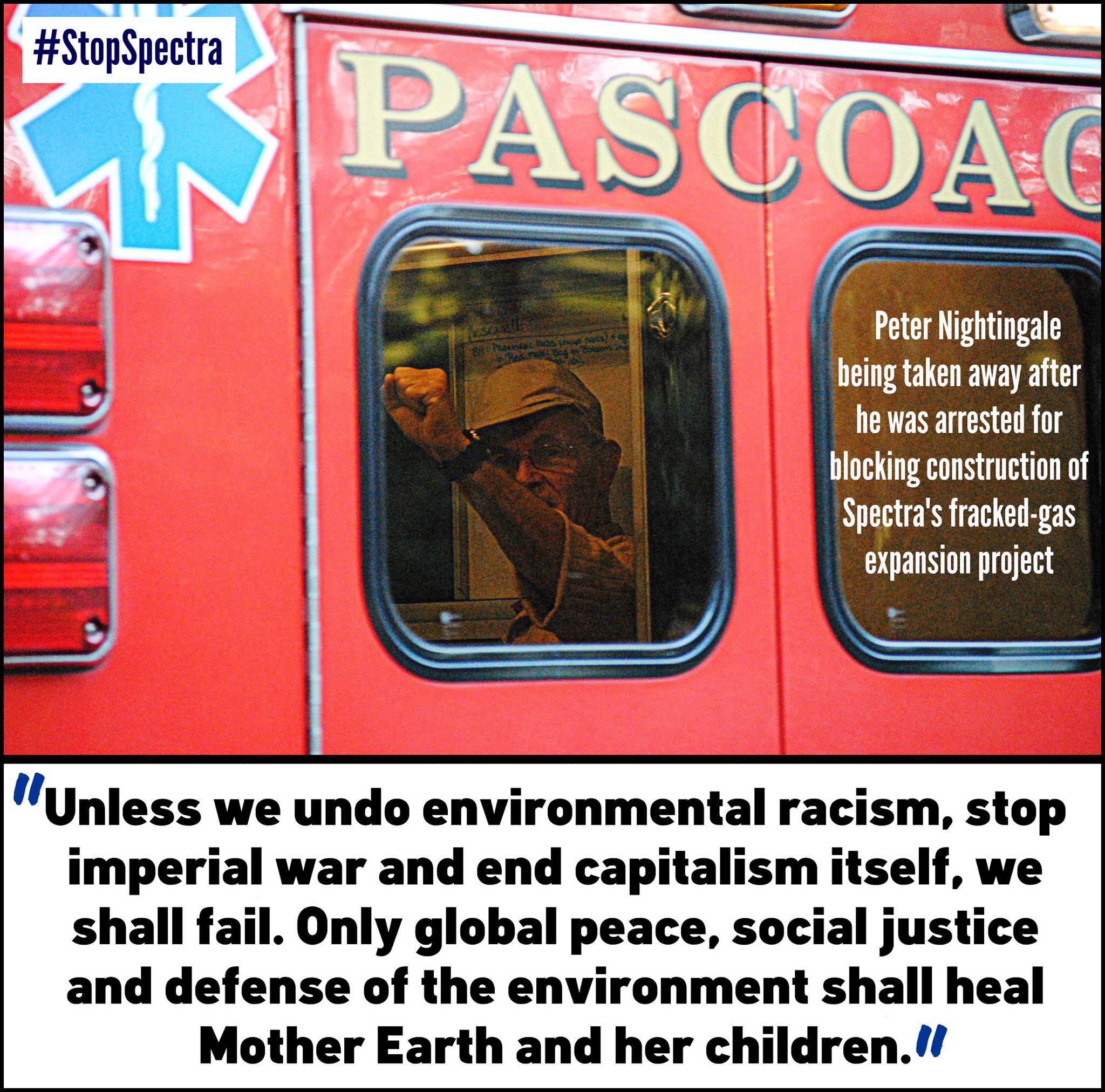
Click here or here to read more about the actions of University of Rhode Island physics professor Peter Nightingale and Massachusetts pediatrician Curt Nordgaard.

PeterHauledOff

Thanks, Peter and Curt, for helping us all move beyond extreme energy!

Lyn Shaw Speaks Out About Northeast Energy Direct

Comments provided by Carolyn Shaw of Middletown, CT 2014-06-30 cindy lyn 0138at a scoping meeting of the Federal Energy Regulatory Commission. The hearing, held at Central Connecticut State University in New Britain, CT was on Thursday, July 29, 2015. Subject of the hearing: the proposed expansion of the shale gas pipeline, Northeast Energy Direct, a project of Tennessee Gas and Kinder Morgan Energy.

Good evening. My name is Carolyn Shaw. I’ve lived in Middletown for close to 50 years.

As a woman of the Christian faith, I have been considering the moral implications of this scoping hearing and the Northeast Energy Direct project. I myself am directed less by facts and figures, troubling though they may be, than by the stirrings of my heart.

Like me, you may have heard the following verse from Psalm 8 in the Christian Bible many times: “When I consider thy heavens, the work of thy fingers, the moon and the stars…what is man that thou art mindful of him?”

Tonight I wonder… Aren’t we all infinitesimal parts of the great Universe mentioned by the psalmist? By virtue of the complex brains of our species, don’t we have the responsibility to be deliberate in all things? (As we raise our children and grandchildren? In the communities we choose to inhabit over the course of our lives? At our places of work and in our careers? On behalf of the Earth and of those humble species that cannot speak for themselves?)

With regard to this hearing and project I also wonder… To what extent, if any, should decisions made by individuals at the Federal Energy Regulatory Commission be exempted from the rigorous ethical parameters other people try to follow in their lives? And if they are to any extent exempted can and should that be changed?

For many months people and organizations have been reaching out to FERC attempting to comply in good faith with its processes, dutifully filing required documents and attending scoping hearings such as this one. No actions have lessened the number of permits granted or ensuing damage to the Earth. The necessity for increased moral reflection by FERC as it makes permitting decisions has become clear to me. I suggest that there be both Environmental and Ethical Impact Statements: the existence of these two types of EIS will encourage more balanced decision making. Decisions to approve permits will be made in a more balanced way. Two sides of the equation will be taken into account: the need to protect the Creation for which all humans are stewards and the need to exhibit the noblest of ethical behavior .

As FERC’s process stands now- in a system without balance- FERC is the Generator- Beginner of projects which, once given an official blessing in Washington, can be moved along to the states. When a project has been blessed by the five commissioners, all actors at FERC- from the Commissioners appointed by Congress to legal staff and support personnel- emphasize and give priority to the plans of and profits from requesting energy companies. The wishes of hundreds of people who have raised their voices in dissent again and again, people whose health and livelihoods have been enormously impacted, are given only slight consideration by offering token scoping hearings.

Two weeks ago I watched the videotape of a homeowner’s impassioned plea before a meeting such as this one in Massachusetts. She and her husband own a house on 22 acres of a beautiful state forest. As birders, they have counted over 50 species on their property. The home has been their lifelong dream. Spectra Energy’s plan to site a compressor station 1500 feet from their property line, permitted by FERC, has suddenly put them into an untenable position: no one will buy their house once the land has been ruined; even if a buyer could be found, no mortgage company would grant a loan on their compromised property. After years in their home she and her husband will have to leave it. At the end of her testimony she fell to her knees and begged. Were not ethical choices made here, choices with human consequences?

I will guess that by now you know my bias has emerged. I like to think that I take the side of the God who created us all and expects much from us in return.

From poet and writer Wendell Berry, two stanzas of his poem, “Questionnaire”:

How much poison are you willing to eat for the success of the free market and global trade? Please name your preferred poisons.

In the name of patriotism and the flag, how much of our beloved land are you willing to desecrate? List in the following spaces the mountains, rivers, towns, farms you would most readily do without.

Final thoughts: As adults we make hundreds of choices, weighing possibilities. Despite the politics, despite the lobbying from oil and gas companies, despite peer pressure from those around you, my hope is that each person leading this scoping meeting will choose to be the greatest possible version of him or herself. Listen to your mandate as an ethical human being. Whether you work on First Street in Washington or represent the agency in other parts of the country let the moral dimensions of your choices rise to the surface of your minds like bubbles as you live out your days.

Again from Psalm 8: “For thou hast made him a little lower than the angels and hast crowned him with glory and honor. “

Thank you.

Why I Will Be Fasting For No New Permits (And How You Can, Too)

Click the banner for details.

a

by Greg Yost

301_9380-1a a a

Caring about kids means acting now to address climate change.

a

a

a

I’m a high school math teacher in North Carolina. I love my job and my students and so I don’t mind putting in a lot of hours preparing lessons, grading quizzes, and doing all the things teachers do.

But to do my job well, I know that I have to do more than just teach algebra. If I leave behind a planet decimated by catastrophic climate disruption, sea level rise, and ecological collapse, then I will have failed my students no matter how much math I taught or how nurturing I was. Caring about kids means acting now to address climate change. Waiting, distraction, timidity, and avoidance behaviors are not options.a

Let’s be honest. Right now we’re addicted to fossil fuels. But earth’s climate system won’t cut us slack just because we’ve been foolish enough to paint ourselves into this corner. We can’t make physics adhere to our preferred schedule for weaning ourselves off of energy sources that produce greenhouse gases and sicken local communities. Rather, we have to understand and conform to the timetable demands of physics. We have to use cleaner sources of energy now. We have to leave fossil fuels in the ground where they belong.

You might think that such a daunting challenge would leave me feeling overwhelmed and discouraged. After all, the problems are so big and I am so small. But you’d be wrong! As important as it is to know about climate change, it’s just as important to know about social change: how ordinary people like you and me make it happen and how hard work can sometimes bring about the impossible seemingly in the blink of an eye.

FERC: NO NEW PERMITS!

15536092150_d2641b9cbf_b Here’s what I’m working on now. In Washington there’s a very powerful agency on First Street called the Federal Energy Regulatory Commission (FERC). FERC has been granted broad powers by Congress to regulate the interstate transmission of electricity, natural gas, and oil. FERC supplies the permits for interstate gas pipelines, gas compressor stations, underground gas storage facilities, and liquefied natural gas (LNG) export terminals. Unfortunately, these pieces of fracked gas infrastructure aid and abet the release into the atmosphere of carbon dioxide and methane, two tremendously damaging greenhouse gases, and their construction runs roughshod over local communities concerned about air and water quality and their control of their own homes and land.

The trouble with FERC is that it is staffed and run through a revolving door with the industry it’s supposed to regulate. FERC is essentially unable to resist giving the gas industry anything it wants. This means billions of dollars are being spent on new infrastructure which will lock in fossil fuel dependence for another generation. At the precise time we need to be using our limited financial resources to transition to a new kind of economy based on clean energy, the gas and oil companies want us ratepayers to underwrite their efforts to squeeze the last remaining profits from their dirty and outdated businesses.

So that’s why Beyond Extreme Energy is organizing a water-only Fast For No New Permits in front of FERC from September 8th–25th. Participants will gather in DC where some will fast for the entire period while others will join it as they are able. The fast coincides with Pope Francis’ visit to the United States and his address to the Congress and the United Nations. Francis will speak about using all of our physical, moral, and spiritual resources in the fight for climate justice. We in Beyond Extreme Energy plan to take up that challenge immediately with respect to FERC.

NOT EATING? SERIOUSLY?

I know what you’re thinking: “How can fasting stop FERC from issuing permits to companies to build things which hurt us?” It’s a logical question. The answer is that the campaign to hold FERC 301_9356-1accountable—to change it from an institution that promotes global warming and corporate predation to one that combats it—does not start or end with the fast. Recall what I said about ordinary people creating social change. There is just no substitute for persistence and hard work. That’s why people are speaking out, submitting comments, disrupting meetings, and even getting arrested for pushing FERC to change.

The pressure is constant and it is always increasing. In November of 2014 and again in May of this year BXE and its allies shut down FERC in week long nonviolent direct action protests. Increasingly, FERC-impacted towns and communities across the country are reaching out to each other and are no longer isolated and powerless. And as they have built power, the intimidating shroud of mystery around FERC has seemed to melt away. It turns out that FERC’s nameless and faceless bureaucrats have both names and faces. We know that they are human beings who can be held accountable. a

Fasting creates radicals in the sense of people newly able and willing to go to the spiritual and moral root of a problem.

There is a reason that social movements throughout history have used fasting to build power and topple their opponents. Fasting’s secret is that it does far more than merely get attention for a cause. Fasting creates spiritual clarity while simultaneously stripping bare the ego to reveal one’s personal capacity for seriousness and sacrifice. And the good news is that the vast majority of us do have that capacity in large measure even if we haven’t often drawn upon it before. Fasting creates radicals in the sense of people newly able and willing to go to the spiritual and moral root of a problem.

Because of my teaching job, I am unable to make it to Washington in September. I will instead fast in support from September 6th to the 11th in my own community in western North Carolina. I’ve elected to make my fast during the work week for a particular reason: I want to thoroughly entangle these two important parts of my life, my teaching and my activism. Each enriches and strengthens the other. And that’s good and right:  I’d like my fast in some small way to undermine the neat separation of our daily lives away from issues of ultimate importance like racial, economic, and climate justice. That segregation is what gets us into these messes. But bringing the two parts back together can get us out. 18137358659_97167e1dae_k

SUPPORT AND JOIN THIS FAST

To sum up, if we are disengaged from and in denial about the problems exemplified by, but not limited to, FERC and fracked gas, then we will deservedly succumb to their effects. But when we join together in giving of ourselves wholly in body, mind, and spirit, we discover there is still time to find solutions. We can fight (and win!) battles on behalf of the places and people which we love. I really believe that. That’s why I’m asking others to support and join this Fast For No New Permits.

I’m proud of my daughter, Anna, who is going to organize her friends into a “rolling fast” of a day or more each at her high school (not the one where I teach) over the entire September 8th–25th time period. My son, Will, is going to do something similar with friends from college. We will be posting these young people’s pictures and stories online as we receive them. Also, the DC fasters will be bringing printouts of their posts each day pinned to a bulletin board to display in front of FERC in Washington. We will demonstrate that the power and effectiveness of this Fast is strengthened both by the distances it surmounts and the unexpected participation it generates.

Could your family, school, faith community, or civic organization follow Anna and Will’s examples by organizing from home to support the Fast For No New Permits? If you live in a front line community which directly suffers the impacts of FERC decisions, we need your strength and experience. And if you understand that on a warming planet we all live at climate ground zero, then, likewise, we need your body and your voice. The pictures you send, the words you write, and the connections you make with others like you through this effort are going to contribute to meeting our goal of stopping new fossil fuel infrastructure.

We are the raw materials for this life-giving and life-affirming project. Together we can resist the deadly whisper in our ears suggesting that we dare not confront the powerful and corrupt fossil fuel industry. We can. We can build and create a new future in which we and our children live and breathe free. It begins here. FERC: NO NEW PERMITS!

Click here for more information about joining the Fast either in Washington or at home and/or supporting this work with a financial contribution.

customLogo

PRESS RELEASE: Pipeline Resistance Escalates in Wake of Rupture

Pipeline

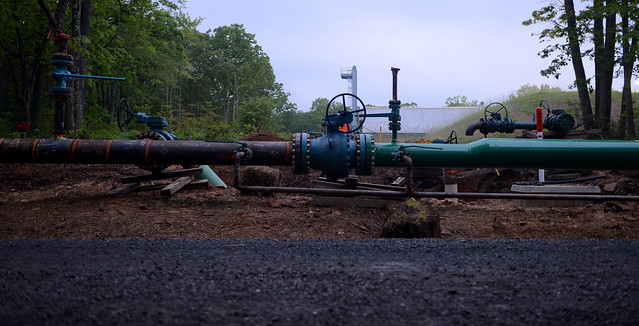
Pipeline construction alongside Pennsylvania state forest roads that were blocked for a day by protesters in the spring of 2014. © Kyle Pattison for Public Herald

PRESS RELEASE

For Immediate Release
Thursday, June 11, 2015

Contact:
Deirdre Lally, the Clean Air Council, 570-854-2288

Pipeline Resistance Escalates in Wake of Rupture


Benton, PA On Tuesday, June 9th 2015 at approximately 9:30 p.m. the Williams Transco pipeline running along the Lycoming/Columbia County line ruptured, releasing gas into the air, according to a phone call with the Pennsylvania Department of Environmental Protection. Nearby residents experienced confusion and fear upon feeling the impact of the explosion from miles away, hearing a prolonged roar sounding similar to a jet engine, and smelling gas in the air.  After calling emergency services and neighbors, many residents were told that it would be safest to evacuate the area until the problem was resolved.  Williams is the same company proposing to build a 178-mile, 42” high pressure natural gas line through Pennsylvania, which would cut through the Benton area.

“I am a resident of Jackson Township and I live near the village of Waller with my infant son, husband, and many pets.  The rupture last night shook our house from several miles away,” said Alysha Suley of Waller, PA.  “Factual information regarding the rupture has not yet been widely disseminated, but I have learned that the explosion and roaring sounds involved the Williams Transco pipeline.”  Williams is the same company who wants to build a new 178-mile, 42” natural gas pipeline through Columbia County.  Other nearby residents reported the smell of gas in the air from up to 5 miles away, and could also hear the roaring sound.

Tuesday night’s pipeline rupture highlighted the safety concerns of many local residents. This rupture happened just one day after concerned residents of the Benton area came together for the first time to discuss the impacts of even more pipeline development, and how to resist Williams’ proposed Atlantic Sunrise Pipeline.

The Benton meeting and the pipeline rupture happened amidst a flurry of anti-pipeline activity in Columbia County, and Pennsylvania as a whole.  All ten counties that would be impacted by the Atlantic Sunrise Pipeline have seen active resistance to this project. Safety in the event of explosions is the main concern of many.

“Tuesday night was terrifying because of all the ‘what ifs’ it brought up.  The rupture was caused by a pipeline built and operated by the same company as the proposed Atlantic Sunrise.  What if a larger pipeline, or one nearer to our home, had failed?” Suley expressed of her safety concerning nearby existing and proposed gas infrastructure.

Residents of Columbia County have been organizing at the township and county level since last April when the Atlantic Sunrise Pipeline was announced.  The next meeting of concerned residents of the county will be hosted by the Shalefield Organizing Committee and the Clean Air Council on Monday, June 16th at 6:00 p.m. at the Pro Shop Café at the Links Golf Course in Hemlock Township.  An attorney will be present to discuss his legal concerns with the leases Williams is offering landowners along the potential right of way of the ASP.  For that reason, if you are a concerned resident facing a gas lease, you are urged to attend and ask questions.

This meeting will continue to bring residents into a year-long, active movement to prevent dangerous shale gas infrastructure from continuing to be built in our region.  All concerned residents and the local press are invited and encouraged to attend.  Please contact shalefieldorganizing@gmail.com or call 570-204-8927 for more information on the local movement to stop the proposed Atlantic Sunrise Pipeline.


###

link for release: https://docs.google.com/document/d/1kUXssJwJ2Bm1Ii4PF9eHuz93qJ-PbV0efJY2kn1Bfjk/edit?usp=sharing
short link: https://goo.gl/mUIpKO

Creativity Runs Rampant at Stop the FERCus!

1415230_orig

by Melinda Tuhus

Just got back from Stop the FERCus!, a week-long series of actions mostly in front of FERC, the Federal Energy Regulatory Commission, in D.C., organized by Beyond Extreme Energy, or BXE. We want FERC to stop approving all the fracked gas infrastructure that allows the unending expansion of fracking, and to move to supporting truly clean energy.There were amazing blockades using people, banners, a metal tripod 20 feet high from which a woman was suspended, and other creative paraphernalia. This action differed from the week we did at FERC last November in that we had many more people here for just a day or two, rather than a full week, so it seemed less cohesive, but it was also good that folks were there representing anti-pipeline, anti-gas export terminals and anti-stinky, polluting compressor stations (to move the gas through the pipelines) all over the East.

I was working on media, trying to get traditional outlets to cover us, as opposed to social media where we made our own news. We weren’t that successful with the former, though we did break through with a local TV station and we have some good ideas for improvement for next time. And I finally learned to tweet, and I could see how it could become addictive.

Kim, a genius organizer and artist from NYC, collaborated with a graphic artist to create a 16-panel “United States of Fracking” that showed 16 different consequences of fracking and the struggles against it. (Visit BXE’s website and scroll down to see it.) They provided a color postcard of each panel that a big bunch of us then spent several hours painting in, which was very satisfying. We displayed the banner every day we were in front of FERC and on the last day we marched around D.C. with it, doing flash mobs in the lobbies of buildings housing a gas pipeline company, the American Natural Gas Association, and NPR, which runs those awful ads from ANGA that all end, “Think about it.” We had our own slogans, like “Fracking destroys communities; think about it” and “Fracking is a climate killer; think about it.”

I was endlessly impressed with the creativity and leadership displayed by the BXE organizers, many of whom were young people who were on the cross-country Great March for Climate Action last year.

It’s legal to sleep on the sidewalk in D.C., and one action we did was to set up a “FERCupy” on the sidewalk right in front of FERC. (See photo above.) It was mostly young people who stayed there for three nights, though three women in their 50s and 60s also did, some not even using a sleeping pad. I wanted to spend at least one night there, but it was complicated getting my bedding there from the place I was staying, so I just stayed til 9 or 10 p.m. two of the nights, which were lovely and cool after the heat of the days. A highlight for me was a sanga (community sharing) one of those nights with about a dozen people. I was so moved to hear from the mostly young people how they really feel about facing severe climate disruption for the rest of their lives, how they turn to others for love and support, and how they don’t plan to stop fighting, in fact needing to escalate resistance to the status quo (and the “all of the above” energy strategy in effect). As one of the teenagers said, “This is my family.”

Only five people were arrested this time, as opposed to about 80 last November, which the media depict as a weakening of our movement. Our goal is not to get arrested, but to make the strongest impression we can on FERC and other players that the status quo needs to change, and I think our actions conveyed that. We actually had significantly more people at our week of action this time, though many only for a day or two. Of course, arrests do accomplish some things: they increase the visibility and seriousness of our work in the media (that’s always the first question they ask) and with our targets; and they provide those of us arrested with a visceral reality check of how the criminal (in)justice system works, which puts us in touch with a demographic different from our own almost exclusively white, middle class one, at least among those who travel to D.C. for the FERC work.

One of the five was Sydney, a 19-year-old college student who decided on the spur of the moment to be arrested. Rather than being processed in 20 minutes and paying a $50 fine like last time, they were held in jail for 30 hours, but ultimately charges were dropped. Click here to listen to or read the eloquent, inspiring 5-minute interview she did with me after her release.

When A Pipeline Comes To Your Town…

by Lee Stewart

During the recent Stop the FERCus actions, Ted Cady from Myersville Citizens for a Rural Community delivered a valuable presentation on pipeline infrastructure, FERC and its process, and PHMSA safety. The presentation included the slides below. 

Much gratitude to Ted and Ann Nau for the presentation and the PowerPoint resource, and to everyone who attended as well.