Beyond Extreme Energy (BXE)

September 25th At FERC

By Ted Glick

It’s the morning of the twelfth day that I haven’t been eating. The only things I’ve been putting into my body are lots of water, salt, potassium and a multi-vitamin.

How do I feel? Weak, very weak, as do most of the others—about 15 as I write—who are also fasting and intend to do so until September 25th, the day after the people’s pope speaks to Congress. 11 of the 15 are also, like me, on the twelfth day of water-only.

We’re physically weak mainly because of the water-only diet but also because we’ve been conducting this hunger strike on the sidewalk in the hot sun in front of FERC, the Federal Energy Regulatory Commission, from 7 am to 6 pm every work day. We’ve been leafletting and talking to FERC employees, including, several days ago, Norman Bay, the chairperson. We’ve been leafletting and talking to passers-by and people who come to visit, as have Tim DeChristoper, Medea Benjamin, “No Impact Man” Colin Beavan, local high school students, and more.

We’ve been using white boards to make signs that we change as the days go by. We’ve been putting up quotes from Pope Francis and Gandhi. Every morning part of our routine is to change the number of the days that we’ve been fasting on the signs that say, “Day ___ of 18-Day Hunger Strike for No New Permits for Fossil Fuel Infrastructure.”

We’ve also been traveling around DC. We’ve gone to important local demonstrations, several times to the site of a sister fast being conducted by the Franciscan Action Network, and meetings.

All of these activities are taking a physical toll, adding to the impact of not eating.

Spiritually, however, we’re a very strong group. Every day we gather together outside of FERC in the morning and the afternoon to meet and go over everything that has happened or is happening that day. We always begin by going around our sacred circle with each faster reporting on how they are doing. Sometimes individual fasters have reported problems, some pretty serious, as far as how they are doing. So far we have been able to help everyone in those situations to get over them and continue on, sometimes aided by local nurses who have volunteered their services for free.

At the end of each meeting, we join hands for a minute or more of silent breathing together and communal strengthening, and it always works.

Two-thirds of the way through this ordeal, we’re seeing the end of it. We’re starting to talk about how to come off the fast in a way that doesn’t do damage to your digestive system. I shared yesterday my nine-day plan—one day of transitioning back for every two days of fasting– for how to do so based on my past fasting experiences.

The fast will end this coming Friday, September 25th, at 12 noon in front of FERC, the day after Pope Francis speaks before Congress. We will end it by breaking and sharing bread together—a very small piece for each of us—and with the many hundreds or more people we hope will join us. We are inviting people who do so who can to bring a healthy loaf of bread to share so that, together, we will break bread together there on First St. NE, affirming life and community and our determination to keep at it until we have won.

We need people to join us on the 25th not so much to support us but to make a strong statement to FERC, and all those who will learn of our action, about the need for FERC to heed our demand: No New Permits for Fossil Fuel Infrastructure.

Some of the fasters got into the monthly meeting of the FERC Commissioners a few days ago, the meetings BXE has been attending and speaking out at for a year. One of them stayed throughout it, and he reported on how the Commissioners were talking about how electrical power companies need to be making plans to switch to gas as their fuel source going forward. Much of that would be fracked gas. This is consistent with the EPA’s Clean Power Plan projections and the very serious economic problems being experienced by the coal industry.

The Commissioners did not talk about the need for power companies to get serious about switching to wind or solar energy as their power source, even though 1) they are price-competitive with coal and gas, 2) they are actually clean and non-polluting, no water contamination, no poisoning of the air and land, and 3) they don’t leak methane, a greenhouse gas 86 times more powerful than CO2 over a 20 year period.

It has become very clear that a, if not the, central battle to prevent worldwide climate catastrophe is the battle over whether natural gas, increasingly fracked gas, or renewables is going to become the primary electrical power source in the next decade. FERC Commissioners are going all-in on an expansion of fracking infrastructure and exporting the stuff around the world.

This decision must not go unchallenged, and it is not. There is a growing and connecting national movement, centered along the east coast right now, that is taking on FERC, in DC and in the scores and scores, maybe hundreds, of local communities where people are organizing to fight new fracking infrastructure. Many more need to join this fight, and now.

Let’s make September 25th at FERC in DC, following upon the big Climate Justice rally September 24th on the mall as the Pope speaks to Congress, the next major manifestation of our determination to prevent FERC from continuing to poison local communities and our threatened climate. In the words of Pope Francis, “There is an urgent need to develop policies so that, in the next few years, the emission of carbon dioxide and other highly polluting gases can be drastically reduced, substituting for fossil fuels and developing sources of renewable energy.”

Wake up FERC!

Ted Glick is the National Campaign Coordinator of the Chesapeake Climate Action Network. Past writings and others information can be found at http://tedglick.com, and he can be followed on twitter at http://twitter.com/jtglick.

Personal Update From Faster Steve Norris

Steve Norris of Fairview, NC sent the email below to friends and supporters this morning.

NPR ohoto of SteveLee Stewart, a 28 year old faster wise beyond his years, wrote:  “To fast is absurd.” But as Gandhi said:  “Fasting is the purest form of prayer.”

Being here, eating no food for 18 days, has taken me down a fascinating and disorienting rabbit hole, where “normal” appears absurd and even suicidal, and where unrealistic may be our only way out. I recall hearing Starhawk saying something like this many years ago. “The time for reasonable is past,” she said. But I have struggled to make sense of this. The fast is a journey into unreasonable.

The other day was hot on the sidewalk in front of FERC, I was talking with a guy I dislike – he dominates conversation and is loud and bombastic. He mentioned something about money in the middle of our conversation, but I got so tired of him after 15 minutes I got up and, so as not to appear impolite, distributed fliers to passersby on the sidewalk. He continued talking to another faster, but when he decided to leave, I asked if he was serious about donating money. He hemmed and hawed, but we talked for a minute about the $1000 BXE wanted to give to Lincoln Temple, the very poor African American Church which generously has been providing us space for sleeping.  He left, and I forgot about him. But half an hour later he returned and gave me an envelope with $1000 in cash.  “Use this for whatever BXE needs.”  We’ve given it to the minister of Lincoln Temple.

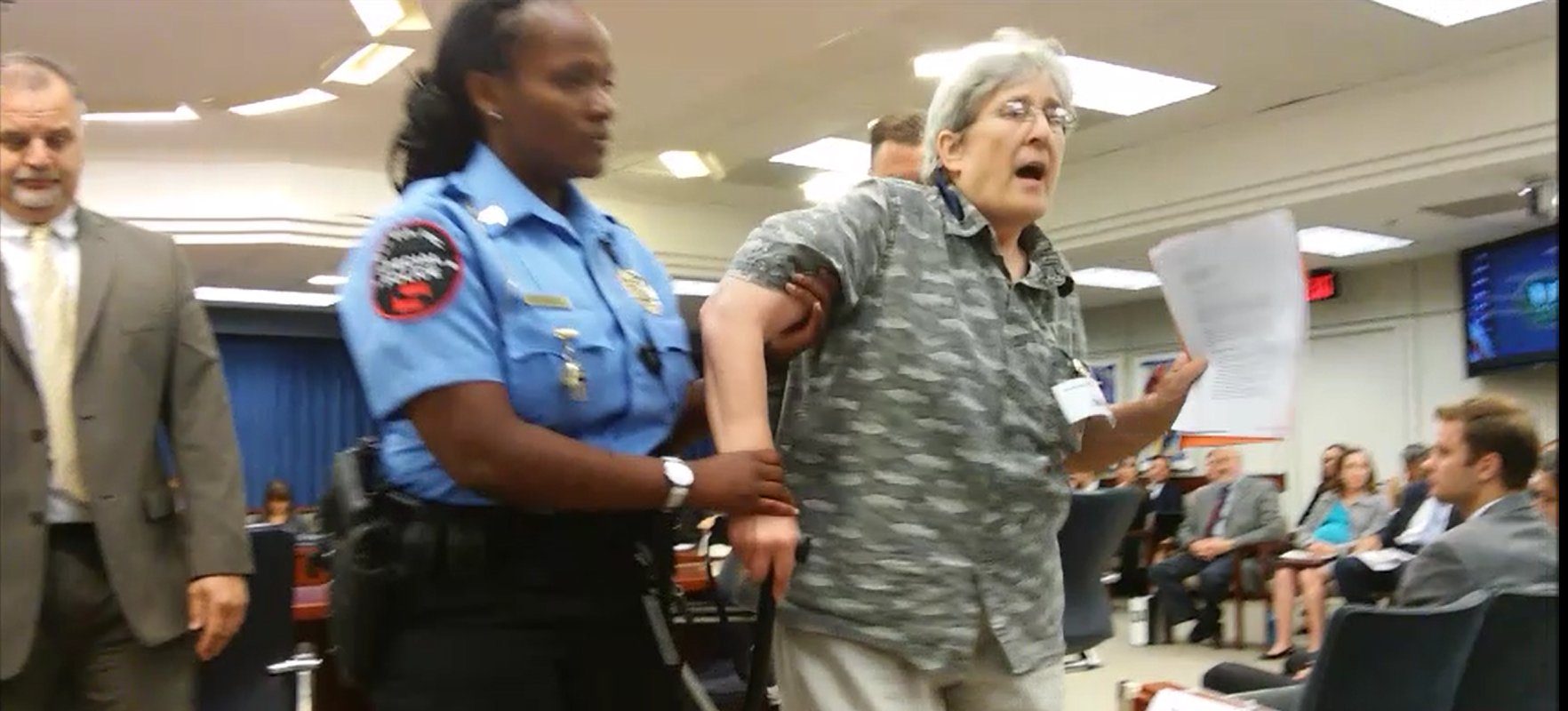
On Thursday twenty year old Berenice Tomkins, a college student, went into the “open” FERC commissioners meeting, which does not allow public comment. The five polished FERC Commissioners are the corrupt decision makers in this  powerful regulatory agency which makes life and death decisions for communities and people all over the country. Most of us are not allowed entry because we have disrupted meetings in the past, but this was Berenice’s first time, so she got in. She wasn’t sure what to do and waited through the incomprehensible conversations of the Commissioners, which in a coded language talk about decisions already made behind closed doors. When they started talking about forest fire mitigation she could no longer hold her tongue. She stood up and with a twenty year old’s strong voice took over the meeting: ” What are you talking about? It’s your policies which are creating the climate crisis, and you can’t mitigate the fires without talking about the climate crisis?” She talked for a minute or so until until FERC  Security grabbed her arm and dragged her out. She was crying and proud as she came out.

As we were passing out fliers and attempting to engage FERC workers on their way into the building, a female security guard in an adjacent building next to FERC told us :  “I wish everyone had your kind of courage.”

Ted Glick managed on Wednesday to stop FERC Commission Chairperson Norman Bay on the sidewalk on his way to lunch. He told Ted he respected us, and thought the fast was okay, but did not like our monthly disruptions. He also repeated what other FERC employees said, that if we want to stop fracking FERC is the wrong target. According to Bay all the natural gas infrastructure FERC permits, even though it is needed to transport the gas, has nothing to do with fracking. The conversation was ended curtly by Commissioner Bay, but clearly he felt the heat.

My sense from this conversation and others we have had with FERC employees is that many of them understand that that climate change is real and dangerous, that many communities are being badly hurt, but that because of our legal structures, because of their narrow fssil fuel culture, and because they disbelieve in viable alternatives, their minds are wedded to the madness of more fossil fuels.

Elliot Grohman, the bent shouldered and clumsy head of the Homeland Security detail which in past protests at FERC has arrested 75 of us showed up on Wednesday. He actually seems to like and respect us. “Anything you guys need?” he asked pleasantly and in a way that sounded genuinely concerned (other security people have done this too).  “No”, I replied. And then I asked “How are you doing?” He talked for about 15 minutes about organizing security for the Pope’s visit, which for the police is on the scale of a presidential inauguration. I felt sorry for him.

Many people, FERC employees and passersby, walk past and ignore us. But many also stop and talk, ask what we are doing, give us a victory signs, say “Thanks” or “God bless you”, ask for a flier, or simply smile. Many have also stopped and asked probing and important questions, thanking us when they leave. A group of students from a nearby high school in a peace studies class came by, and wanted to learn more. We took them with us to CNN headquarters which is next door to FERC. We were trying to deliver a letter to CNN asking for the moderator of CNN sponsored Republican  Presidential debate to ask the candidates about climate change. CNN refused to talk with us or accept the letter. So on the way out, in the fancy cavernous and echoing CNN lobby we chanted “CNN: Ask about climate change,” giving these youngsters a small taste of real world activism.

So where does all of this lead? What will all the people we have touched in various ways, all of the silent people who have walked past but read our signs saying “Day 12 of 18 Day Hunger Strike, all the police, all the FERC employees, and others – what will they do with this? Is our fast an absurd prayer which they will hear and which will touch their hearts? Will it enable them to see outside of the suicidal trance many still inhabit and which most world leaders, including our own, still embrace?

On September 24 Pope Francis speaks to the US Congress. On the next day, with the help of some clergy, we are planning a ceremony/action at noon in which we will attempt to deliver to Commissioner Bay five copies of the Pope’s encyclical, Laudato Si (Care for Our Common Home) calling for a rapid transition from fossil fuels to renewables, and for social, economic and racial justice. If possible, please join us.

Steve

***********************************************
A photo of me at NPR is attached: As you can see I am doing very well. Shockingly, after 11 days without food, I feel almost normal. except for sometimes intense fatigue when I exert myself too much. I’ve lost about 12 pounds. Last evening I walked about 2.5 miles from FERC to Lincoln Temple, and was okay at the end.

Here’s some photos: https://www.flickr.com/photos/coolrevolution/sets/72157656438333594

Here’s more details about how we are doing, from Ted Glick’s Future Hope Columns:
http://tedglick.com/future-hope-columns/september-25th-at-ferc/

DONATIONS:  BXE needs to raise more money to support the fast, and for our ongoing future work. If you can, please consider a tax-exempt donation through BXE website,  or a (non-exempt) check to me at 372Sharon Rd, Fairview, NC 28730. The website is: https://beyondextremeenergy.org/

Ellen Barfield Reports On “Hump Day” At The Fast For No New Permits

DSC_1900by Ellen Barfield

I’m the Beyond Extreme Energy faster at the Federal Energy “Regulatory” Commission who is NOT taking water only, but juice, because I have to buzz back and forth to Baltimore every night to look after my elderly husband, and also dash to various meetings of other orgs I work with. But on the 9th day, over the HUMP!! of our fast I too am feeling muzzy-headed, spacing out on other responsibilities, dealing with tiredness. But the strong solidarity of our little group, and the kind support from all kinds of folks all over the place, is such a bond, and the gathering energy for the Pope’s visit and all the activities in support of the environment and against climate crisis is so inspiring, that I have no doubt this is what I need to be doing.

The FERC employees are getting to know us and smiling and even some of them talking though they’ve been told not to. BXE folks around the country are fasting during daylight Ramadan-style, or for a day or several, or a few days a week. Frontline community members who resist fracking projects damaging their towns and threatening their families are sharing their stories with us and helping us create quilt squares for a visual representation of the BXE network.  We 12 fasters at FERC check-in twice a day for calendar updates and to see how we’re doing physically and spiritually, and to plan all the documents and events we have coming up. We hold hands in a circle at the end of each meeting, and the strength is amazing.

We advocate FERC shifting from facilitating extreme fossil fuel extraction to green renewables, and the workers  there keeping their jobs and helping move the nation toward zero emissions. The idea of economic conversion, changing existing damaging jobs to good life-affirming jobs with government support for re-training and transition, is something I’ve understood and discussed ever since my first activist work seeking to change the nuclear weapons complex. An editorial cartoon I inspired back then shows a woman burying a bomb which grows up to be a windmill. Fracking towers should also become windmills, and workers in the fracking industry, and the government regulators at the Federal GREEN Energy Regulatory Commission, can do jobs they feel proud of helping us shift our economy and infrastructure. And new jobs installing wind and solar arrays and retrofitting existing buildings for efficiency will build the new economy.

When the Pope speaks to Congress next week, and so many citizens listen and endorse his message, we BXE fasters will be adding our energy to many other faith and environmental leaders and tens of thousands of citizens to push the government beyond its resistance to going green. We have no illusions green change is around the corner, but the Pope’s visit is a terrific opportunity to rally and increase the pressure for that change.

For more information on BXE and the fast, and to support BXE, go to https://beyondextremeenergy.org/september-fast-at-ferc-for-no-new-permits/

Peace, Ellen Barfield

Fast For No New Permits Supports The Dyett 12

IMG_0704
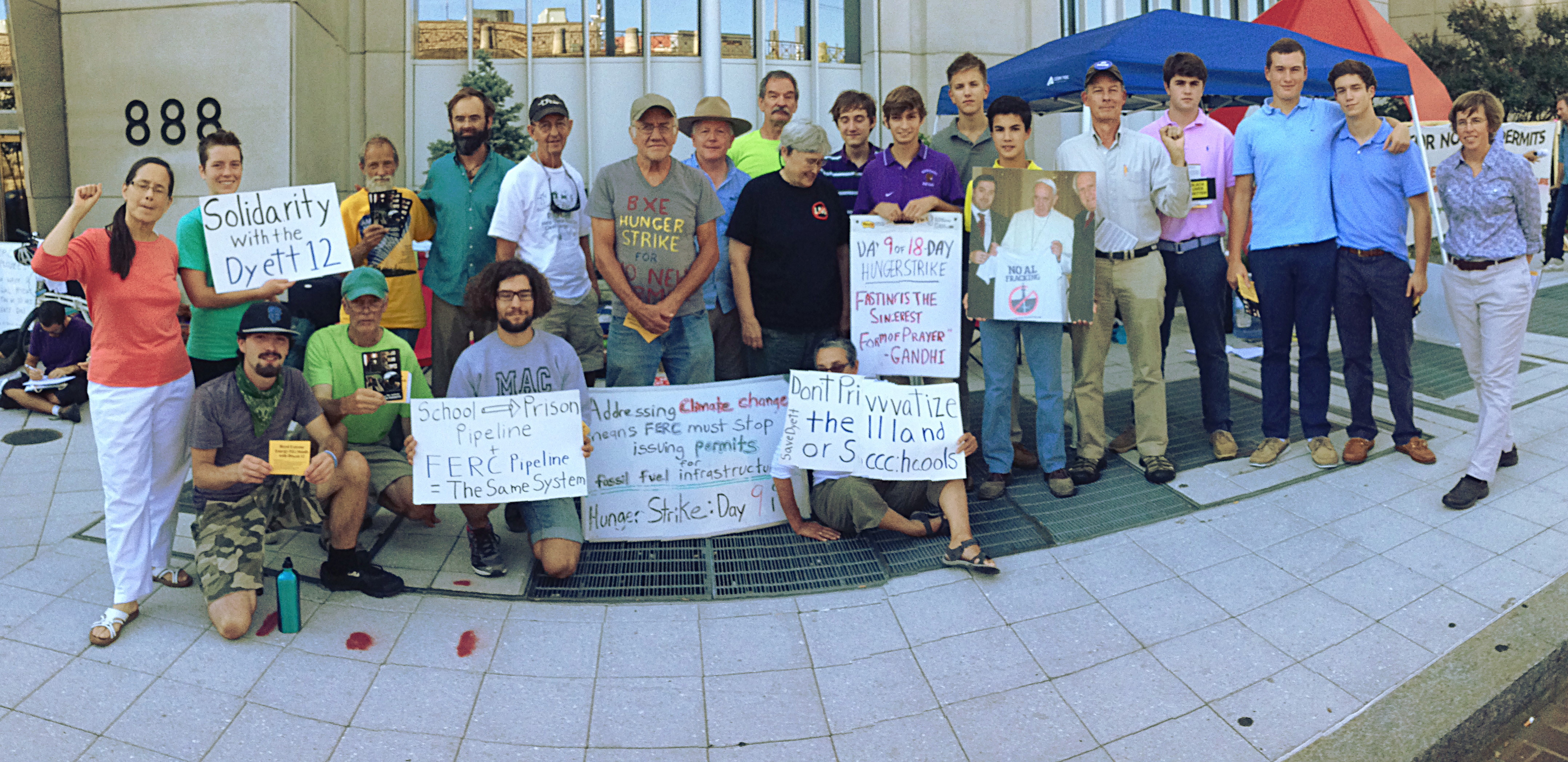
BXE’s Fast For No New Permits expresses its solidarity with the Dyett hunger strikers.

by

a
Washington, DC –  Beyond Extreme Energy (BXE) fasted in solidarity with organizers and hunger strikers working to reopen the Dyett highschool with a green energy curriculum. This was the 9th day of the BXE fast and the 30th day of the Dyett hunger strike. BXE is fasting at the Federal Energy Regulatory Commission (FERC) demanding an end to all new fossil fuel infrastructure permits. FERC’s continued permitting of fossil fuel projects disproportionately impacts poor folks and people of color due to project placement (like many LNG terminals in the Gulf South that need FERC approval) and climate change (like super-storms Katrina & Sandy).The Dyett hunger strikers are demanding that their high school, in a mostly black area of Chicago, be reopened with a green energy curriculum. After years of organizing and numerous days without eating, their school will be reopened, but not with the requested curriculum—thus, their hunger strike continues. The courage of the Dyett hunger strikers, including Cathy Dale and Jeanette Taylor-Ramann who had to end their strike due to health concerns, has inspired BXE fasters to keep going, despite weakness, dizziness, hunger, and other pains.

BXE sees the fight for climate justice at FERC as inextricably tied to the fight of poor, black, and brown communities against the school to prison pipeline and the privatization of education. They are both symptoms of the same system that prioritizes private profit at the expense of people and the earth. Furthermore, many FERC approved projects are placed right next to threatened schools.

BXE sent this letter to the Dyett organizers and hunger strikers:

Dear Dyett 12 and all working to save Dyett School,

Twelve people from Beyond Extreme Energy (BXE), ages 19-72, are undertaking an 18 day water only fast/hunger strike from September 8-25 at the Federal Energy Regulatory Commission (FERC). We would like to express our deepest gratitude for the work that you are doing to Save Dyett High School and take back power in the south side of Chicago. We support all of your demands including a green technology curriculum, an important piece of addressing climate justice. Your hunger strike, long term organizing, and all of your actions are an inspiration to our group and many others across the country.

More about Our Fast at FERC:

In addition to the 12 full time fasters, others are undertaking shorter fasts in their communities or at FERC. The FERC is a powerful regulatory agency that is causing irreparable damage to the nation, and especially those living next to fracking wells and fracking infrastructure (like pipelines, compressor stations, gas refineries, and export terminals). We have written letters, lobbied, gone to meetings, talked to Congress, and carried out non-violent civil disobedience in an attempt to stop that harm. In response FERC has ignored us all, and actively helped corporations win approval of project after project. FERC uses its power to regulate us, the public, while providing cover for industry as it tries to increase its profits while it endangers our communities and the earth.

Because nothing else has worked to change FERC’s policies, we are now engaged in an 18-day water-only fast to demand NO NEW PERMITS for industry until FERC prioritizes wind/solar/renewables, not fossil fuels. See more at BeyondExtremeEnergy.org.

Our Struggles Are Connected:

We believe that climate change cannot be addressed in isolation from other movements and struggles. Whether we look at New Orleans after Hurricane Katrina, industrial polluters like tar sands refineries or trash incinerators placed in black and brown urban areas across the country, starvation and famine in the underdeveloped world as a result of drought, or so many other examples around the world, climate change impacts people of color and poor communities most. Climate change is the result of hundreds of years of capitalism, colonialism, white-supremacy, and patriarchy. These same forces also create poverty, homelessness, gentrification, food deserts, disease, mass incarceration, and inequality in all parts of society, notably in education. The privatization of schools in the United States is an unconscionable problem, often funded by the same banks and investors that fund the fossil fuel industry. You are a leading example of how to challenge the powers that be and reclaim control.

In solidarity,

Beyond Extreme Energy Fasters

More Truthtelling At The Federal Energy Regulatory Commission’s Monthly Meeting

francis1
Francis Eatherington of Roseburg, OR is removed from FERC’s public meeting after trying to communicate to commissioners her concerns about the Pacific Connector Pipeline.

by Melinda Tuhus

Today’s monthly Federal Energy Regulatory Commission meeting marks the one year anniversary that Beyond Extreme Energy has been attending these meetings and raising the issue of FERC’s approval of almost all fracked gas infrastructure projects that come before the agency. A few fasters and other supporters who had never attended before were able to get in, while the “regulars” were shunted to another room to watch the proceedings on video.

Francis Eatherington came all the way from Oregon to try to address the commissioners about the Pacific Connector Pipeline route. As the meeting was about to start, she stood and said, “You have to listen to me. Wildland fires are burning right over the proposed pipeline route. FERC never considered the dangers of this common occurrence in southwest Oregon.” The wildfire season has been extended for several weeks in recent years, burning many more acres, due to climate change. She expressed concern for the firefighters risking their lives already, and moreso if they have to contend with possible gas explosions.

In response to her statement, she was removed from the building by security.

In solidarity with the members of Beyond Extreme Energy who are conducting an 18-day, water-only fast, Eatherington began a juice fast today until September 25.

Tighe Berry, a member of Code Pink, simply stood up and asked why Eatherington was being removed. “She came all the way from Oregon” to speak to the commissioners, he said. “This is supposed to be a public meeting, but you don’t let the public speak. You could hold your meeting in a closet.”

Another BXE faster who got into the meeting was Berenice Thompkins. She spoke passionately about the dangers of the climate crisis exacerbated by drilling and burning fracked gas, and of the damage to communities forced to host these projects. She was also escorted out.

Video from the meeting and interviews with Eatherington and Thompkins:

My Conversation with FERC Chairman Norman Bay

 Faster Ted Glick speaks to FERC Chair Norman Bay earlier today
Faster Ted Glick speaks to FERC Chair Norman Bay earlier today
from Ted Glick’s personal account:

I spoke to Norman Bay for several minutes today, Day 9 of the 18-day water-only Fast for No New Permits, on the sidewalk in front of FERC. I went up to him when he was seen leaving the building with an assistant. I introduced myself and walked next to him, asking if he would come down to receive the five copies of the Pope’s encyclical we will be bringing to FERC on September 25th at noon. He said he would consider it.

Then he stopped and we looked each other in the eye. He told me that he respected what we were doing with the fast and the commitment it showed as far as our beliefs. He said he felt this type of action was a good type of action.

However, he went on to say that he really had problems with us disrupting their monthly meetings and asked if we would stop doing that.

I responded: how can we do that when there’s no change at FERC as far as permitting gas pipelines and fracking infrastructure, one after the other, with virtually no exceptions.

His response: these are just pipelines. We’re a regulatory agency. Blaming us is like blaming the steel companies that make pipes. It’s the production of the gas that you need to deal with.

My response: how can you say you have no responsibility for the expansion of fracking? Without pipelines and infrastructure the fracked gas industry couldn’t be expanding and the gas wouldn’t be sent around the world. And you have a legal responsibility to do environmental impact statements and assessments which address the climate and environmental impacts. You also are supposed to be acting in the public interest, not the interests of the gas industry.

At that point, he checked out on the conversation, said something to the effect of “we should talk more,” and he headed off down the sidewalk.

The BXE fasters will discuss this new development and determine next steps.

Beyond Extreme Energy Stands With Black Lives Matter


The portly man hustled out of the steely faced portal to glare at us. He was brandishing the flyer I handed him earlier.

“All lives matter,” he huffed, before turning on his heels and disappearing back through the glass doors.BXE BLM flier

I looked down and shook my head. I shouldn’t have been surprised.

A woman came around the corner of the same building. As many others in DC during early morning rush hour, she was in a hurry to get to work. I extended my arm and held out a flyer printed on cardstock paper.

“Good morning,” I said as she approached. “Can I offer you a flyer?”

It didn’t look like she was going to take it. We’d been flyering for a week, so she couldn’t be bothered. Only today was a special day, and we had a different flyer. It caught her eye, and she reconsidered. She took it from my hand and studied the back.

“Thanks for doing this,” she said with a smile, as she too disappeared into the cold, sterile entrance. My heart was racing at this point. For one, I was baffled by the stark difference between the two responses I just experienced. Mostly, however, I was exhausted from lack of food and nutrients. It was my seventh day going on water and salt alone, my only true sustenance being the community of 11 other fasters, as well as responses from people like the lady who smiled. Today was long in the making. I reflected on the meeting I attended with a fellow member of Beyond Extreme Energy a few months back, at the Potter’s House, a café, bookstore, and community space that has been in Adams Morgan since the 60’s. A group of folks from around the city gathered there in late July for the first meeting of the Black Lives Matter Spokescouncil, which I learned about on the Washington Peace Center website.

BXE handing BLM flier out at FERC
Jane Kendall hands out literature while fasting at FERC.

“This is an open meeting for all affinity groups, solidarity groups, established organizations, unions or religious communities who want to stand in solidarity with the Black Lives Matter Movement,” the website said, followed by an explanation of two proposed weeks of action to collectively address and confront white supremacy in DC.

Among the spokescouncil goals listed on the website were “support Black leadership of the Black Lives Matter movement”, “create democratic and cooperative space to coordinate Black Lives Matter events, actions, and strategy”, and “work together to create avenues for formerly inactive Black people and allies to become participants and leaders in the movement locally.”

The website also listed the goals of the first week of action.

1.) To call people in and provide spaces and opportunities for previously inactive people to get involved. 2.) To provide an initial project for the spokes council to coalesce around. 3.) To provide an opportunity to increase strategic cooperation between organizations doing the work in order to increase proactive nature of organizing and increase impact. The group I’m in, Beyond Extreme Energy, which focuses on climate change and fracking infrastructure, is working on a set of principles that incorporates anti-oppression work into the core of what we do. One responsibility added to those expected of organizers, for example, is to “help maintain Beyond Extreme Energy’s active role in the broader struggle for collective liberation to which the realization of our mission is inextricably tied.”

FERC faster, Jimmy Betts.

Working in a coalition under Black leadership in the struggle for Black Lives Matter is something the organization felt compelled to do. The spokes council provided a structure that would establish accountability to and leadership from Black Lives Matter DMV.

The first week of action outlined above was to take place during the first week of September, when we’d be in the midst our 18 day water-only fast for no new fossil fuel infrastructure permits at the Federal Energy Regulatory Commission (FERC), the captive federal agency that rubber stamps fracked gas infrastructure projects all around the country. It was the steely building I referenced earlier, nestled behind Union Station.

Heeding the invitation from the Black Lives Matter Spokes Council, we dedicated one day of our fast to Black Lives Matter. In addition to attending other Black Lives Matter events around the city, we held a visibility event right there where we were, at FERC, by holding Black Lives Matter signs and passing out flyers that directed people both to Black Lives Matter organizing going on in DC, and to why Beyond Extreme Energy views our struggle for climate justice at FERC as something inextricably tied to the struggle for Black Lives Matter.

Here are the flyers we handed out.

“I had my questions about how our Beyond Extreme Energy-Black Lives Matter support day would go, but it seemed to go very well,” said Ted Glick of New Jersey, one of the 18-day fasters.

“It felt so good to be expressing our solidarity,” added Ellen Barfield of Maryland, another faster.

“We got a couple of hostile comments from older white guys, like ‘what do you mean? There are white people being killed by blacks. Why aren’t you talking about that?’ The guy looked like he wanted to assault me, but didn’t,” said Steven Norris of North Carolina, also a faster. “And another guy yelled at Melinda who was not blocking him at all, ‘Get out of my way or I’ll hurt you.’ FERC employees have been ordered not to talk to us, so we got many of the usual blank stares at the doorway when we attempted to hand them fliers. Some people seemed moved that we are doing this fast day-after-day, and showing up with friendly faces.”

Faster Jerome Wagner of New Jersey also reflected on his experience. “For me, it felt a bit awkward but generally good to do the flyering that we did in front of FERC. For one thing, it underscored that I am only a beginner in appreciating deeper aspects of racism in America. On the other hand, I am able to connect the subjugation represented by slavery and other racist practices with the environmental damage that we confront. I had one Hispanic man respond ‘all lives matter.’ Sure – on a philosophical and ideal level. However, it is black people who have been killed recently by the aggressive police forces which protect the interests of white people – that is the practical and urgent situation that BLM confronts.”

There’s one comment I’ll probably take with me for a long time. A woman of color passed by and told me she didn’t like what we were doing. She said we were using Black Lives Matter to serve our own agenda.

What does it mean to organize in a way that reflects the inextricable connection between the struggle for climate justice and the broader struggle for collective liberation? It certainly means more than participating in days of solidarity, or even joining the Black Lives Matter Spokescouncil.

To go without eating has been painful, but out here on the sidewalk, fruitful relationships have been fostered. With racism still clinging to the hearts of white folks in Beyond Extreme Energy and across the climate justice movement in North America, to embrace in word and deed the centrality of collective liberation, especially the struggle for Black Lives Matter, will be painful also, but that pain too must be fruitful.

Hungering For Climate Justice

IMG_2130
Fasters in front of FERC say they are tired but steady and strong.

by Elisabeth Hoffman, reposted from https://climatehoward.wordpress.com/2015/09/12/hungering-for-climate-justice/

All along, fasters with Beyond Extreme Energy have had two questions: How will this feel, and how will I pass the time? Of course, that’s in addition to the broader concern about how to ensure their actions help bring change.

jane kendall at ferc
Faster Jane Kendall takes her message to FERC.

From the day after Labor Day until Sept. 25 — 18 days — a dozen people are on a water-only fast on the sidewalk in front of the Federal Energy Regulatory Commission, or FERC, on First Street NE in Washington, just down the street from Union Station. Some have stayed overnight on the sidewalk as well, although most head for Lincoln Temple United Church of Christ to sleep.

Other people are fasting for a shorter time, at FERC or in their communities. They are calling on FERC to stop issuing permits for pipelines, compressor stations, storage and export facilities, the machinery of a fracked-gas-powered economy. They want to end the revolving door for employees between FERC and the industry it regulates. They have the support of more than 80 health professionals who have signed an open letter to FERC asking it to stop its “unethical experiment” on communities. They are fasting to show their “unwavering commitment,” as one faster’s sign says, to people and places in the way of fracking. And to a climate overheated by our insatiable appetites that require ever more fossil fuels to be extracted and burned.

The fast ends Sept. 25, the day Pope Francis speaks at the United Nations and the day after his address to Congress, when he is expected to call for climate, economic and environmental justice, topics from his encyclical Laudato Si’: On Care for Our Common Home.  Because the “earth, our home, is beginning to look more and more like an immense pile of filth” — as the pope phrased it.

Beyond Extreme Energy activists have been at FERC before, blocking its entrances in nonviolent disobedience actions or speaking out at its meetings. They are always hauled out, sometimes to jail. They and affected residents have written letters, testified, lobbied. So far, FERC has not slowed the pace of permits. It has called BXE activists a “situation,” which it has handled with new rules intended to silence dissent and isolate FERC commissioners. FERC members are appointed by the president and approved by the Senate but have no oversight other than the courts.

As the days pass, the fasters, ages 19 to 72, remain optimistic, sometimes tired, sometimes lightheaded and dizzy, particularly if they forget to get up slowly. Many say they feel weaker. Food comes only in dreams. One dreamed of a trolley of teacakes rolling by, another of eating a cookie in front of the others. One said he dreamed he had eaten a sandwich and woke up feeling shame and fearing the dream was real. One evening, Steve Norris, a retired history professor and, at 72, the oldest faster, took his son to dinner: “It was very interesting, because I was not tempted by the food. … It’s not that food doesn’t appeal to me. It does a lot. But there’s something about this mysterious journey being more important now than anything else.”

IMG_2123
Clarke Herbert explains the fast to seniors in town for Elders Climate Action events, including lobbying and two flash mobs.

Faster Clarke Herbert, a former teacher, says one key benefit is that those fasting are getting outside their routine. “And that is what we are asking others to do” to solve our environmental and climate crisis. “We will have to move into a new world, to change from compulsive consumption. That makes fasting really beautiful,” he said.

In an email on Day 5, Norris of Asheville, NC, wrote that “the experience so far is one of both joy and sorrow: There is the great exuberance and learning that comes from working and fasting daily alongside people with rock-solid determination to challenge climate change and its attendant economic, social and racial injustices. And

IMG_2152
Steve Norris rides the bicycle generator.

the exhilaration each time I see a stranger’s eyes light up and they say something like: ‘thank you for being so bold. Please keep it up.’ Then too there is the sadness of dealing daily with the reality that millions of people (the victims of Hurricane Katrina and emigrants from Syria, for example) are already dealing with the impacts of climate change, and that nothing in the short term is going to stop their uprooting and pain, and that ultimately my own grandchildren and great-grandchildren may be similarly impacted.”

Faster Lee Stewart posted on Facebook Saturday: “Today is day 5 of the 18 day water-only hunger strike at the Federal Energy Regulatory Commission (FERC) — an agency that fuels community destruction and climate pollution. My energy and spirits ebb and flow. Sadness, joy. Fogginess, clarity. Breathlessness, stability. Can hardly walk, ready to stand strong. Much love to those who stand up to FERC all over the country. Much love to those who act for justice in the face of bleakness.”

Among the youngest fasters, at 23, Sean Glenn says she is feeling mostly “sleepy and grateful to be doing this with such amazing support.” After the fast, she heads to Rome, where she will join a 500-mile pilgrimage with former Filipino diplomat Yeb Saño, among others, to the Paris climate talks.

With no need to shop, cook or wash dishes or be much of anywhere but FERC, how do fasters fill the time?

  • They offer a glossy card with information about the fast to passersby, often FERC employees. Some accept it, others walk by stony-faced. A few offer words of support. On Day 1, someone driving into the FERC parking lot accepted a flier and said FERC employees had been instructed not to talk to the fasters.
    IMG_2147
    Charlie Strickler passes out information about the fast to passersby at FERC.

  • They take a turn on the bicycle generator, which is used to power phones and laptops during the day. No passersby have taken them up on offers to try out the bike.
  • They put dots on a United States map to show the locations of communities fighting fossil-fuel projects.
  • They use fabric paints or markers to design fast T-shirts.
    combo photo
    Charles Chandler, aka boxturtle, worked for days on his T-shirt.

  • They design and will be making quilt squares showing the harm to communities from FERC-approved projects. During the summer, faster Jimmy Betts traveled across the country with the United States of Fracking banner, which was made for an earlier BXE action at FERC. He talked to people fighting fracking and other fossil-fueled projects and now is connecting them with the fasters. Each faster will call one or more of the contacts and design a quilt square based on the conversation. BXE is also spreading the directions for the quilt squares through social media.
  • They read. Some read Pope Francis’ encyclical, which was part of the inspiration and timing for the fast. Or newspapers. Or Rivera Sun’s new novel, The Billionaire Buddha, a story of love, connection, healing and awakening. “Imagine that one generation could change the course of all the generations of humanity yet to come. Imagine that the human story does not end in the chapter of today,” Rivera writes in the novel. The fasters can imagine that. Day 1 of the fast happened to coincide with International Literacy Day, which was celebrated with a read-in.
    readin at ferc
    International Literacy Day did not go uncelebrated in front of FERC.

  • They get interviewed by alternative media. CNN, just steps from FERC, hasn’t even poked its head out the door to ask what’s going on.
  • Every few days, one of two nurse volunteers checks their blood pressure and pulse.
    IMG_2150
    Thomas Parker, who is 19 and the youngest faster, gets his blood pressure checked.
  • They know the sun’s cycle, which beats down on the sidewalk in front of FERC from about 9 a.m. to 3 p.m., before slipping behind the building. During the first three days, the fierce sun and humidity had them crossing the street to the shade for meetings and respite. In the sun, they mostly sit on camping or beach chairs under rain umbrellas. They apply sunblock.
  • One day, some fasters joined Elders Climate Action for a flash mob at Union Station and in the cafeteria of the Longworth House Office Building. In the evenings, some attend #BlackLivesMatter and environmental justice meetings in DC, because all these struggles are intertwined in a system built on inequality and sacrificed communities.
  • On Day 1, Doug Hendren, the Musical Scalpel, entertained the group with his guitar-playing and anti-fracking and social justice songs — “The Ballad of Pope Francis” and “Fracking’s Just a Bad Dream,” for starters.
    IMG_2140
    Faster Charlie Strickler holds song lyrics for musician Doug Hendren, a retired orthopedic surgeon.

  • They hold morning and afternoon meetings to check in with each other and plan activities, including the Sept. 25 action to end the fast. That day, starting at noon, the program will include music, speakers, a procession and an attempt to deliver five copies of the pope’s encyclical to the FERC commissioners. BXE is inviting passersby who have seen the fasters daily, as well as people who have rallied in DC during the pope’s remarks to Congress the day before, to join in the ceremony to break the fast and deliver the encyclical.
  • They nap.
  • And they fill and refill and refill again their water bottles from jugs of spring water that faster Debbie Wagner brings from her home. Periodically, they add a bit of salt or potassium. And they hunger for climate justice.
    IMG_2136
    Faster Sean Glenn seeks shade across from the FERC office.