 by Anne Meador of DCMediaGroup
FERC Commissioner Philip Moeller attended his last public meeting yesterday before he quits the agency at the end of the month. The White House has not yet nominated a replacement.
Moeller may have given us a little insight into just what kind of person presides over electrical utility markets and interstate gas infrastructure permits. If they’re anything like Moeller, they’re not just bureaucrats–they’re GEEKS.
 Last March, Commissioner Moeller thrilled his Twitter followers while indulging in an ultra-geek fantasy: He photoshopped himself into a promotional poster for the hit TV show “Game of Thrones,” altering it into an invitation to a FERC technical conference.
Moeller sits on the “Iron Throne,” wearing leather jacket, gloves and boots and clutching a sword. His bespectacled face replaces brooding actor Sean Bean in the original.
Like any geek, Moeller gets in as many references as possible in his Tweet, as well as a self-deprecating pun about his receding hair line!
@PMoellerFERC In honor of @ErnestMoniz, hair is some encouragement to attend FERC’s Eastern regional tech conf on 111d.
(Ernest Moniz is the Secretary Energy and well-known for his thick hair cut in a bob. The long hair in the photo surpasses Moeller’s own.)
The text of the photo reads:
BUT THE HOUSE OF MOELLER ENCOURAGES YOU TO ATTEND FERC’S TECHNICAL CONFERENCE TO DISCUSS THIS MATTER.
“Game of Regulations” sounds like a pretty accurate way to describe FERC’s rigged process, but we never expected a Commissioner to admit it.
Maybe Moeller should think twice before he leaves FERC. He may never rule from an Iron Throne like that again.

Environmental groups burn bridges with gas industry at press conference
from SNL 10/01/2015

Environmental groups burn bridges with gas industry at press conference
Gone are the days where the Sierra Club might try to work with the oil and gas industry to limit its impact on the environment.
Representatives from its Dirty Fuels Campaign and a group spawned out of opposition to Keystone XL made clear at an energy policy event in Washington, D.C. on Oct. 1 that there is little or no common ground left between their organizations and energy producers.
“The science is increasingly coming up that climate change is here, we’re feeling the impacts, they are just going to get worse, and we need to act quickly and boldly,” Lena Moffitt, director of the Sierra Club’s Dirty Fuels Campaign, said at the event. “What that means is we leave the vast majority of fossil fuels in the ground.”
Moffitt said climate change “is the frame in which we need to make all of our energy infrastructure decisions going forward,” which means stopping new pipelines from being built and leaving untouched 80% of the remaining coal reserves, 50% of the remaining gas reserves and 30% of the remaining oil reserves.
“Pipelines lock us into the energy of the past,” said Jane Kleeb, founder of the advocacy group Bold Nebraska that has fought TransCanada Corp.’s Keystone XL oil pipeline project. Furthermore, she said, through the use of eminent domain, “the energy companies come in and take [people’s] land against their will.”
“Do we use natural gas and oil now? Yes. Do we need to continue to build infrastructure that locks us into that energy of the past that also rips our land and water? Absolutely not,” Kleeb said. “And we’ve changed the game. Citizens like me, citizens like Lena … we’ve changed the energy game and we’re not going to back down.”
The approach confounded a gas industry leader and a Republican U.S. senator at the same Oct. 1 Politico news event sponsored by WGL Holdings Inc. They said common ground could be found with environmental groups and landowners on issues ranging from climate change to the use of eminent domain.
Marty Durbin, president and CEO of America’s Natural Gas Alliance, said the U.S. must use all its energy resources. “What is our energy future here?” he asked. “How are we going to take advantage of all the fuel sources we have? From a natural gas standpoint, we have an opportunity — not only with the abundance of natural gas here, but the ability to provide cleaner air, cleaner energy, drive economic growth for the country, and also enhancing our energy security, both here and abroad.”
“We’ve got to have pipeline expansions to be able to do that,” Durbin continued. “And the communities the pipelines are going through — of course they are going to have questions and concerns, and we’ve got to be part of that dialogue. But I think unfortunately we’ve gotten into a conversation that starts and ends with ‘we don’t want them.'”
Speakers touch hot topics
The two factions were on opposite ends of their energy infrastructure panel at the Politico event. Durbin and Sen. John Hoeven, R-N.D., are working to improve a permitting system that, while it might be slow going in the eyes of gas infrastructure developers, generally works for them. The speakers took the high road and expressed an interest in dialogue.
Moffitt and Kleeb, facing a U.S. permitting system that mostly lets projects go forward over their objections, were more willing to lob incendiary comments that set fire to the idea of the two sides ever working together.
Hoeven, the author of legislation to streamline cross-border energy projects, agreed with Kleeb that it was important to treat landowners well, and energy companies should use eminent domain carefully. The senator pointed out that new pipelines would prevent oil and gas producers from flaring gas in production regions that currently lack infrastructure. And he pointed out that no matter what energy resources the U.S. chooses, even renewable energy sources, transmission infrastructure will have to be built.
“You still have the issue of dealing with landowners,” Hoeven said. “That’s not going to go away, regardless of your fuel choice.”
“Right, but some of the energy sources are poisonous,” Moffitt said, and some are not.
Durbin objected to that description. He said the U.S. has hundreds of thousands of miles of major pipelines in place. “We don’t have a poisonous wasteland around the country,” he said.
Hoeven said the U.S. needs to encourage investment in energy by, among other things, providing certainty in regulation. For renewables and traditional sources, he said, “if we continue to empower investment both in energy production and in infrastructure, we will get more energy, better environmental stewardship” and make the market more safe and more efficient, and other countries will then adopt the new technology.
“That’s been the hallmark of America,” Hoeven said. “We are the entrepreneurs, we’re the investors, we’re the inventors, we’re the innovators.”
In the end, the belief in U.S. innovation was one all the speakers could share.
“Like Sen. Hoeven, I believe in an America that is innovative and entrepreneurial, and I think in the face of the greatest crisis the planet has ever known … America will lead the way into the clean energy future,” Moffitt said, noting such technological advances as battery storage. “I think we can get there.”
https://www.snl.com/InteractiveX/article.aspx?ID=34047784&KPLT=4
http://www.politico.com/events/2015/10/americas-energy-agenda-whats-next-213895
Local Resident Hopeful Of Results After Fast Against FERC
Click the ‘maximize’ button (lower right) to view full screen on the Scribd website.
Pope Francis Comes to the Capital, FERC Protests Escalate
 by Gabriel Shapiro, Hampshire College, gabeshapiro42@gmail.com
This past week, I took a trip from my school in Western Massachusetts to Washington DC, to hear the Pope’s message, to participate in Jewish Yom Kippur services in solidarity with the Pope’s call for climate action, and to support the Beyond Extreme Energy group as they neared the end of an 18-day water fast. They were fasting on behalf of communities across America that are being impacted by the fracking industry. At the confluence of the Papal visit to the capital and many interfaith climate justice actions leading up the event, the fasters were giving everything they had to the last couple days of prayer, in order to take a bold stand against the fracking industry.
Spending time with the fasters in the church where we were sleeping, at the climate justice rally in the National Mall and throughout various actions allowed me to ask questions and to understand the motivations behind the fast. Being with people who are fasting is odd, because you can tell that they are struggling but it’s not very visible on the outside. Through words, they shared the difficulties they were facing, the objectives of their actions, and the impact they hoped to make.
Steve Norris, one of the BXE fasters, noted how this method of protest was passed down from struggles in the past. “Gandhi said that fasting is the purest form of prayer,” he said, “This is a prayer we put out to the Universe.”
It is also a strategy, used to raise awareness and heighten the stakes. BXE is hoping to bring fasting back into the active toolbox for creating change in our modern world.
Why did these folks feel strongly enough to resist food for 18 days?
The Frack Attack
The past decade of increased domestic oil and natural gas extraction has resulted in a major build-out of related infrastructure, all across the United States. The flow of fracked gas to the shore for foreign export is never fast enough to satisfy the corporations at play. More and more transmission, compression and storage facilities must be built to support the corporate pursuit of profit and control over the market. We are in the midst of a global pipeline epidemic, none of these projects being limited by borders as they are connected to the trans-national energy market.
With little to no regulatory restrictions to adhere to, large energy infrastructure corporations, often based in faraway places are quickly establishing new pipeline routes and related infrastructure in a web stretching across all parts of the country. Each step of the process, from fracking to exportation of liquefied fracked gas provides an opportunity of profit for the extreme energy industry while exploiting and endangering communities. Even in the face of declining stock returns and even the threat of bankruptcy for some fracking companies, the industry continues to seek expansion, putting communities and the Earth in jeopardy. Helping to decline the financial stability of this industry is the renewable energy sector, which is enjoying unprecedented growth, creating new jobs and helping to transform the country’s energy profile.
—————————————–
We Are Cove Point is a coalition working to stop a massive fracked-gas export terminal from being built by Dominion, centrally located in the town of Lusby, Maryland. The facility would be the first on the East Coast, its impacts would be felt by many. Learn more: www.wearecovepoint.org
—————————————–
 Community Resistance and Movement Building
Communities across the United States are being faced with these large scale industrial projects which bring harm to their ways of life and the land they hold dear. They are being forced to organize themselves in opposition to projects, coming together in homes and churches to plan strategies. These communities are using scientific research to determine and make public that these projects do pose a serious threat to their lives and to the entire region. This research also clearly addresses the ways in which these projects would increase global CO2 emissions, contributing to widespread climate chaos.
Many of these communities are engaged in ongoing resistance campaigns, using a variety of tactics to protect themselves from the onslaught of the fracking industry. The individuals that make up the resistance campaigns have dedicated their lives to defending their communities.
These resistance communities often use a variety of tactics, carried out by volunteers, often whom have a deep connection to the land in jeopardy. While working painstakingly through the different legal avenues, many of these groups have also engaged in nonviolent direct action campaigns, feeling they have no other option to fight off the industry. These pockets of human resistance are forming multi-faceted social movements, each specific to its place and population. Looking at the vast number of communities engaged in this struggle, from those along the TGP pipeline route in Western Massachusetts, to those facing massive compression and treatment facilities in Philadelphia, to those facing the effects of local power plants switching to fracked gas, we ask what could allow a single industry to cause so many cases of human resistance in such a short time period. Who regulates this industry and why are they not doing their job?
—————————————–
FANG (Fighting Against Natural Gas) has been organizing resistance to Spectra’s Algonquin pipeline, part of the AIM project. After many levels of escalation and movement growth, FANG delivered an official pledge of resistance to Spectra. Construction is set to begin… Learn more: http://www.fangtogether.org/
—————————————–
 FERC Doesn’t Work
The Federal Energy Regulatory Commission is the government body responsible for overseeing the construction of interstate natural gas projects. FERC should be a federal agency supported by democratic process which represents the common good. To the contrary, it is lead by federally appointed officials who are not required to report to any superior government structure. It is tasked with researching and reporting risks associated with natural gas related projects, and using that research, along with public comments, to determine whether or not approval should be granted.
Unfortunately, the payment FERC receives from the very industry it is meant to regulate serves as a deep bias on the side of the corporations. FERC hasn’t denied approval of any natural gas project, at least in recent years. FERC consistently ignores hard, scientific evidence and thousands of public comments as well as direct actions at their doorstep, consistently for over a year, in order to give the fracking industry permission to expand, at the expense of many.
—————————————–
We Are Seneca Lake is using ongoing human blockades to prevent trucks from entering a facility where Crestwood is planning to store vast amounts of fracked gas in unstable, underground salt caverns. Crestwood’s plan to industrialize the Finger Lakes puts the whole community in jeopardy.
Learn more: wearesenecalake.com
—————————————–
#BXEFast for #NoNewPermits
“Everything that we’ve been doing for the past year in front of FERC has been to call for no new permits, to say that if we continue building out fossil fuel infrastructure, which is what this agency keeps approving, our world is going to be unlivable.” says Melinda Tuhus, a BXE organizer and member of the fast.
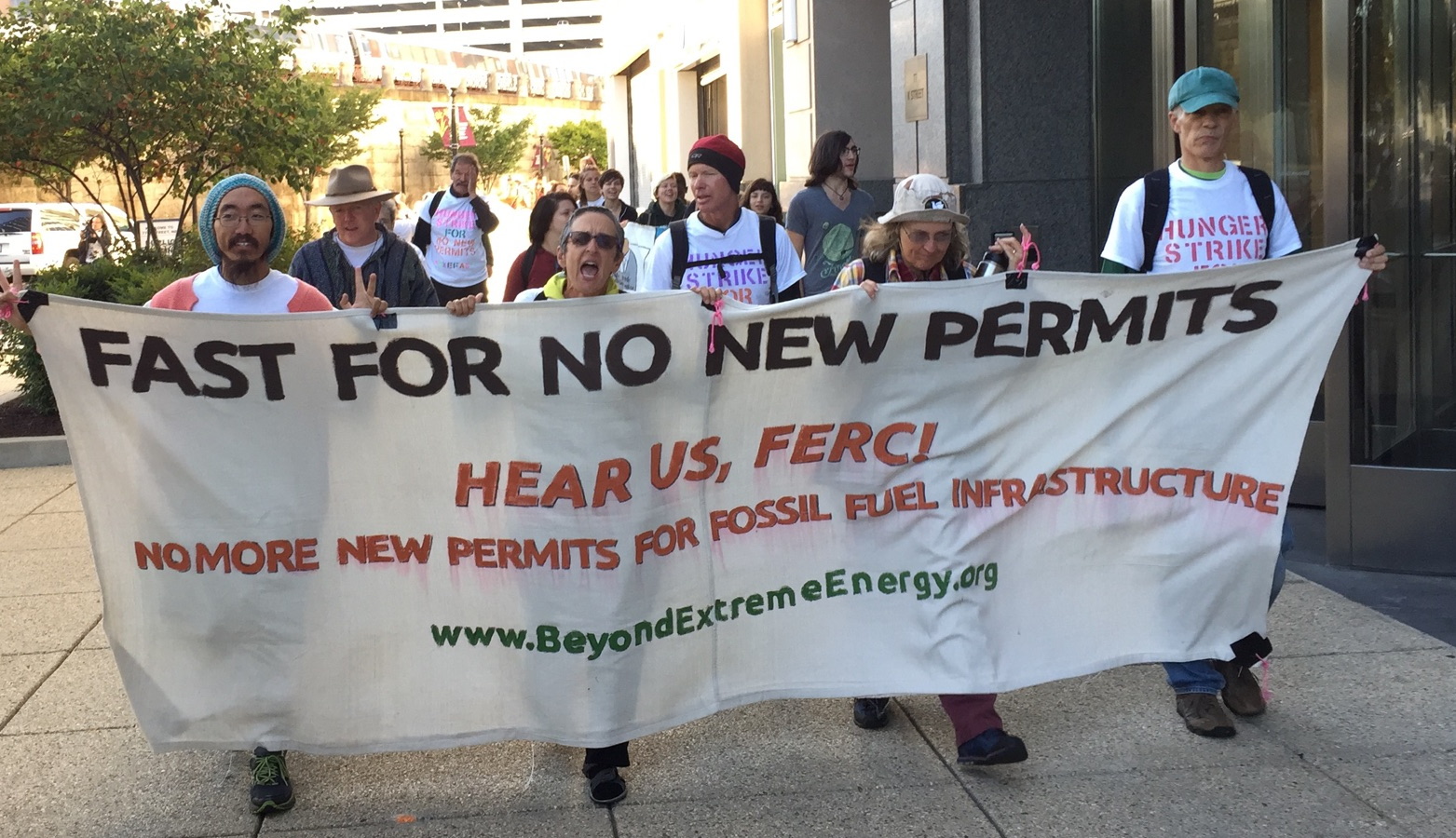
The Fast for No New Permits was organized by Beyond Extreme Energy, a group whose target is FERC for its role as a key player in support of the fracking industry. The fast was created to bring attention to FERC and to bring prayers together from numerous communities across America who remain at war with the fracking industry.
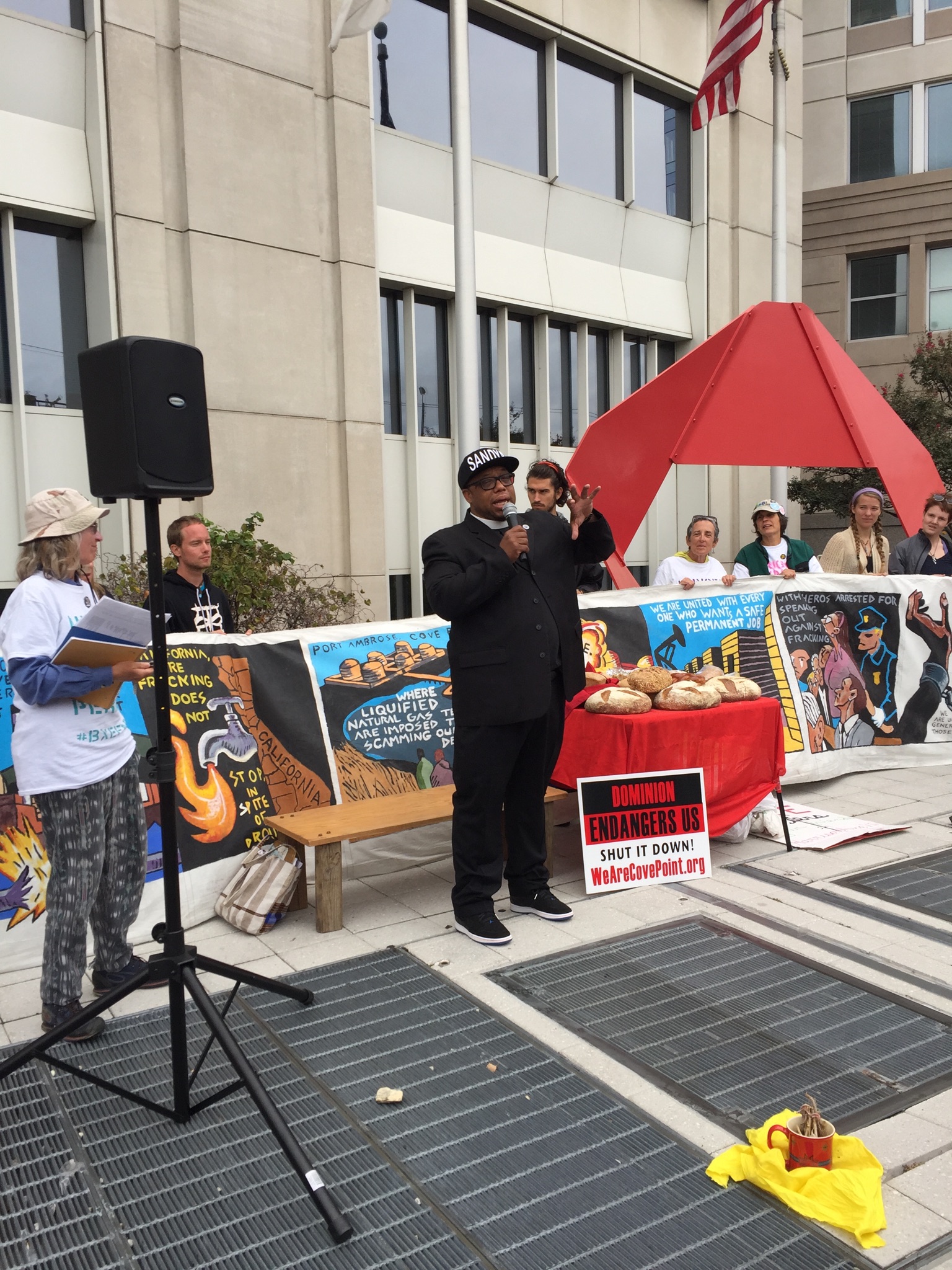
The members of Beyond Extreme Energy helped bring these prayers together in the form of a quilt with squares from different resistance communities, a 50 ft. hand painted banner called “The United States of Fracking Banner”, and the hunger in the bellies of those fasting. Stories were brought from the resistance communities, of permitting processes, public hearings, pipeline surveyors, stances of elected officials and the actions taking place to protect themselves from this persistent and destructive industry.
Lisa DeSantis, from the “frack fields” of Western Pennsylvania, joined the fasters to stand up for her community, a place transformed in recent years from a lovely countryside to an industrial maze of drill rigs, compressor stations and pipeline clearings. She was joined by representatives from many communities across the country.
“We are dealing with water pollution,” she says, “the first site that was drilled in my county in 2012 contaminated four known water wells. The sanitation department is taking the residual waste from the fracking industry and dumping it into our water, causing environmental damage all the way downstream in the Ohio river.”
—————————————–
Millennium Pipeline installed a 12,260 horsepower compressor station in Minisink, NY, regardless of overwhelming evidence of negative impacts on the community. The resistance community continues to explore new ways to protest Millennium. More: http://www.stopmcs.org/
—————————————–
 People vs. Power

Beyond Extreme Energy feels it has done everything it can through the legal and accepted means of delivering their opinions to FERC. Receiving no recognition or reply, these demands have evolved into action. The objective now is to raise awareness of the heinous set of practices and convoluted processes that make up FERCs work. This fast comes after disruptions of public hearings, a full week of direct action at FERC, and numerous other tactics over the past year, publicly pointing directly at FERC and demanding accountability and an end to permits for hazardous projects.
On behalf of those communities being negatively impacted by the fracking industry, these fasters remained strong and hopeful, even in the face of a powerful and rogue government agency.
“I think it’s a great tool” one of the fasters, who chose not be identified, explained, “it’s worked in the prisons of Northern Ireland, and it’s working in the prisons of Palestine, and it’s going to work here.”
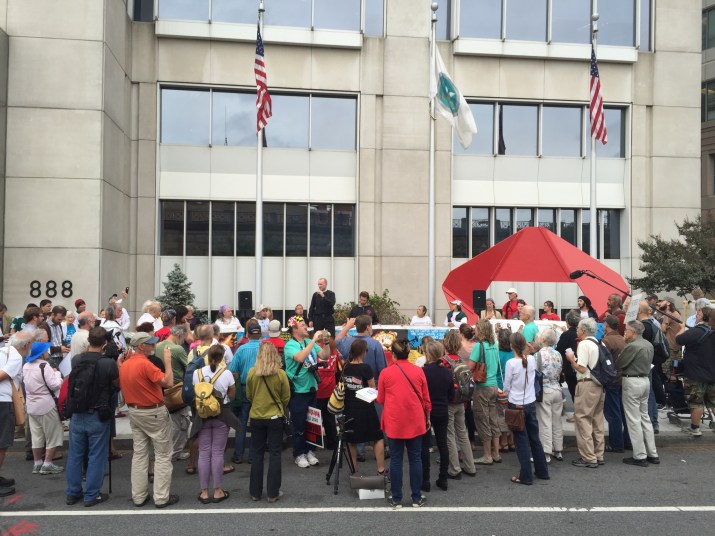
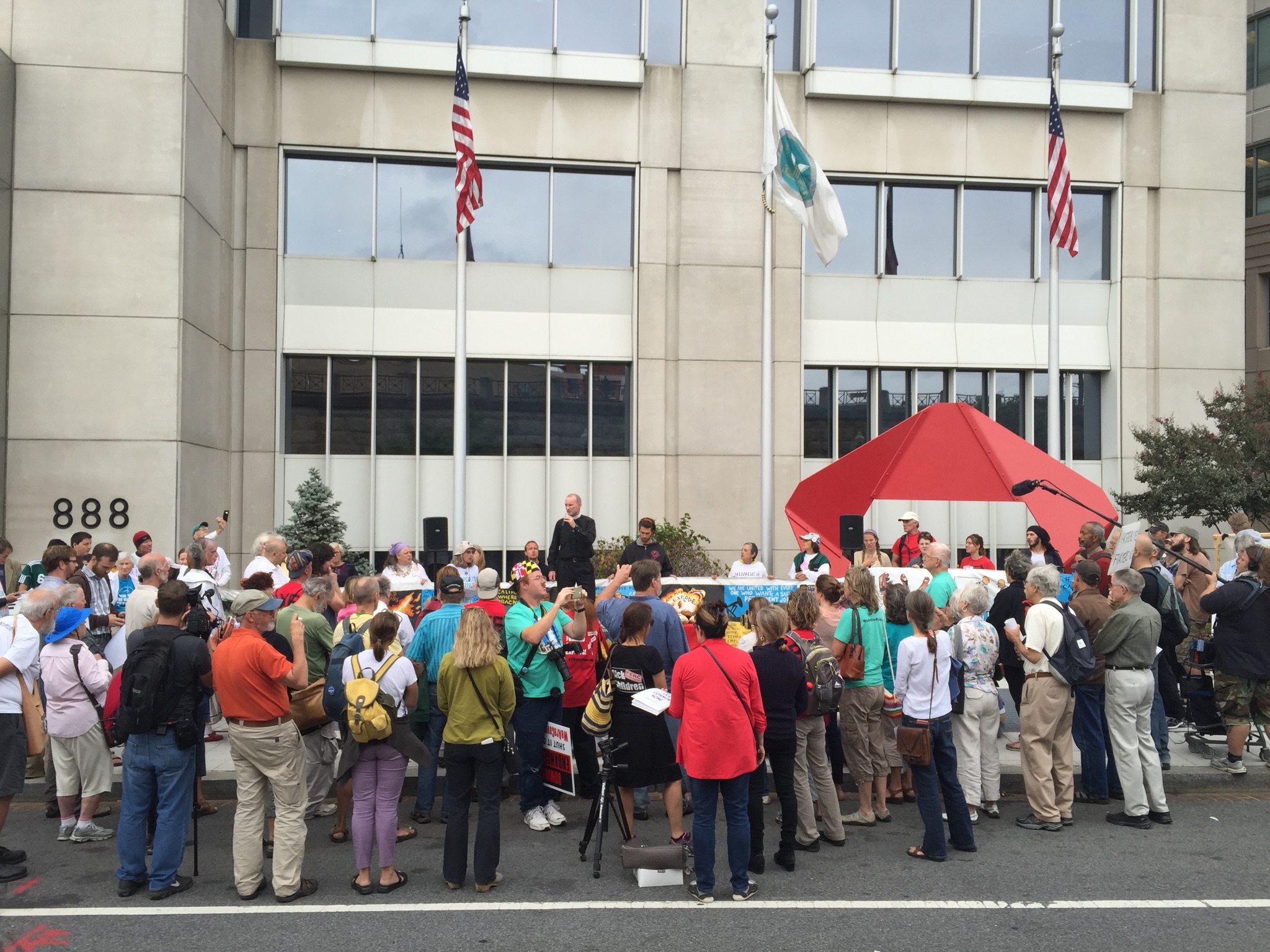
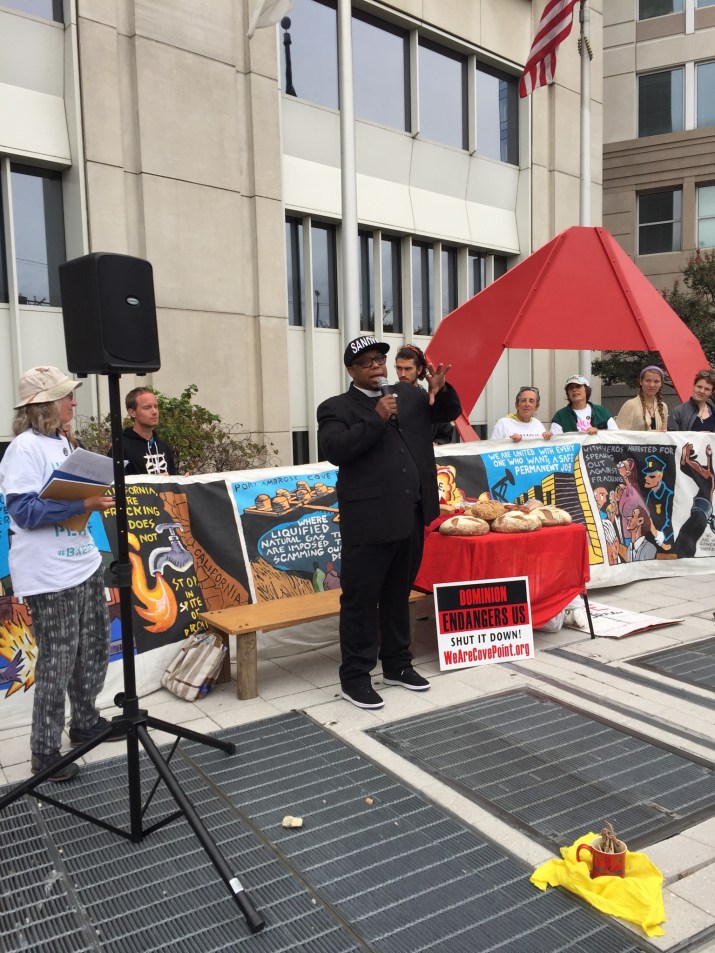
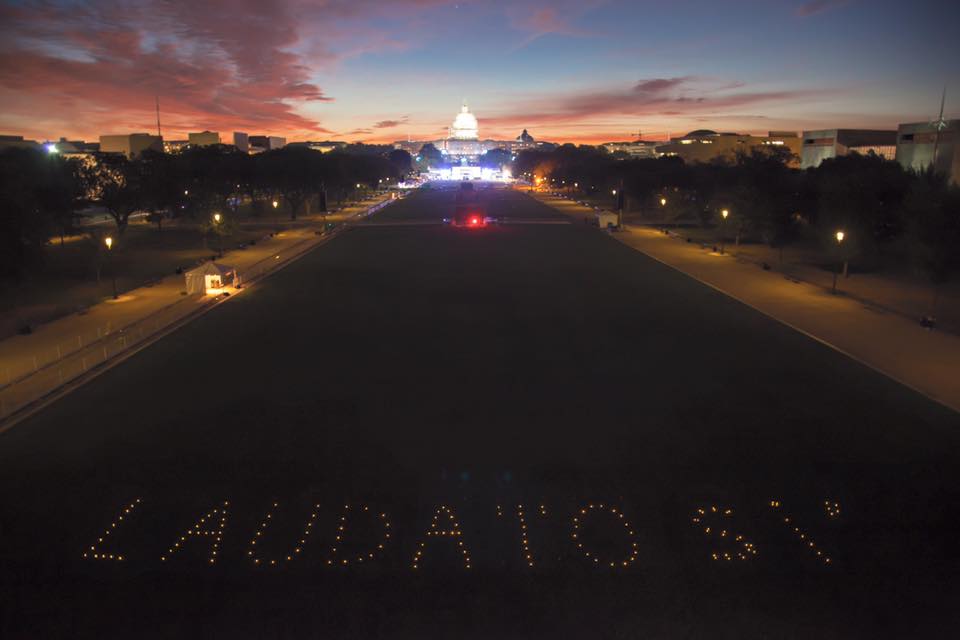
At the end of the 18-day water fast, BXE, their supporters and individuals from communities impacted by fracking infrastructure held a rally outside the FERC headquarters in DC. Along with breaking bread to fill empty stomachs and impassioned speeches making the message clear, BXE delivered the Pope’s monumental encyclical, Laudato Si to the five FERC Commissioners.
At a time of climate chaos and a new era of human action to address it, the fracking industry remains in a state of growth, destroying the livelihoods of countless communities in its path. FERC is a part of the reason for this destruction. BXE and their supporters hope to put us on a different path, one that includes 100% renewable energy, decolonization, and re-localization of our economies.
“This fast, these prayers, are a stone we throw into the water, and there is no way to know how far the ripples will reach, or where they will go.” said Steve Norris, remarking on the impact of their actions. Their prayer was sent widely and the impacts are yet to be seen. For what it’s worth, these fasters successfully raised a major alarm at the headquarters of an agency whose time has most certainly come. It was a blessing to spend time with them and an inspiration to see the principled actions they continue to take for the creation of a better world.
To learn more about and to engage with Beyond Extreme Energy, visit: https://beyondextremeenergy.org/
-Gabriel Shapiro, second-year student at Hampshire College.
Connect with me on Facebook, Instagram ‘minimarv’, or e-mail gabeshapiro42@gmail.com
18 Day Fast Comes to an End
“The gift of the Earth with its fruits belongs to everyone.” — Pope Francis, Laudato Si’, paragraph 71.
by Ted Glick, reposted from www.ecowatch.com
There were many kind people, including some Federal Energy Regulatory Commission (FERC) employees, who thanked me or had supportive things to say during the 18 days that I fasted on water only in front of FERC with 11 other sisters and brothers from Sept. 8 – 25. But there are three people whose words I doubt I’ll ever forget.
There was the young black woman whose job was to staff a small booth by the entrance to an underground parking lot just across from the main employee entrance to FERC. She was friendly and over the three weeks that I stood across from her during the work week, holding signs and distributing leaflets to FERC employees going into or leaving work, we often exchanged small talk and smiles. About a week before it ended she commended us on our courage. Then, on the 15th day, she told me, “Some women came by yesterday, asking me, ‘What are they doing here?’ and I told them, ‘They are taking action for all of us.’ Some of us have jobs and have to pay bills and can’t do what you’re doing, but I think what you are doing is important.”
Then there was the Homeland Security Federal Protective Services policeman, a tall, tough-looking, white guy, who came by to talk to me on day 18, asking how I was doing, clearly impacted by our willingness to suffer for what we believed in. After a couple of minutes he said, “I’ve seen lots of groups demonstrating on issues, but yours is the most persistent one I’ve ever seen.”
But the most profound interaction I had was with a woman who might not have known I was fasting. She was an old white woman, on crutches, looking like she was homeless, a beggar on the DC Metro subway. I had seen her earlier in the 18-day ordeal; she had come up to me asking for money. On day 16, the day the Pope was in town meeting with President Obama, on my way home from FERC in the evening to the church where we stayed every night, I saw her again. We were both standing on the Metro platform and I had a mounted, blown-up picture of the Pope holding a sign which said, “No al Fracking.”
She came over to me, our eyes connected and she said, to paraphrase, “You know, I know all about Jesus Christ and everything, but I just want to say that if it’s not about unity, it doesn’t mean crap.” I had listened carefully and what she said rang true, was genuine and deep, and I responded, “Yes, you’re right. That is absolutely true.”
The Beyond Extreme Energy-organized “Fast for No New Permits” was not explicitly about “unity.” It was the latest in a now-over-a-year campaign focused on what we call “the most dangerous federal agency most people have never heard of.” We are doing everything we can think of to throw a nonviolent wrench into the gears of the FERC machinery. This semi-independent agency has just kept grinding out permit after permit for the expansion of fracked gas infrastructure, with virtually no rejections of gas industry proposals, from what we’re able to tell, for many, many years.
The idea of doing a serious fast emerged a few months ago as some of us realized that the Pope was going to be in DC in late September, the Pope who has been outspoken about the need for action on the climate crisis and who, yes, had no problem being photographed a couple years ago with that “No al Fracking” sign.
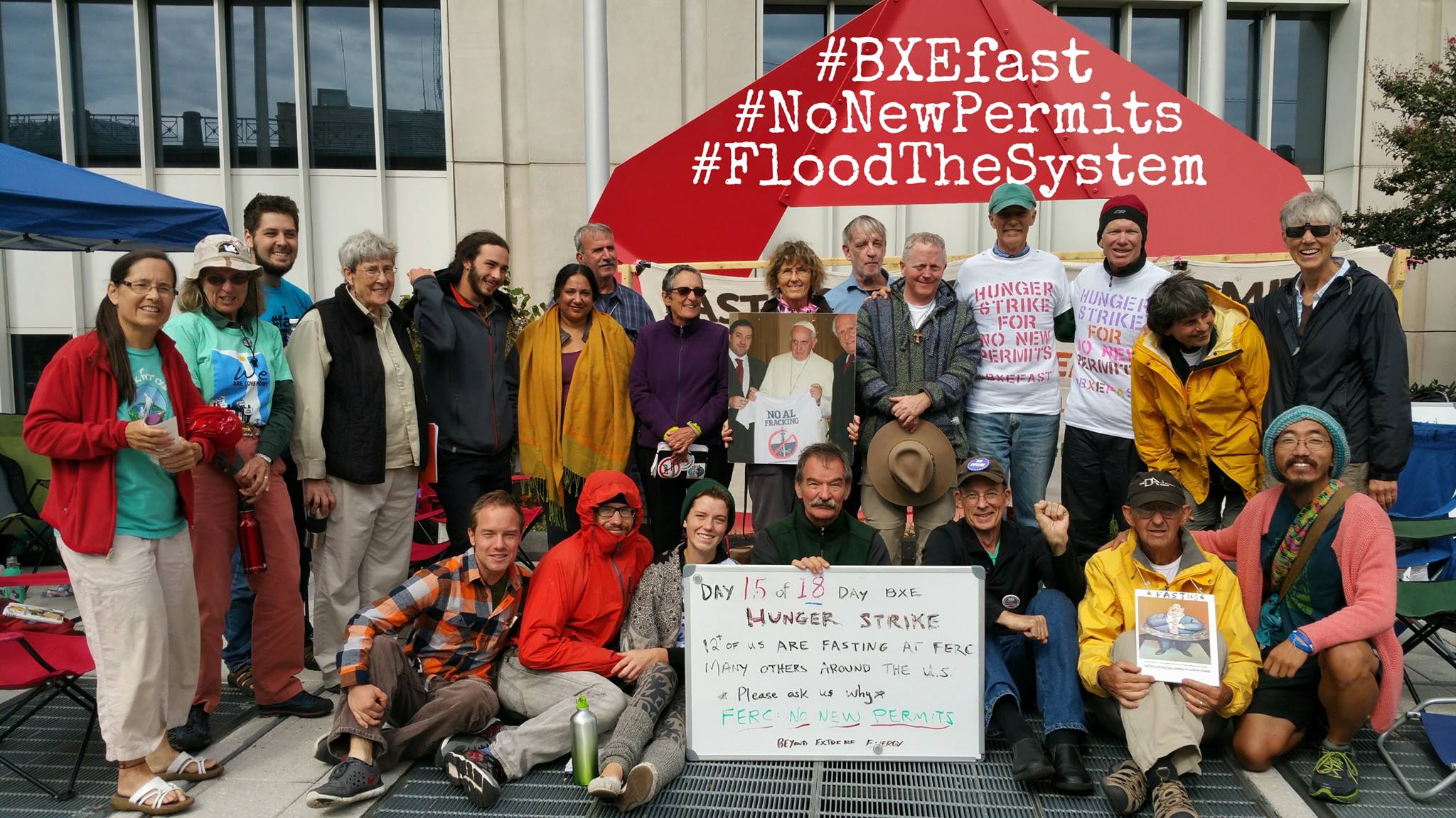
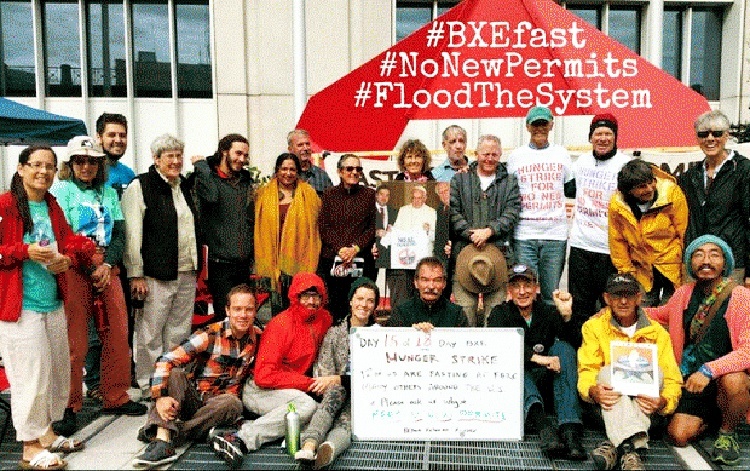
And so on Sept. 8, the day after Labor Day, 12 of us, from ages 19 to 72, began a diet that consisted of water, salt and potassium. Ten of us continued on that diet until the 25th, the day after the Pope’s speech to the U.S. Congress. One faster had to end it around day 10 because of serious physical difficulties he was encountering; the other did so after about 14 days because of her need to build back some strength before joining a 900-mile walk from Rome to Paris beginning next week in connection with the early December UN Climate Conference.
There were at least 100 other people who fasted around the country, including several who fasted for 18 days also, as I understand it, in Oak Flat, Arizona, protesting federal plans to take land in Tonto National Forest sacred to local Apache nations and give it to multinational copper companies to mine.
In DC we 12 fasters and other supporters set up camp in front of FERC on the sidewalk every work day from 7 a.m. to 6 p.m. We passed out many thousands of leaflets and had hundreds of conversations with FERC employees and people passing by. Dutch TV came by and did interviews, as did a dozen or more other press outlets. We found a great deal of support and almost no overt hostility. One of the more interesting conversations we had was with Norman Bay, chair of FERC. I was able to talk with for a few minutes when he was spotted coming out of the FERC building while most of us on this very hot, sunny day were across the street in the shade of a 30-foot high stone wall. Little of direct substance came out of that discussion, though you never know.
On the 17th day, the day the Pope spoke to Congress, we had a breakthrough with the Washington Post when a reporter interviewed me on the mall and posted a blog about it that morning. The next day that blog post became a substantial part of a good and prominent article in the first section of the paper, taking up 2/3rds of a page and with a big picture. It was helpful to see that Post article reporting that our fast was “to protest what he said was the Federal Energy Regulatory Commission’s support for the use of fossil fuels and pipelines.”
I would expect lots of FERC employees, including Commissioners, as well as DC judges who will be hearing appeals of FERC’s rubber-stamping ways, see that article and smile.
There is no question this was an effective action. But it was more than that. In significant part because it was a fast—what Gandhi called “the most sincere form of prayer”—and connected to the visit of the people’s Pope, it was also, indeed, about unity, about what the wise, old, beggar woman on the Metro platform had said to me on day 16.
Yes, “the gift of the earth with its fruits belongs to everyone.” And yes, “a true ecological approach always becomes a social approach, it musts integrate questions of justice in debates on the environment, so as to hear both the cry of the Earth and the cry of the poor.” (paragraph 49).
And more directly, to amplify the wise woman, “Everything is connected. Concern for the environment thus needs to be joined to a sincere love for our fellow human beings and an unwavering commitment to resolving the problems of society.” (paragraph 91).

I lost 30 pounds over those 18 days. It is good to be eating again, slowly returning to normal eating habits. It is good to have energy to work, feel my strength beginning to return, to taste the delicious flavors of fruits and vegetables, the only things I am eating these first two days of my back-to-normal-eating, nine-day plan. It is good to be home after three weeks away. And it is good to know that the memories of those 18 days and the wonderful community of sister and brother fasters and supporters will be with me always, nourishing my commitment to keep taking action for a stable climate and a transformed world until the day I die.
Ted Glick is the National Campaign Coordinator of the Chesapeake Climate Action Network. Past writings and other information can be found at tedglick.com and he can be followed on Twitter.
Press Release: A follow up climate justice action to Pope Francis’ visit to Washington, D.C.
A follow up climate justice action to Pope Francis’s visit to Washington, D.C.
For more information, text or call Melinda Tuhus, 203.623.2186 or (secondary contact: Don Weightman, 215.292.4110)
Visuals: 50-foot United States of Fracking banner and No New Permits quilt
Audio: Short statements from fasters and clergy; singing; chanting
Facebook event: https://www.facebook.com/events/397353760461766/
=====================
On Friday, Sept. 25, fasters from Beyond Extreme Energy (BXE), together with their supporters and leaders from several faiths, will break bread in front of the Federal Energy Regulatory Commission (FERC) in D.C to end a dramatic eighteen-day fast undertaken to demand that FERC stop issuing permits for the pipelines, storage facilities and LNG export terminals that use fracked natural gas, and instead heed Pope Francis’s call to care for the Earth.
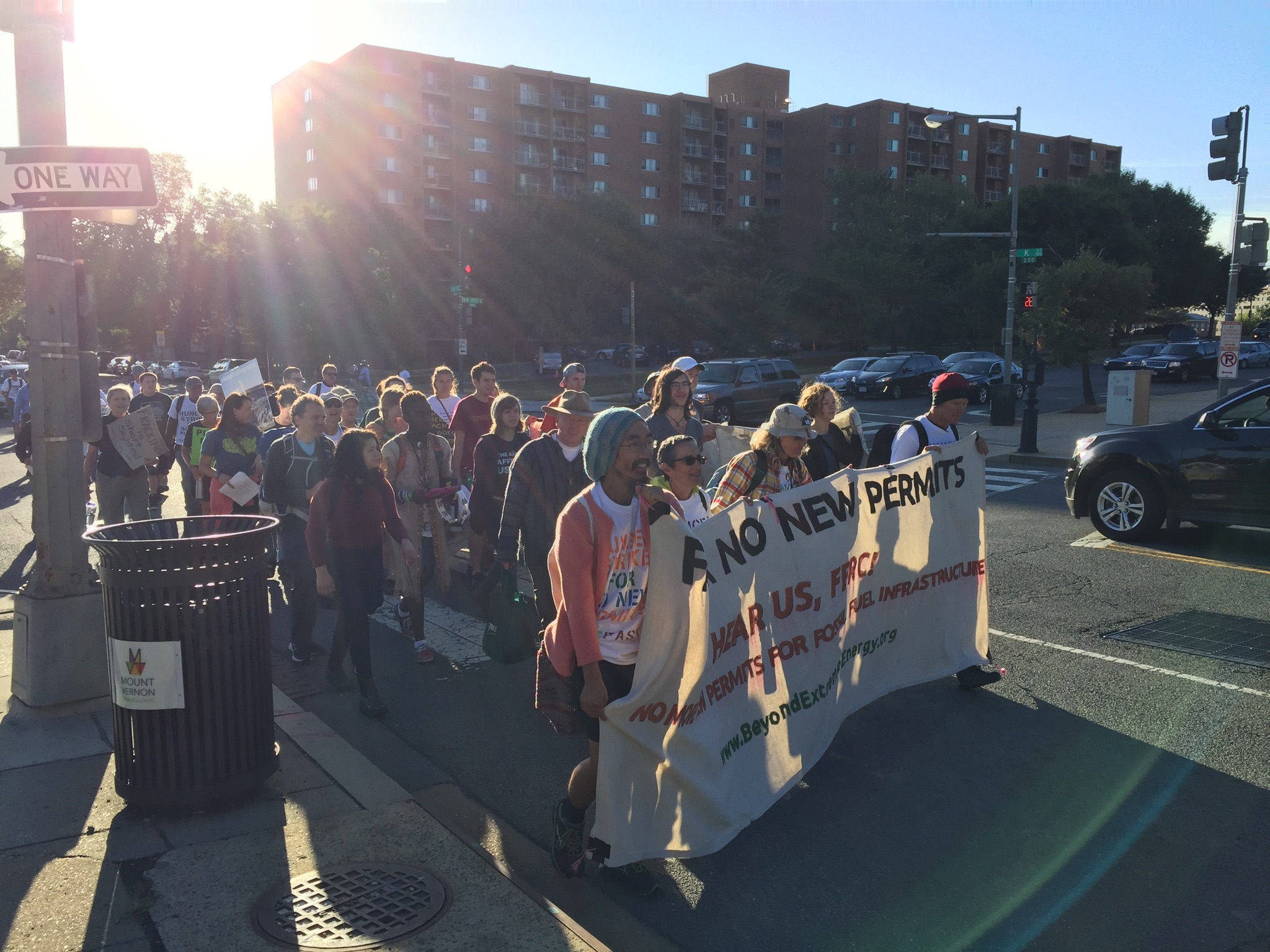
On Friday copies of the Pope’s encyclical will be presented to the five FERC commissioners; and there will be music, brief statements, and a procession, featuring BXE’s colorful and moving 50-foot anti-fracking banner, “The United Sates of Fracking”, around the FERC headquarters block, to honor the Planet and the People. BXE will also display the new quilt made in collaboration between fasters and residents of far-flung communities fighting fracking infrastructure in their communities.
Steve Norris, of North Carolina, at 72 is one of the oldest fasters. Describing what he has learned during the fast, he said:
“Being here, eating no food for 18 days, has taken me at 72 the oldest faster a fascinating and disorienting rabbit hole, where ‘normal’ appears absurd and even suicidal, and where unrealistic may be our only way out. I think because of our legal structures, because of their narrow fossil fuel focus, and because people disbelieve in viable alternatives, their minds are wedded to the madness of more fossil fuels.”
Sean Glenn, of Connecticut, at 23 is one of the youngest fasters. “I think this fast has just reinforced my belief in the power of people and our ability to overcome our old ways and really embrace new ones with complete curiosity, not knowing what we’re getting into,” she says. “The love that everyone has shown has been really powerful and the respect that we’re receiving for it is what has surprised me.”
WHERE: Federal Energy Regulatory Commission (FERC), 888 1st St NE, Washington, DC.
WHEN: Friday, Sept. 25, noon to 1:30 p.m.
WHO: The fasters, their supporters, and faith leaders.
WHY: The BXE fasters demand that FERC end its fracking-friendly support for expanding natural gas infrastructure, which has led to a toxic locked-in fossil fuel network at the expense of safe, sound, and clean renewable energy. Fracking wells and gas pipelines contaminate the homes and communities nearby, and also leak methane, which is responsible for about 25% of the man-made global warming we experience today.
———————
Beyond Extreme Energy is a network of people and organizations dedicated to raising public awareness of the disastrous effects of fracking, natural gas infrastructure, and other kinds of extreme energy extraction; to taking direct action to stop them, and to promoting policies based on clean and safe renewable energy.
Watching Over The Fasters: A Guest Post From Melinda Tuhus
 by Melinda Tuhus, reposted from www.MelindaTuhus.net
It’s instructive hanging around people who are fasting; one can focus on what’s really basic about life. It saves so much time, not cooking or eating. And you realize how absolutely central food is to any culture, so these folks are denying themselves not only nutrition, but social interactions that come with sharing a meal.
I’m at the Beyond Extreme Energy (BXE) fast at FERC (the Federal Energy Regulatory Commission) for No New Permits for fracked gas infrastructure. A dozen members of BXE began a water-only fast Sept. 8 and will break their fast Sept. 25, the day after the pope speaks to Congress. I am in awe of these people – aged 19 to 72 – who are now two-thirds of the way through it.
Most have good days and bad days – nausea, headaches, dizziness and extreme fatigue, as well as fuzzy thinking, indicating that this is serious business – but they carry on out on the sidewalk in front of FERC in DC. The young people are having more trouble, most likely because their metabolisms are so much faster, so they experience the lack of food more acutely. What’s really surprising is how
It’s a wide sidewalk, and despite a lot of foot traffic, no one has objected to us sitting in folding chairs, placing a big banner and various posters around (one of the Pope holding a sign “No al Fracking”); also a map of the U.S. pinpointing some of the FERC-regulated projects seeking approval or already approved; there are lots. Last weekend when it threatened rain, a security person even suggested putting up a canopy, which has come in very handy to keep the blazing sun off of us all week. That now takes up more than half the sidewalk.
I told my fellow BXEers I wasn’t going to fast (the very idea sent me into a depression) but I would help in other ways. So I’m doing media work and am having mild success. I’m trying to prime the pump of places like CNN and the Washington Post so they’ll be more likely to cover our big closing event on Sept. 25.
I’m also doing other general support, like driving the van (those of you who know me know that this is the least favorite of my duties) and getting flyers printed, facilitating our meetings as others get too tired to focus. What’s astonishing to me is how at different times these folks – who have had nothing but water and electrolytes for almost 300 hours – have the energy to walk back and forth to the Metro, or, like one day this week, the energy to walk across the Arlington Bridge into DC with the NAACP’s Journey for Justice.
Some of them talk about food constantly, but not in a whiny way, just reminiscing about what they love to eat. In fact, I haven’t heard anyone whine at all, or get more than a tiny bit impatient with each other or anyone else, except for one brief interchange, after which the person quickly apologized. Hell, I get grouchy if I miss one meal!
Many people going by have taken our various leaflets, others not, and then usually with a polite gesture or a smile. The worst is when someone totally ignores me, like I’m not there. I find it very hurtful. Made me think of how homeless people must feel most of the time. Some famous person said the opposite of love is not hate; it’s indifference. My fave comment (recounted to me, not experienced directly) was when someone angrily yelled, “Eat food, asshole!” I’m going to try to never ignore homeless persons again.
We’ve also had some incredibly wonderful conversations with a lot of people. They often thank the fasters for their commitment – even the chairman of the FERC Commission said he respected our commitment when he engaged one of our folks this week.
We don’t know what impact the fast will have on FERC’s policies and practices, but we’re pushing forcefully to make it harder for them to carry on business as usual. I hope anyone reading this or hearing this will join us for our breaking fast ceremony on Friday, September 25, from noon to 1:30 p.m. at FERC, 888 1st St. NE. Spread the word to anyone you know living in the DC area.
Activists oppose methane gas, fracking at RI State House
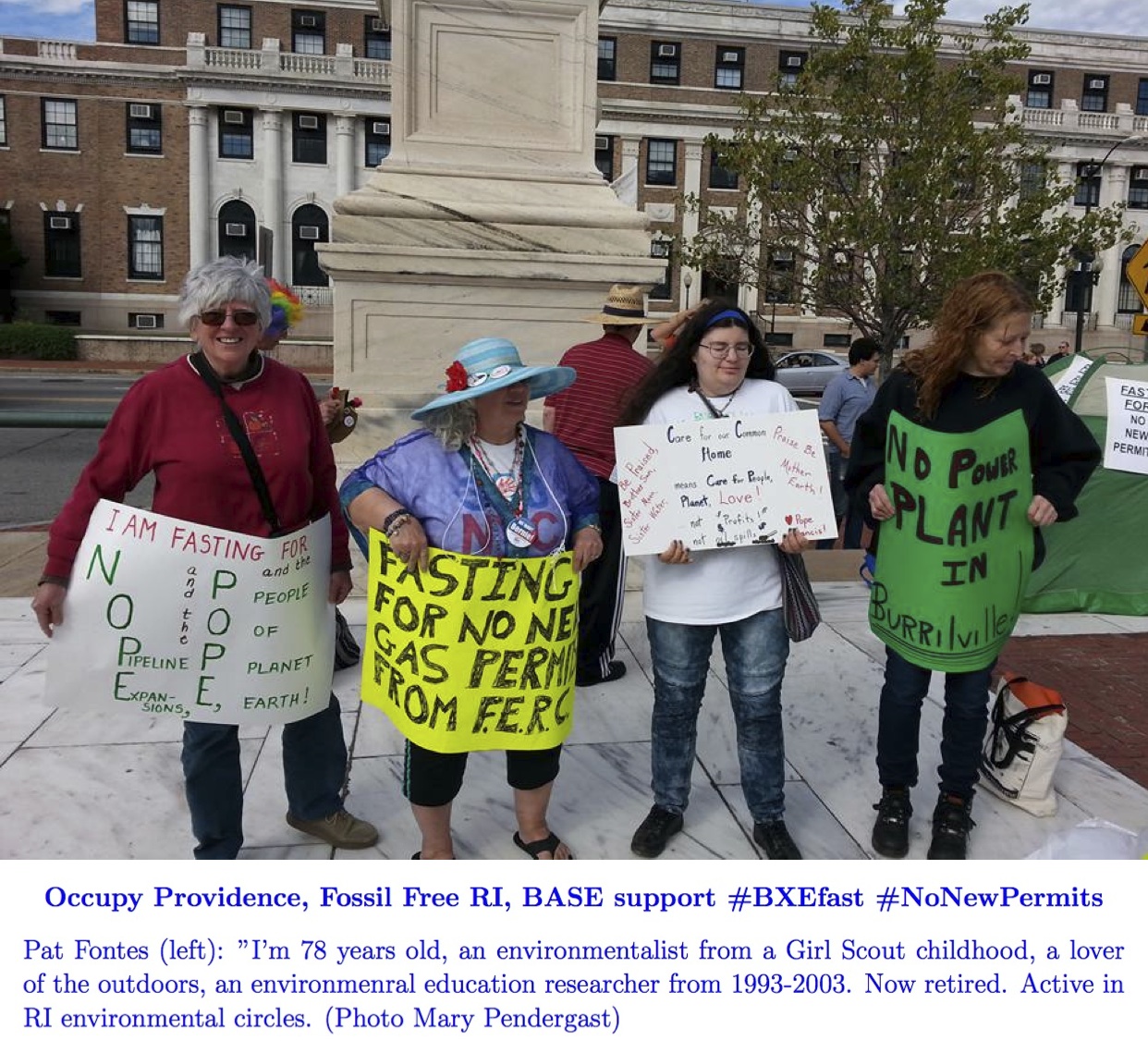 A small state with a big heart for resistance, RI once again connects the dots in the struggle against fossil fuel infrastructure.
by Andrew Stewart, reposted from www.rifuture.org
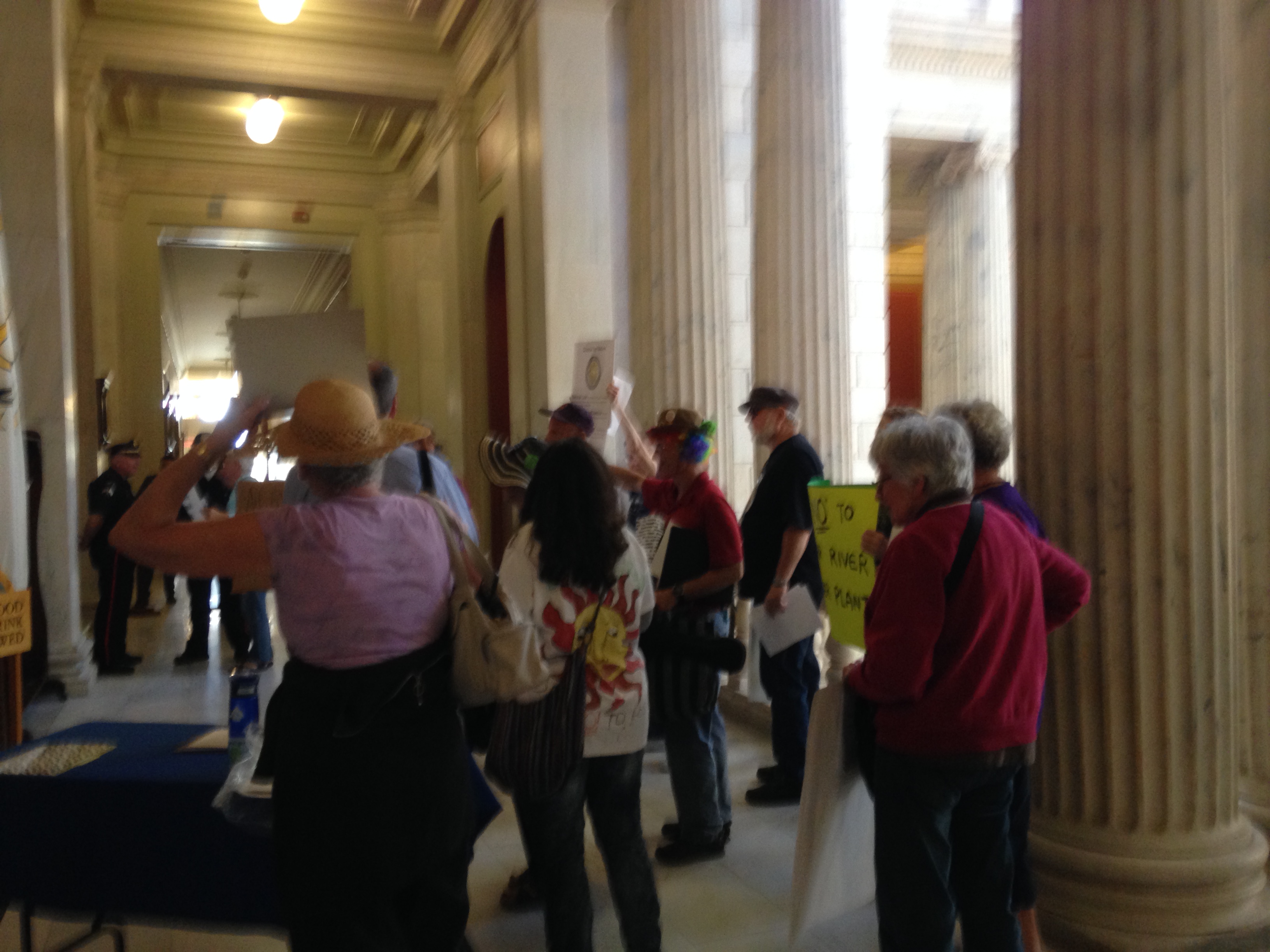
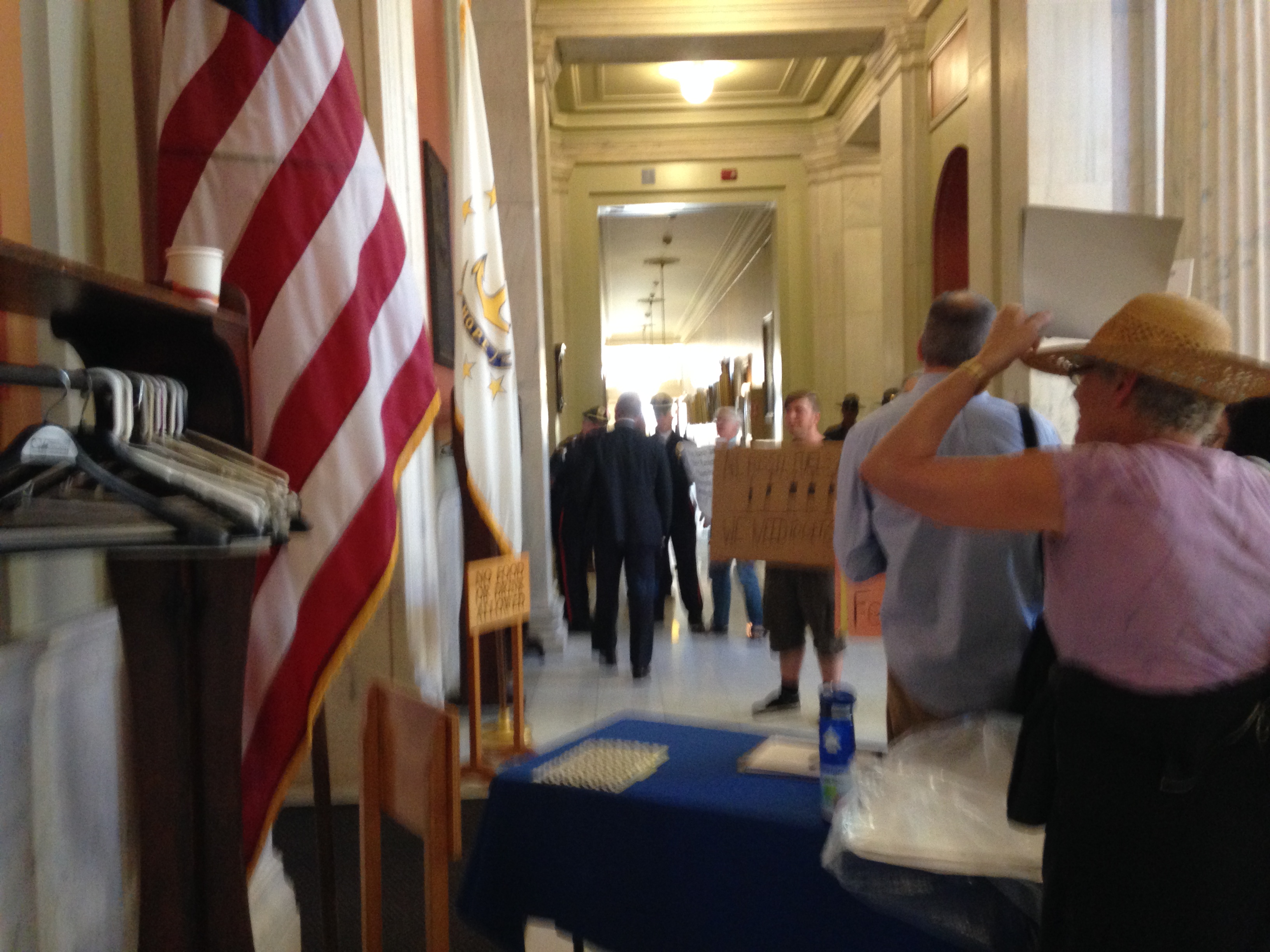
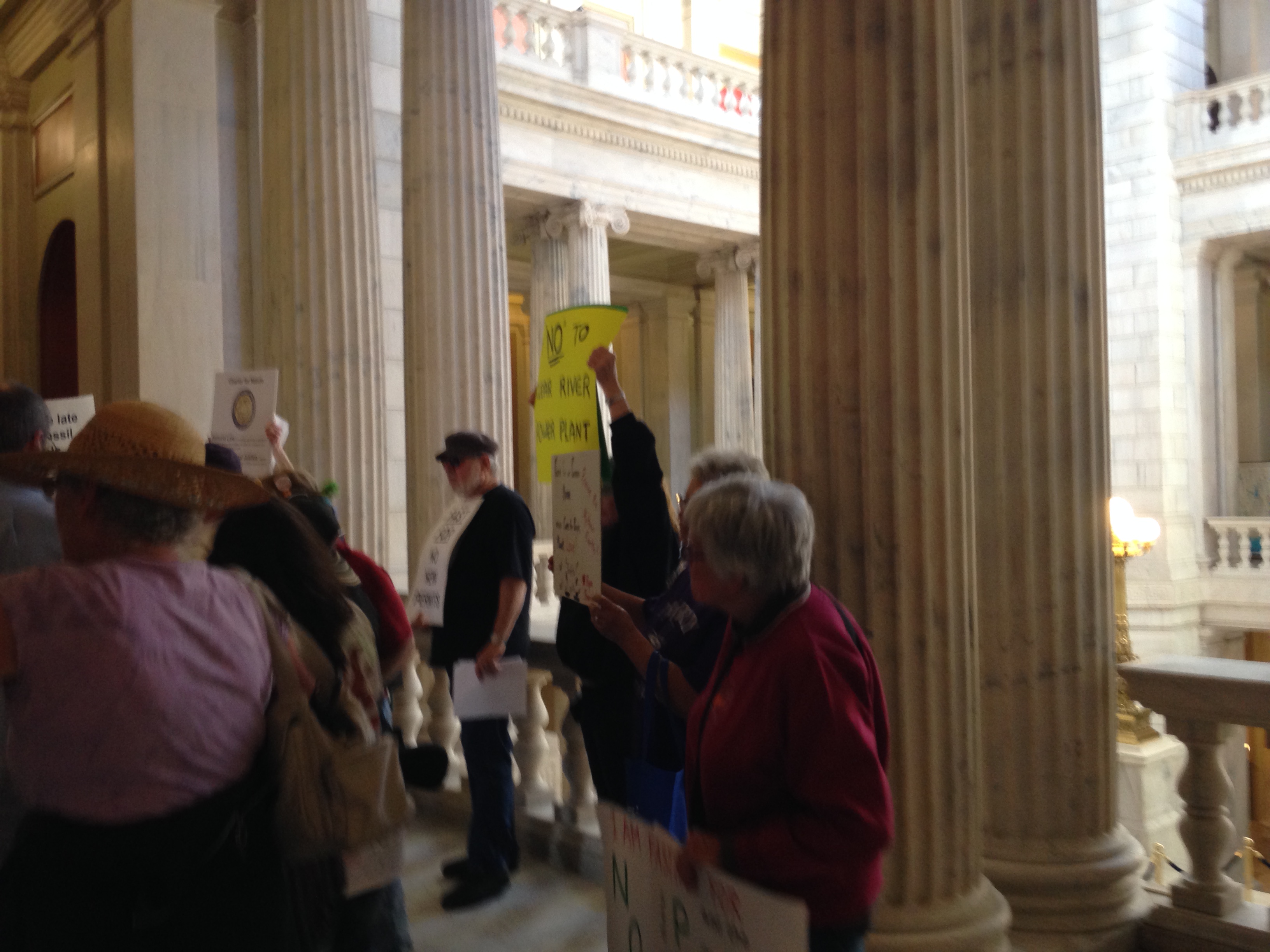
A small group of protestors from a variety of socio-economic backgrounds repeated their opposition to the proposed methane gas power plant in Burrillville. Simultaneous with this event, Governor Raimondo welcomed the Prime Minister of Cape Verde, José Maria Pereira Neves.
Among the protesters was Randall Rose, of Occupy Providence, Dr. Peter Nightingale, of the University of Rhode Island, independent film maker Robert Malin, Green Party activist Greg Geritt. They were offering their protest in solidarity with fasting environmental activists in Washington DC who are staging their action simultaneous with the arrival of Pope Francis. The Catholic leader has made climate change a major focus is his recent encyclical, LAUDATO SI, and is expected to raise the issue during his visit to America and the United Nations this week. The Pope just recently visited Cuba, a country that converted to a sustainable energy power grid and green infrastructure after the fall of the Soviet Union collapsed their petroleum import markets in the early 1990’s.
During her opening remarks, Governor Raimondo emphasized the cultural and economic ties between Rhode Island and Cape Verde. Cape Verde has begun rolling out a sustainable energy program in the past several years, such as opening a solar panel energy park last month that Prime Minister Neves attended. The nation, made up of a chain of islands, stands to sustain extreme damage should the oceans rise significantly due to climate change’s melting of the polar ice caps. A significant portion of the population lives beside the ocean in housing whose foundations would be threatened by erosion. Some of the islands would be completely submerged. Beginning in 2011, the island began an expected nine year program to convert the power grid to renewable resources.
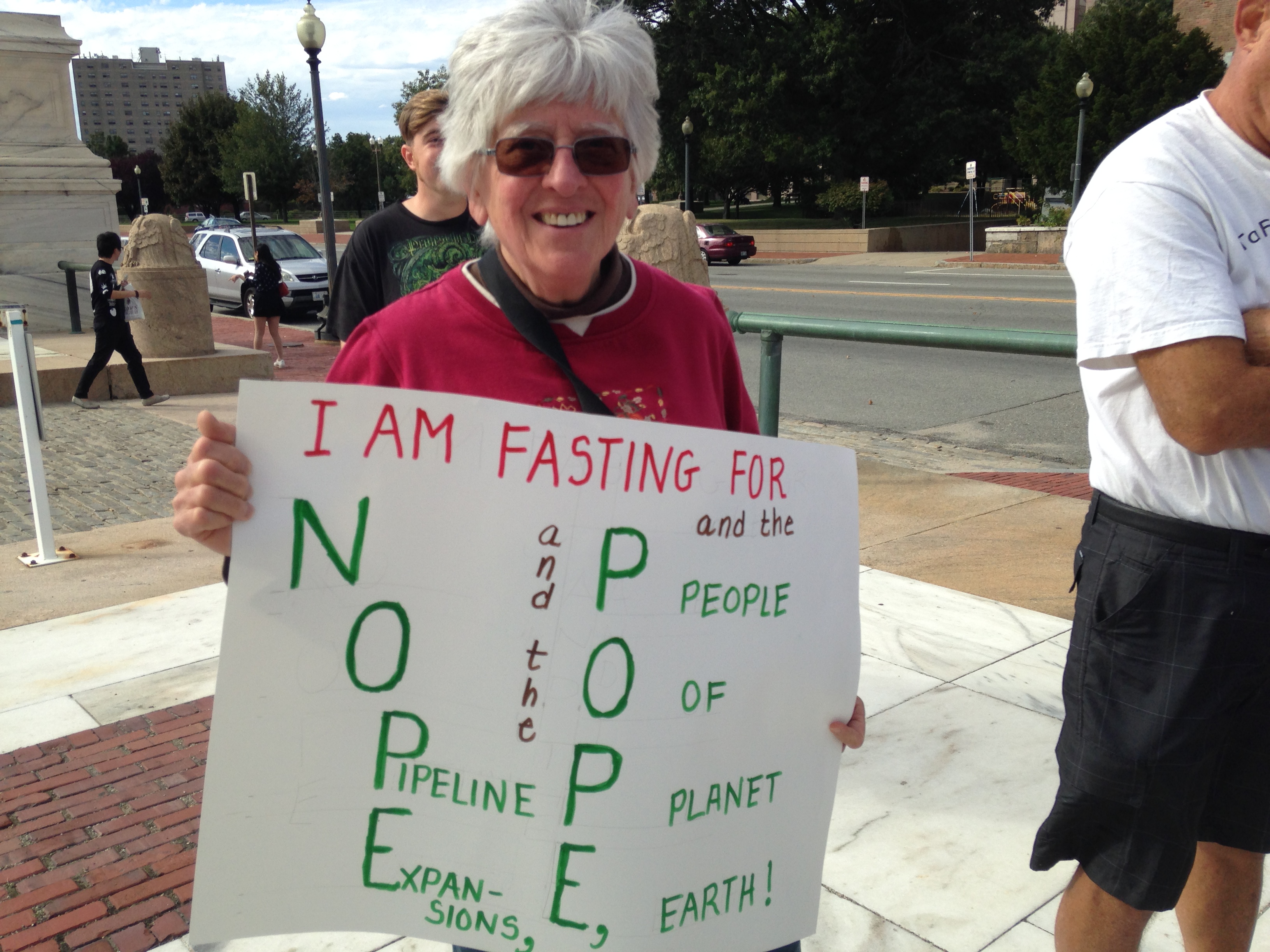
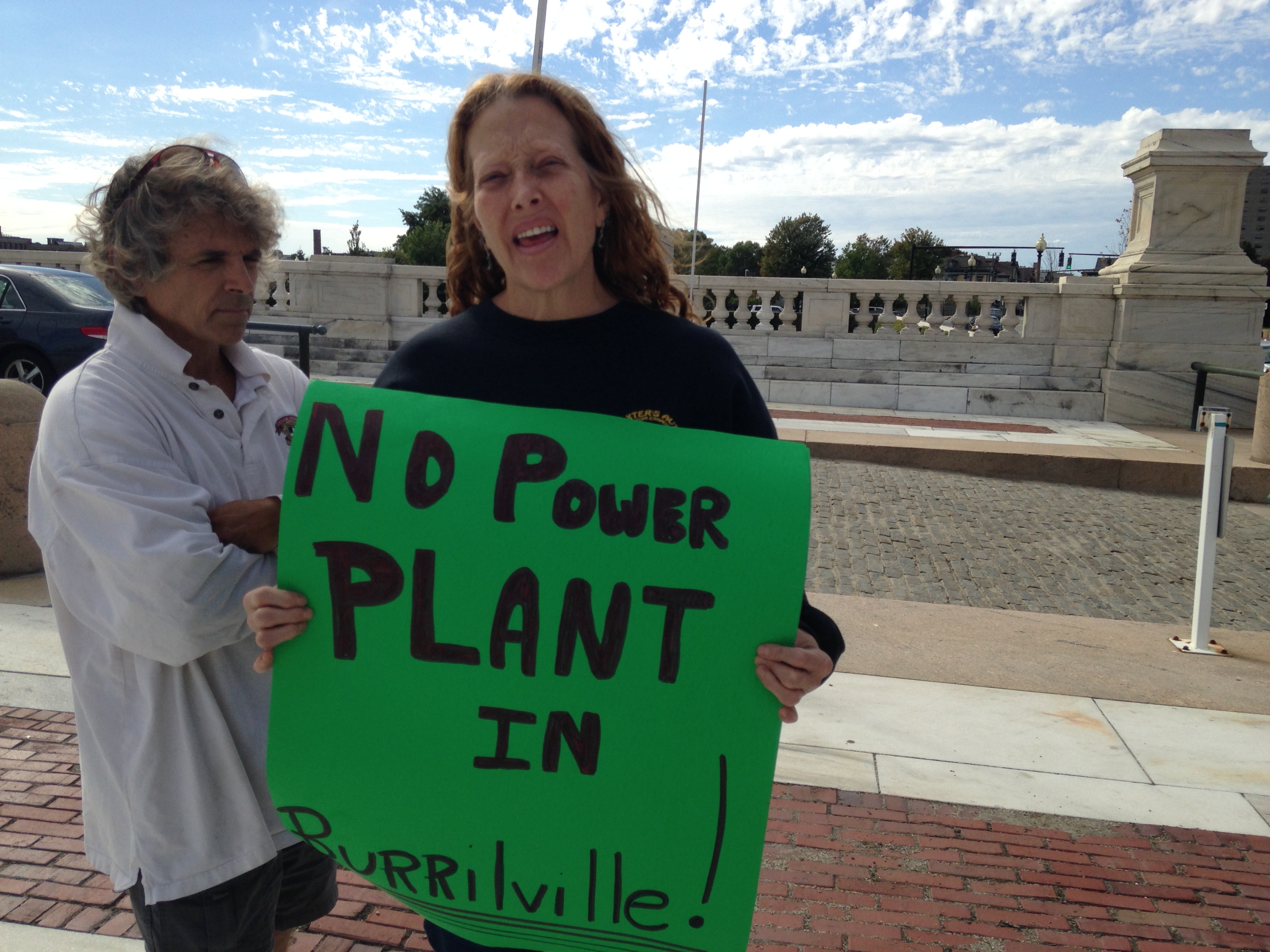
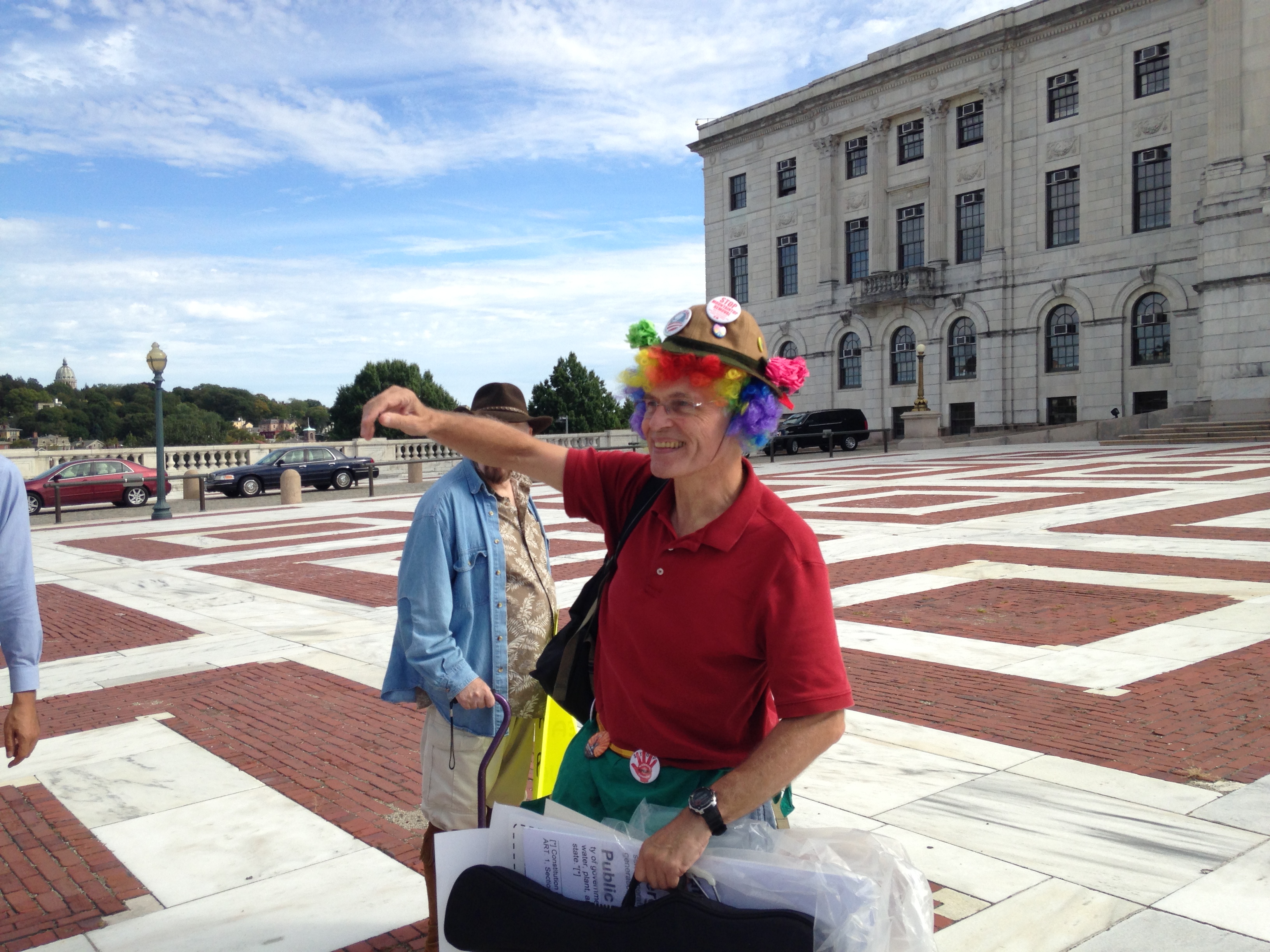
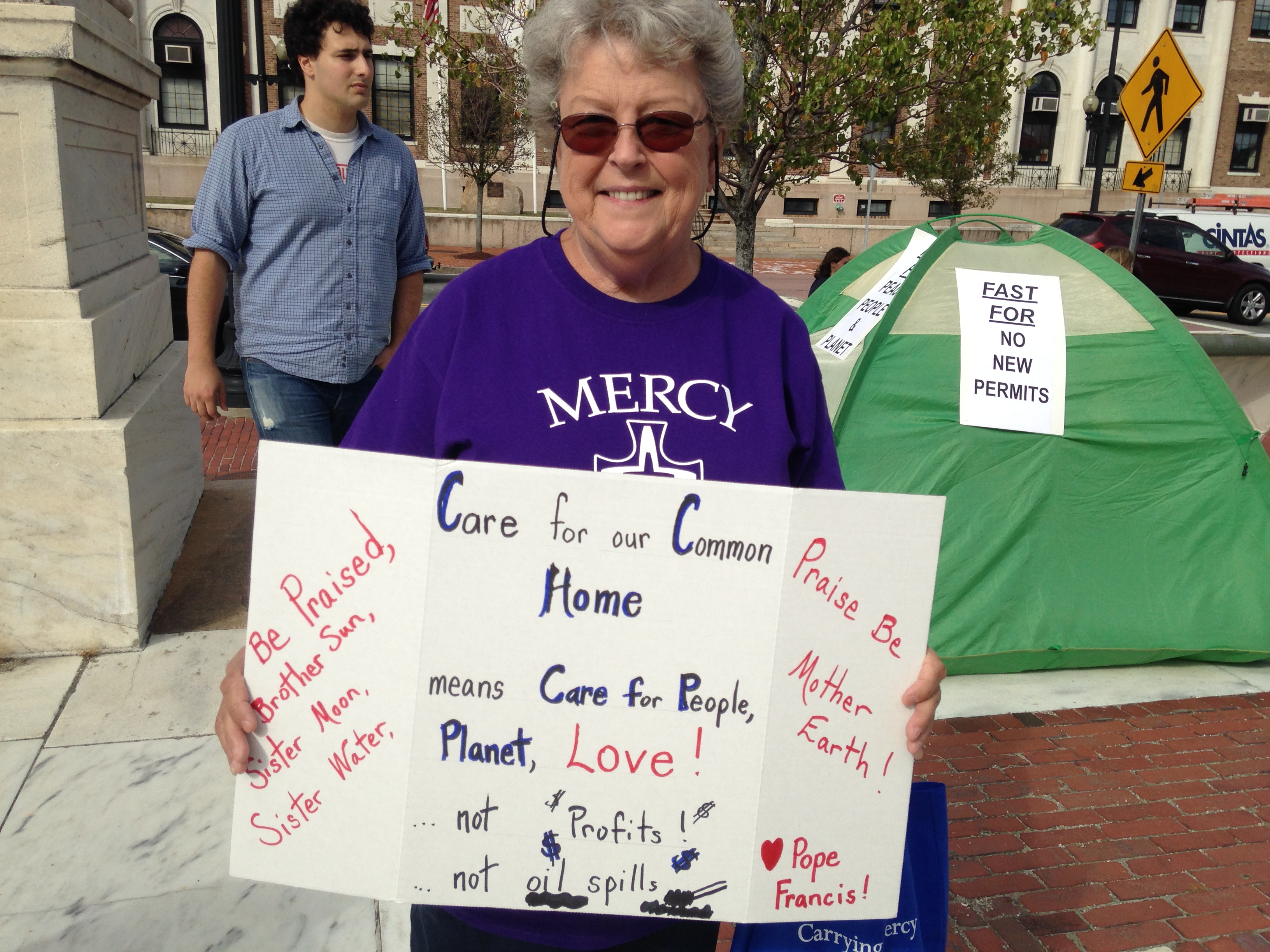
Protestors outside the room hosting the Prime Minister of Cape Verde.
PRESS ADVISORY: Hunger Strike grows at Federal Energy Regulatory Commission demanding No New Permits
Press Advisory: For more information, text or call Melinda Tuhus, 203.623.2186 (Ted Glick, secondary contact: 973.460.1458.)
Hunger Strike grows at Federal Energy Regulatory Commission demanding No New Permits
Beyond Extreme Energy will hold press conference Tuesday, Sept. 22, at 10:30 a.m. on 15th day of their water-only fast, leading up to Pope’s visit. Outside FERC headquarters, 888 1st St. NE, D.C.
Two women have traveled across the country to join Beyond Extreme Energy’s 18-day fast at the Federal Energy Regulatory Commission (FERC). Their communities have been directly harmed by the permits FERC has issued or has pending regarding fracked gas infrastructure. A dozen members of BXE began their fast September 8 calling on FERC to stop issuing new permits. This is in line with Pope Francis’s call in his recent encyclical for the world’s leaders to immediately address the already devastating impacts of climate change – fueled by the burning of fossil fuels – especially on the poor who have contributed the least to the problem.
Pramilla Malick is the mother of four and a resident of Minisink, New York, where the Millennium Pipeline, owned by parent company NiSource, built a compressor station. She says that FERC approved it over the concerns of residents about methane and other toxic emissions, and the risk of catastrophic explosion.
“FERC enables the egregious excesses of a predatory industry that destroys communities such as mine, where many of my neighbors have been forced to flee because of this FERC permit. Our stories, however, of being fracked-by-FERC forewarn of even deeper looming crises; a climate crisis, democracy crisis, and human crisis all in one. We need bold action by multitudes to change course, so that my children, your children, and all our children are not robbed of their right to a future.”
Francis Eatherington flew to Washington, D.C. from Oregon to join the fast.
“I am here to help FERC understand that the Jordan Cove LNG Export Project on the Oregon coast and the 230-mile long Pacific Connector Gas Pipeline are reckless investments,” she says, “violating the laws of nature — the former being sited in an earthquake zone, the latter through forests prone to frequent forest fires. In fact, a forest fire is currently raging over part of the proposed route. It would also violate private property rights, as FERC is getting ready to issue a foreign company (Veresen, from Canada) the right to condemn the land of over 300 Oregonians to build the pipeline. And I’m one of those landowners. FERC will force me to host infrastructure that will lock us into using global warming fuels for at least the next 30 years.”
One of the long-term fasters, Jimmy Betts of Omaha, Nebraska will also speak.
BXE will end the fast at noon on Friday, September 25, with a ceremony that will include music, brief statements, and a procession to honor the Planet and the People featuring BXE’s colorful and moving 50-foot anti-fracking banner, “The United States of Fracking,” around the FERC headquarters block. Five clergy members representing different faiths will present copies of the Pope’s encyclical to the five FERC commissioners.
Beyond Extreme Energy is an activist network of organizations and individuals that came together in 2014 to raise public awareness of the disastrous impacts of fracking, fracking infrastructure, proposed gas exports and other extreme energy extraction practices; to take direct action to stop them; and to promote an energy present and future of renewables and efficiency.

A Note From Michael Bagdes-Canning
Michael Bagdes-Canning is a long time fracktivist from Butler County, Pennsylvania. The following is taken from an email Michael wrote this afternoon in response to Steve Norris.
Steven, other fasters, all,
When you wrote, “Many people, FERC employees and passersby, walk past and ignore us.”, it was jarring to me. I wake up every morning and I think of you all. Throughout the day, I think of you. Before I go to bed, I think of you. Sometimes I wake in the night thinking of you. I tell others about what you’re up to. I know that you are fasting for me and others like me. I know that you are fasting for all of us – including those that walk by ignoring you, FERC employees, the FERC Commissioners. I am grateful.
The work that you are doing is both profound and humbling. Confronting the Commissioners in their lair is fierce. Confronting them over and over with the damage they are doing is relentless. Confronting them with an empty stomach, day after day, for weeks on end is heroic, fierce, and relentless.
I cannot believe that you are being ignored. If what you were doing was “one and done” – you’d be ignored. What you guys (and I use that term in a generic way, realizing that some of the most amazing BXEers are not guys in the usual sense of the word) have done (and continue to do) is noticed. Eyes may be averted, but people notice. You are bearing witness but you are also also making others witnesses to the ongoing inaction of FERC – your continuing presence is testimony to FERC’s inaction.
People notice. Many, I’m certain, are uncomfortable and look away but looking away doesn’t make you go away. Others may look away because they realize they should be doing something and aren’t – your action shames them. Others may look away out of guilt, they work for FERC or the industry that pulls the strings. Others may be like me, too often, not really see you because their minds are elsewhere but are vaguely aware that you’re there – and then, suddenly, pulled out of their unconsciousness.
Wendell Berry, in an essay entitled The Commerce of Violence, wrote:
You guys are reversing that. You are voluntarily fasting to point out the routine destruction our system imposes “by remote control” on communities everywhere.
I’m reading all of the posts – Debbie’s, Thomas’, Ted’s, yours, others. I’m engaged. You’re not ignored in this small borough in western Pennsylvania. My thoughts, my prayers, my dreams are with you. I’m reading all of the posts – Debbie’s, Thomas’s, Ted’s, yours, others. I’m engaged. You’re not ignored in this small borough in western Pennsylvania. My thoughts, my prayers, my dreams are with you.
Mike
 Beyond Extreme Energy